
204th Convention Eucharist Sermon
The Rt. Rev. Frank S. Logue preached this sermon at Trinity Episcopal Church in Statesboro, Georgia, on November 7, 2025.
Turning the church outside in
An ordination sermon for the 204th Convention of the Diocese of Georgia
Luke 10:25-37
Imagine with me a trip to the County Fair. It’s blue dark on a crisp fall evening. As you walk down the row of carnival rides and games you find yourself drawn to the Fun House Hall of Mirrors. You enter, going by a line of odd-shaped mirrors. First, you are tall and thin and then short and fat and then your head is impossibly tall on a little body. Next you make your way into the maze with plexiglass and mirrors making it difficult to know which way to go. Everything is so confusing. Once inside, you discover the maze is impossibly vast, like a whole other world within what had seemed like every other attraction on the row of attractions at the Fair.
Stay with me in your imagination, as this Hall of Mirrors is going to reveal something about what we are doing this evening in ordaining three servant ministers to serve the communities around our churches. Back in the Fun House, you continue to ramble through the mirrors and plexiglass, you sometimes see a seemingly infinite number of versions stretching out in front of you and there in the other direction when you turn around. Some rooms within the Fun House defy explanation as in one you feel you are walking sideways or in another you seem to grow small as you cross the room. When you walk back the way you came, you feel like you are growing taller. The cleverly designed space is tricking your eyes, but even knowing that, it is challenging to not give into the distorted perspective.
Impossibly deep within this strange carnival attraction you begin to meet people who live within the maze of mirrors. They don’t know that there is a world outside these walls as this is the only place they have ever lived. Everyone they know has lived their while lives within this place. You try to explain to them what the world is like just outside the confines of this weird fairground attraction, but they know nothing else. You try to explain the world outside, but how can you get them to understand the real world?
This image may seem a bit far afield from Encourage, Strengthen, Love One Another, but I begin with this imaginary journey into a distorted world to offer a different angle from which to see the ministry of Jesus of Nazareth and so to see the work of Christ’s Body, the church. The second person of the Holy Trinity entered into a creation turned from God. Jesus preached that the last shall be first and the humble will be exalted and it sounded to those who heard him like he wanted to turn the world upside down. Then as he talked about the outcasts being central to the community and the marginalized as those for whom we offer the greatest care. This sounded like he wanted to turn the world inside out.
Jesus teaching us to love one another was well and good, but he also taught us to love our enemies and that sounded extreme. But this is not what these statements would have felt like to Jesus. For the Son of God knew what the Kingdom of God is like, and so he knew how our world was meant to be. He wasn’t turning the world, upside down and inside out. Jesus described reality to people living in a world distorted by sin and shame, people who don’t even realize how different this world is from the one of grace and love that Jesus knows and desires to lead them into.
We see Jesus’ subversive style of cluing us in on reality in our Gospel reading for this evening, with one of Jesus’ Greatest Hits, The Parable of the Good Samaritan. An expert in Moses’ law who knew he was to love God with all his heart, mind, soul, and strength and to love his neighbor as himself asks Jesus to define neighbor. The expert on the Torah is starting with himself and looking outward in concentric circles to find out who is in and who can be out, how far does he have to take this faith thing.
Jesus then tells the familiar story of a man attacked by robbers and left beaten and half-dead at the roadside. Using a mere 96 words in the Greek New Testament, Jesus gives us one religious leader followed by another who each pass by the gravely injured man. Finally, a Samaritan, the epitome of The Other, goes above and beyond any expectation as he lends the man aid. He spends a good deal of time and pledges all the needed money to make sure that the Israelite can rest and recover. Then Jesus asks the lawyer, “Which one of the three, do you think, was a neighbor to the man who fell into the hands of the robbers?” The expert in Torah said, “the one who showed him mercy.”
What draws me back to this example again and again is that it allows us to see the inside-out compassion of God. The question was “Who is my neighbor?” With the keyword “my,” the question presupposes that I am the starting point and the question is “How far do I have to go?” Jesus turns the question outside-in by starting with the person in need. Jesus asks, “Who is the person closest to the man in need?” If you see a need, if you know of a need, then you are a neighbor. Jesus taught us to show godly compassion for one another, but then cleverly included everyone in the one another we are to love and even made the one in need the starting point, the center of the concentric circles.
Our Presiding Bishop, Sean Rowe, told the joint clergy conference of the Dioceses of Georgia and Atlanta that met in September, “We do the Christian gospel and the Christian message a disservice when we think of ourselves at the middle and then we think of ourselves as expanding the boundaries to include all people when really, it’s the other way around.” Rowe described the lost, the left out, the marginalized as being at the center of God’s loving concern. Those most in need are most on the heart of the Holy Trinity. Referring to the work of Episcopal priest and theologian Dr. Kelly Brown Douglas, Bishop Rowe said that those that seem on the margins “…are at the center of the story. They’re the bearers of the salvation of the world, their struggles reveal to us the kingdom of God. And so, as witnesses of the gospel, we put their story at the center. So, when we when we reach out, we’re reaching out to the center. We’re going to the center, rather than extending the circle.”
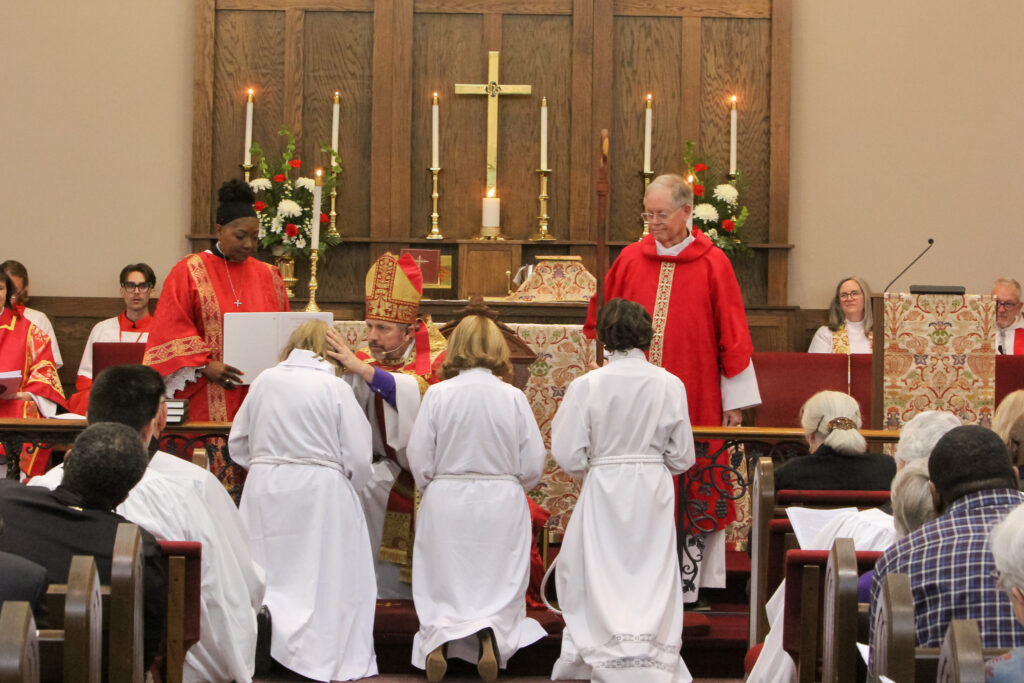 This is the outside-in message of the Kingdom of God that Jesus proclaimed to a world turned from God. Like the last being first and the humble being exalted, Jesus put the margins in the center. This is the ministry of a deacon. In the words of the Ordination Rite for a Deacon, “In the name of Jesus Christ, [deacons] are to serve all people, particularly the poor, the weak, the sick, and the lonely.”
This servant ministry is central to the church’s work. For I will pray for Lynn, Jamie, and Deb, “As your Son came not to be served but to serve, may these deacons share in Christ’s service.” These three servant leaders do not come to this day because we hope that the Holy Spirit will use this ordination to turn their hearts outward in service. It is because we have seen the light of Christ in each of them, revealed in the compassion they have already expressed for the poor, the weak, the sick, and the lonely, that we ordain them today.
As a teen, Jamie spent her summers volunteering through the Red Cross as a Candy Striper at the local General Hospital and she also served as a camp counselor with special needs children. Jamie says these experiences proved valuable and instilled in her compassion and respect for all, regardless of their circumstances. In 2008, she found the Episcopal Church at St. Martin in the Fields in Dunwoody, Georgia and became a Daughter of the King there. When Jamie and her husband, Obie, moved to St. Simons Island, they connected to Holy Nativity and there Deacon R.V. Cate trained her as a Lay Eucharistic Minister and gave her a vision for how the service to others that had always been part of her life fit the ministry of a deacon.
Deb was raised in a staunchly Roman Catholic family with routine Mass attendance and active participation in the Confraternity of Christian Doctrine forming the foundation of her life of faith. When her professional career in sports television production opened the way for her to become a producer of open-wheel racing for ESPN and ABC Sports, Deb continued to go to Mass on Sundays. But it was at Christ Church Frederica when, during the lockdown of the pandemic she found herself going door to door with a partner wearing gloves and a mask to care for neighbors through the church’s backpack Buddies Ministry. Deb saw the face of Jesus in those she was serving, which she described as like a veil lifted from her eyes.
Lynn grew up at First Baptist Church in Savannah, where her Dad was a deacon and her mom a Sunday school teacher. Her home church was active in community outreach and her youth group did work projects to assist persons who were homeless and others in need. A cousin with Schizophrenia showed her how no one made casseroles for those needing care for mental illness and the faith community was usually silent or absent. When visiting the Church of the Good Shepherd in Augusta more than 25 years ago, she learned they were starting a mental health ministry. The Reverends Andy Menger, John Warner, and Curtis Johnson were all part of the Coalition for Mental and Spiritual Health Ministries that later became an interfaith effort.
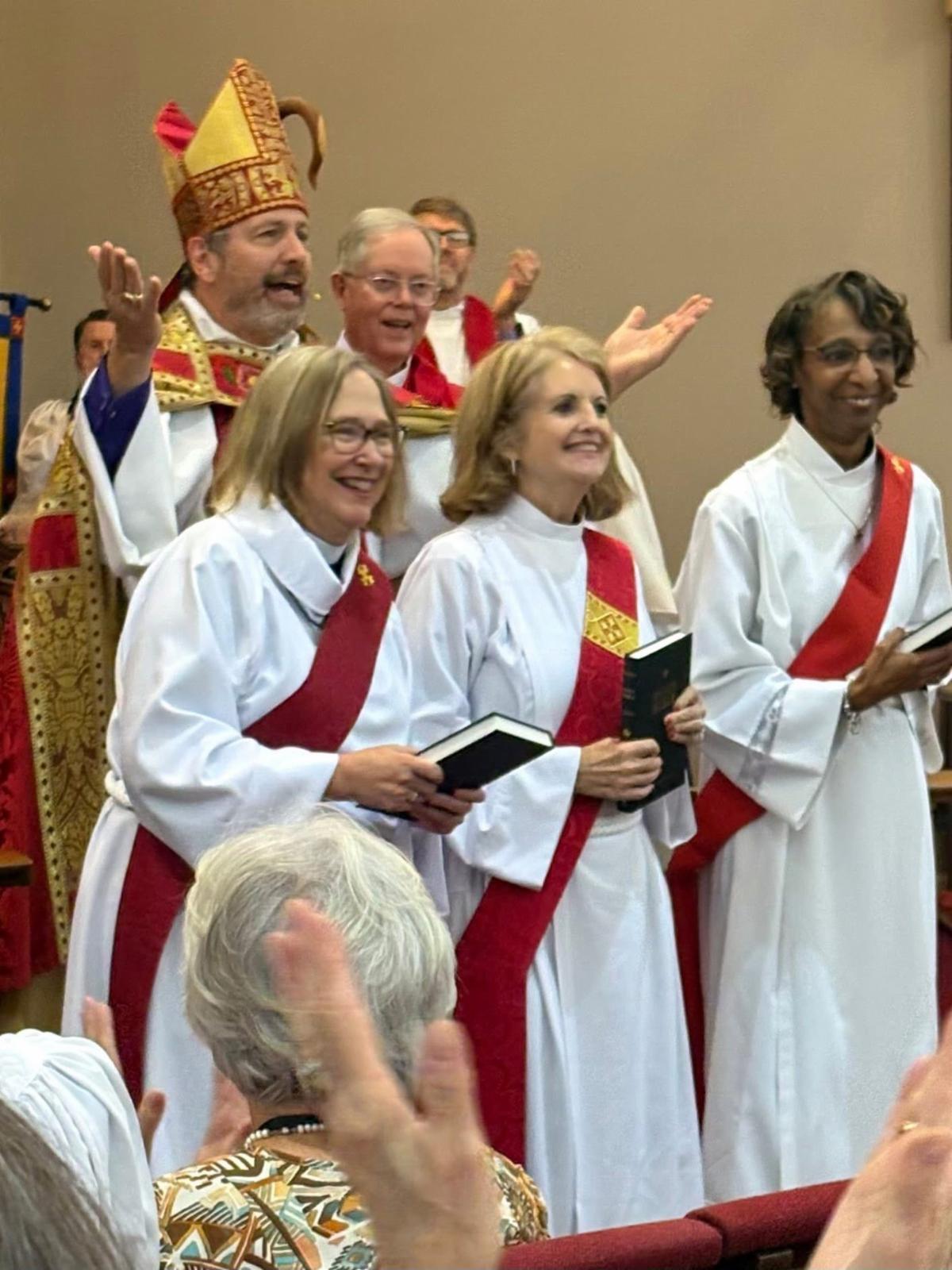 The Holy Spirit led each of these women to use their considerable gifts in service of others. This is, of course, what we are all to do as baptized Christians, to serve others as if we are serving Jesus and we are also to allow others to serve us. This mutual care best reflects the love of the Holy Trinity. The Holy Spirit guides away from dependence on anyone or anything other than God. The Spirit also guides us away from total independence, which is actually an illusion as none of us is truly self-sufficient throughout our whole lives. We all have gifts, and we are all in need. What we are meant to be as people and as the Body of Christ is interdependent. Individuals are interdependent, each of us needing others from time to time, and congregations are to be interdependent as well, each of us being better off for the connections we share.
The New Testament spends a good deal of time telling us how we can better live in community. There are 42 verses, which use the words “one another” telling us how we should treat each other. Those verses tell us to do things like “love one another,” “support one another,” and to “provoke one another to love and good deeds.”
I am constantly amazed at how much of scripture is not about me, but about us. You need your neighbors to even start to fulfill God’s commandments. To really live into your faith, you need to worship with a community of Christians and any group of Christ followers will also need to put their faith into action. We do this by serving those in need, and then learning to accept the care of others when we are the ones in need.
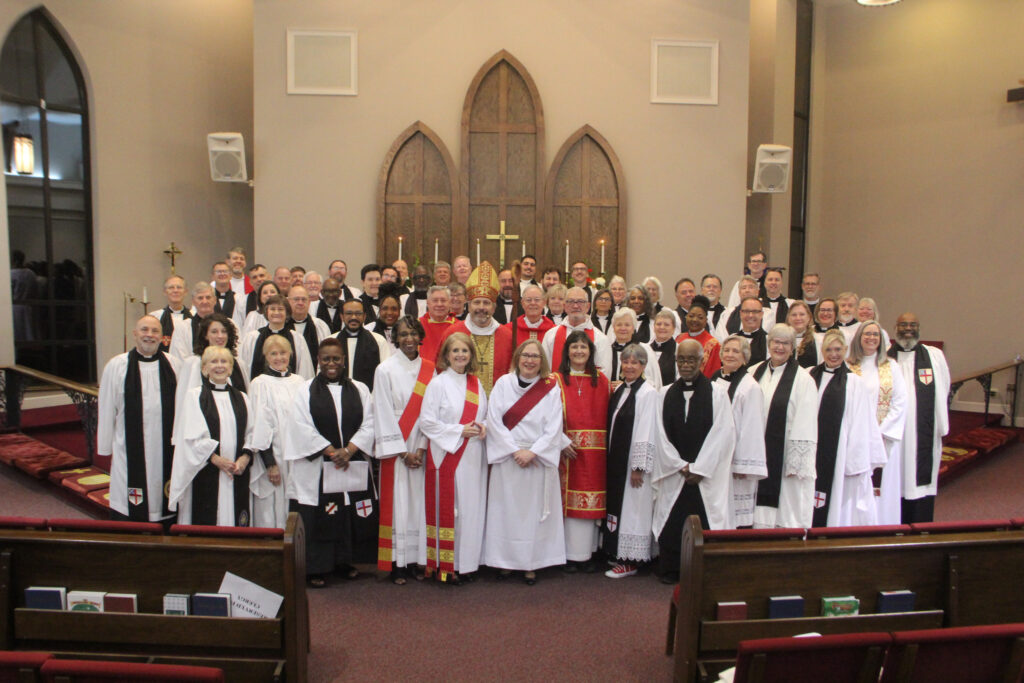 Deacons are icons of the servant ministry that embody this call. When deacons are doing their work of taking the church out into the community and bringing the needs of the community into the church, more of the congregation is challenged to join them or to find their own way to serve. This is how deacons encourage and strengthen the faithful into loving one another as Jesus loves us. This is also how we turn the world outside in again, by getting out of our own needs and concerns enough to see the face of Christ in others and to be amazed as they see the face of Christ in us. In doing so, we see the world rightly.
The lost and hurting world, so distorted by sin and selfishness that it feels like a maze of mirrors, needs us to better care for one another and to do so centering those most in need, just as Jesus located the starting point of his parable we read this evening on the man beaten and left for dead. Serving others as if we are serving Jesus is part of the ministry Lynn, Jamie, and Deb are being ordained to do, but rather than serving others on our behalf, they are to call us to join them in this life of service, according to the gifts God has given each of us. The more we are drawn into this loving service, the closer we find ourselves to the heart of God.
Amen.