
Bishop’s Address to the 204th Convention
The Rt. Rev. Frank S. Logue
November 7, 2025
Beloved in Christ,
Looking back to see what God has done in and through the people and congregations of the Diocese of Georgia is a critical part of the work of our annual conventions. As our 2024 convention was coming to a close, I said, “We need not manage decline as there are ways we can do more.” I pointed back to how the Byllesby Center in the Augusta Convocation and the work of Glynn Episcopal Ministries provide examples of how congregations working together can accomplish more than anyone serving in isolation ever could.
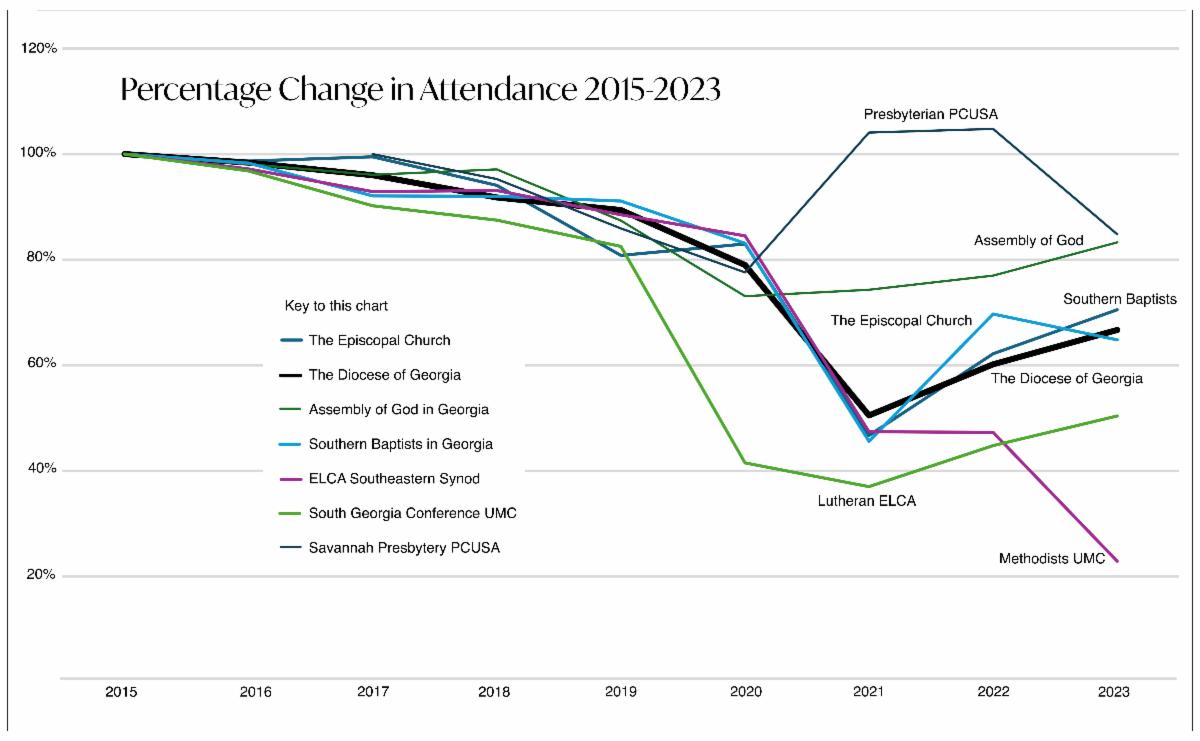
In the Convention Book, you will find four charts that show the reality of our statistics since 2015, including the very real decline in Sunday attendance we have experienced in the past decade. The steep drop of the lockdown of the pandemic is evident, as well as the bounce back that has not taken us to pre-COVID-19 numbers. We provide on one chart some context from other Christian denominations with their percentage change in worshippers on Sunday. You can see that our trend is very much like the rest of the Episcopal Church, and that we are also in line with the Southern Baptists in Georgia. Our rate of change shows us faring better than our ecumenical partners in the Lutheran Church, while not as well as the attendance changes reported by the Assembly of God in Georgia or the Savannah Presbytery, which provides a small sample from the Presbyterian Church.
But these charts are not the whole story. As your Bishop, I get a broader perspective from visiting every congregation in the Diocese. That view provides me with a realistic hope as week by week, I hear the stories of people who are so grateful to have found their local Episcopal Church. In confirming people and receiving new parishioners, I get a steady dose of these stories even as I get to take part in baptisms of more teens and adults than you will see in any given congregation. I am far from alone in seeing this hopeful trend. While we have had a baptism at Honey Creek Summer Camp in prior years, this summer our spiritual directors baptized two teens at High School Camp and two campers at Middle School Camp.
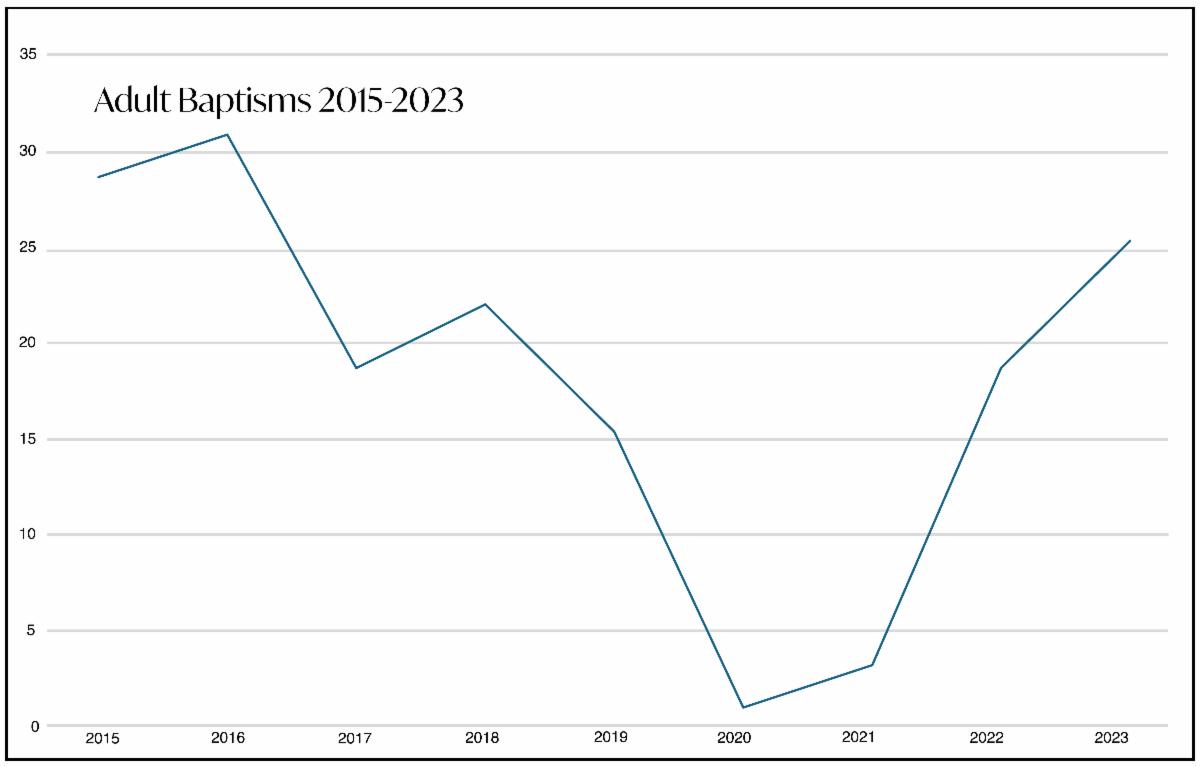 You will find charts of confirmations and receptions, alongside baptisms, and adult baptisms in the book as well. Even with declining attendance, we see those numbers bouncing back now in ways that fit what I am seeing in my travels. We have also seen Cursillo thriving once more with two weekends a year bearing the fruit we have come to expect from those retreats. Yes, attendance is not back to where we were and yes, the number of lives changed by the Gospel of Jesus Christ is more than we should expect given that decrease. God is not done with the Episcopal Diocese of Georgia. The Holy Spirit is working in and through us and sometimes in spite of us to touch the lives of people who need the grace, mercy, and forgiveness we have found.
Since our last convention, I made 44 visitations to congregations, as well as visiting Episcopal Day School and the Byllesby Center, for 46 of the 70 visitations that make up my now usual 18-month cycle of visits. I had the privilege of officiating three ordinations since we last met in convention, and God willing and you, the people, consenting, I will ordain three persons to the Sacred Order of deacons during this convention.
We moved our diocesan offices from the beautiful 1880’s house on 34th Street in Savannah to the location of the former St. Michael and All Angels on the corner of Washington and Waters Avenues. This is a clear example of doing much more than managing decline, as our offices now share a home with ministry to our neighbors. I would be remiss if I did not note that the final move came with me on a ten-week sabbatical approved a year earlier. I planned for the time of rest and renewal to come after the changes underway were completed, but that was not to be. Your diocesan staff, assisted by Dr. M.J. Harris, who managed much of the process for the move, proceeded well. I never once worried while away if the needs of the Diocese were being met. I am so thankful to the whole staff for that and especially for our Canon to the Ordinary and Chief of Staff, the Rev. Canon Loren Lasch who took on everything on my plate that the canons allow. Having fulfilled that role during Bishop Scott Benhase’s 12-week sabbatical in 2016, I know the demands it placed on her. In close consultation with the Standing Committee, she kept everything well in hand.
This past year, as you can see in the videos for this convention, the Diocesan Strategic Planning Committee has put in hard work to use the considerable input you offered in listening sessions and in our last convention to chart a realistic path forward. This is not a static plan to print in a binder and put on a shelf, but a dynamic direction in which we will continue to encourage one another to be imaginative and bold in responding to the challenges we face while strengthening existing programs and stopping those no longer needed as we focus everything we do on love, loving the Lord our God with all our heart, mind, soul, and strength and loving our neighbors as ourselves. The model we have taught for years through the Church Development Institute and Leading with Grace is to Do-Reflect-Do. This means discerning a change to put in place, making that shift and then assessing how it is going to assist us in adjusting the new things we are doing together. That process will see the strategies and goals evolving in the coming years as we iteratively adjust this plan.

As the plan was emerging, we could see areas that we could easily begin addressing and so we got to work even as the plan continued to come together. Hearing frustrations in the listening sessions, I appointed a Communications Committee with input from the Strategic Planning Committee and two persons who are members of both. They have begun work with our Communications Manager, Liz Williams, on aligning our communications with the needs of the Diocese. This includes not just a significant rebuild of our website, but also the new Resource Hub built by the Rev. Charles Todd, through which we offer the means for wardens, administrators, and other leaders to be able to communicate with one another for mutual support while linking ready-to-use resources. The Episcopal Church is working with public relations experts to create branding resources that we will, as intended, tailor to our context. We have looked longingly at other denominations who did this work in years past and now we have a churchwide effort that will benefit us in Georgia. We will assist you in using the elements of the campaign now in the works to make this easy for congregations without the talents in-house for this communications work.
We also heard a desire for more spiritual formation, especially given that every congregation does not have the capacity for new offerings or can’t make something available at times that fit every parishioner. In his new role as our Canon for Congregational Vitality, Canon Joshua Varner began leading online discussions of our 1Book1Diocese reads and then piloted a new program using the BeingWith Curriculum created by St. Martin’s in-the-field in London. Created in pandemic, this is a way to engage those curious about faith in Jesus who are “on the edge of church — uncertain, disconnected, hurt, or simply searching for something deeper.” The initial group went well and we will now roll out more groups online and in person, beginning this January. The few spiritual formation offerings I name here are not an attempt to handle the concerns raised with diocesan staff alone. They are pilot projects that will be added to by others in the Diocese, bringing yet more offerings, so that what one church is doing can benefit others in their convocation and beyond.
Joshua also worked with the Revs. Ian Lasch and Shayna Cranford to put on a Lay Worship Leaders Conference this fall at Honey Creek. This is a licensed lay ministry for those who will lead worship on a Sunday in the absence of a priest. To be clear, any lay person may fill in leading Morning Prayer, but we want to better train and support those who are routinely leading the primary worship service on Sundays.
After significant conversations with bishops in other dioceses to meet the needs of parishioners longing to receive the sacrament more often, I tasked our Liturgical Commission with considering how we could offer Communion by Extension as done by our ecumenical partners in the Roman Catholic and Lutheran denominations, elsewhere in the Anglican Communion, and in a growing number of Dioceses in the Episcopal Church. A vestry at a congregation with licensed Lay Worship Leaders may petition me for permission when they present a plan that will have a priest in the congregation at least once a month and such communion from reserve sacrament no more than two Sundays a month. This permission to use a liturgy designed to show that this is not a Eucharist will be given for one year with a report halfway through and as the year concludes. This will permit us to follow the model of Do-Reflect-Do. Four congregations now have my permission for using this liturgy for the next 12 months.
But, we know that the main way the Anglican Tradition seeks to meet the need that this stop-gap measure fills is to form more people for ordained ministry, and we have been working on that. We currently have 20 people preparing to be deacons and priests, with 16 of those in formation for the priesthood. This includes the Revs. Angela Shelley and Roger Speer, who are now deacons for a transitional period and whom I will ordain in the coming months, as well as seven people already in formation for one to three years and another seven postulants for the priesthood approved in September. This is the result of a lot of work by many people, but it includes significant work by the Rev. Melanie Lemburg and Elizabeth Varner as Chair and Vice Chair of the Commission on Ministry together with the whole commission and the Standing Committee. The Rev. Samantha McKean has taken over chairing the Commission after Melanie accepted a call to serve as the Canon to the Ordinary in the Diocese of Arkansas. Samantha expertly chaired the group through the September Retreat at Honey Creek where we discerned with parishioners who are feeling a call to the priesthood. We have more people now considering calls to serve as deacons and priests who will attend our retreat next September after working this coming year in a process of discernment.
Two key concerns I named in my last Bishop’s Address remain works in progress: Youth Programs and Honey Creek Sustainability.
With Joshua moving to a new role, I need to call a new person to oversee the critical ministry for our future success–youth programs. Mendy Grant chaired a group that got a job description to me a few weeks ago. I will advertise for this position as soon as we get through this convention. Even as we worked on the position, Mendy and Jody Grant assisted us in putting on an Acolyte Festival this fall and we are working toward bringing back WinterBlast this year, an event held during the schools’ Christmas Break.
I appointed a Honey Creek Sustainability Task Group chaired by Susan Shipman, a parishioner of Christ Church Frederica who assisted the Diocesan staff in the plan that successfully paid off the Honey Creek Bond Debt.
The group is tasked with conducting an independent review of Honey Creek and identifying potential pathways for long-term sustainability. I told them that everything is on the table for their evaluation–fiscal, programmatic, operational, internal and external physical plant, and natural assets. The group has spent time touring the 98-acre property, its extensive infrastructure and the surrounding natural environment. Susan reported to me in advance of this convention that, “The team aspires to leave no stone unturned in examining current and potential future uses of Honey Creek for the next two to three decades. Our work is supported and aided by Honey Creek Director Dade Brantly and Administrative Director Georgeanne Younger, and the Diocesan Canon for Administration, Andrew Austin.” She added that, “Foundational to our assessment are mission and trends in financials, and usage. Areas under examination range from status quo to out-of-the-box prospective long-range uses for recreational, experiential education, and conservation practices, to property use partnerships and co-management, to heritage activities such as summer camps, Happening, clergy and parish retreats, and sacred Chapel experiences.
While I do not want to be the bishop who oversees a diocesan decision to sell Honey Creek, I can not ignore the trend toward our using this resource less often with smaller groups. We must engage with this realistically and then make a decision that is more than wishful thinking. I am grateful to the Task Group whose other members are the Rev. Alan Akridge, Alton Aimar, Kevin Hiers, Deb Luginbuhl, Cuffy Sullivan, and Jim Vaughn. They bring diverse expertise and perspectives to this important work. You can expect updates in the coming year with their significant work coming to Diocesan Council and then to this convention. For now, every option remains open, but the time for making changes or moving on is coming.
Our conventions, of course, don’t dwell in the past as we turn from a retrospective look at where we have been to chart the path forward to where we are headed next. While every investment professional has to routinely say, “Past performance is no guarantee of future results,” we are people of faith who know that God is trustworthy. When we follow the Holy Spirit’s lead, God’s providence will supply all our needs. God does not provide what we want, when, and how we want it. That is magical thinking. We must be realistic. Knowing that the Holy Trinity is living and true, we see that God can not meet us in our nostalgia for what is past or in the longed-for future of our own imaginings. God meets us in the messy reality of our daily lives.
When we look realistically at the trends in the population of many of the small towns where we have churches, we find what we know all too well: kids grow up and move away with few, if any, returning after college. There are outlying examples, and I will be back in Swainsboro on Sunday where young families have given the congregation a boost, but a decline in population will make more of our congregations than I wish unable to keep their doors open. Holy Spirit in Dawson has made the difficult decision to close. Dawson saw steady growth from 1950 to 1980 but has been in a decline since. The five remaining parishioners found that their next faithful step was to worship in another church and to sell the beautiful building that served them so well. The Bishop Search Profile that led to my election six years ago named 69 congregations in the Diocese. With Holy Spirit’s closure before the end of this year, we will be down to 65 churches. To be clear, as your bishop, I do not close churches, vestries do. Yet, if our plan bears the fruit we pray for, more congregations will not need to face that difficult decision.
And yet signs of new life abound, two Sundays ago, I baptized one adult and confirmed two new parishioners at St. Margaret of Scotland in Moultrie, whose average Sunday attendance is 17. Last Wednesday evening, I was in Kingsland for the 25th anniversary of our founding of King of Peace Episcopal Church where I watched and prayed as the fourth Rector, the Rev. Aaron Brewer, baptized three teens into new life in Jesus Christ. And on Sunday, I was at St. Mary’s in Augusta. The 30 of us present represented the largest attendance of my four visits to that congregation since I was ordained bishop. In the parish hall, we had a hope-filled conversation about starting a new ministry in their parish hall to meet the needs of the neighborhood around that historically black congregation.
A sabbatical is not just a time of rest, but of renewal and I can see ways in which the Holy Spirit used those ten weeks to get my attention in some important ways. I gained a knew way of seeing this pattern of people coming to faith in Jesus through a pair of conversations with bishops in England and Wales about the Quiet Revival going on in the UK. The Bishop of Chester had told me about how the questions that lead someone to faith have, of course, not gone away. The bishop of Swansea and Brecon said that at an individual church the change is harder to see, but bishops across the UK seeing more young adults coming to faith is unmistakable. Each of these two bishops used the same image of the tide coming. So, I asked Bishop John Lomas about this when in a Wesh pub, he repeated words I heard in Chester. He said the image came from a conference 20 years ago when a speaker pointed to the tide having gone out on faith in the UK unlike anything in the history of the islands since Christianity arrived. The tide was so far from the usual shoreline it was like the coast before a tsunami. He counseled the church leaders, that included both future bishops I spoke with this summer to not lose capacity for welcoming people home, and to develop capacity for assisting people for whom the Christian story is not something they know from childhood, He said that the tide will come back in, it always will, because human hearts long for a relationship with the God who made them out of love for love.
Everyone is still considering what happens when we die and how do we make meaning from the many ways in which we get a sense that tells us that there is more to life than we see. How can we find forgiveness and healing. Everyone wonders about Good and Evil and how to live rightly and to prepare our children and grandchildren to face the challenges that will come their way. The questions that lead to faith persist. Jesus remains the way, the truth, and the life.
My sabbatical pointed me back to the life-giving, soul-nourishing work we get to do together in the Diocese of Georgia. I am so grateful for the dynamic direction the strategic plan offers and I look forward to seeing what God does with our faithfulness to this vision.