The sustainability committee has worked hard for the past year meeting with each other and partners to examine various options for the future of Honey Creek. The Diocese is extremely grateful for the work Dade Brantley and Georgeanne Youngner are doing to manage Honey Creek but recognizes the workload is untenable for two people. The committee has concluded the present situation is ineffective and unsustainable and that change is inevitable. Options include selling, leasing, and repurposing the property. The group is also considering how best to manage the campus, including staffing, energy, and maintenance expenses. Throughout this work, the committee has been mindful of Honey Creek’s mission of bringing people in community closer to God at this place.
The committee proposes three options:
Continue with the current system understanding that additional financial assistance from the Diocese budget will be required to pay for increased staffing and maintenance expenses. This would be the option with the least change but would most likely only be a short-term solution.
Sell the entire property and place the proceeds into an endowment account. The Diocese would look at partnering with other camp and conference centers within our footprint to host our clergy, lay, and youth activities. The endowment account proceeds would assist with expenses of attendees at these events as the fees to utilize other facilities would most likely be higher.
Lease about a third of the property to an entity for an approved use that would blend with the habitat, use of the future public boat ramp and dock, and respect Honey Creek’s ethos. Additionally, capital would need to be raised, either by selling additional property at the western side to developers, or “100 for 100” fundraisers, etc. to improve the overall property and assist with startup costs for additional employees. The combination of the startup capital and ongoing income may provide both financial and logistical solutions.
There are several steps to take before any of these can be officially presented. We are working with land developers, engineers, environmentalists, state and county leaders, and other partners, to help us with this evaluation. The committee’s goal is to present details for these three options to the Diocesan Council and the Standing Committee in the next few months. A final decision may be made as early as Convention 2026. Please contact committee chair Susan Shipman or Canon for Administration Andrew Austin with any questions or ideas regarding the future of Honey Creek by emailing aaustin@gaepiscopal.org.
Sermon for the Ordination of Ben Jones, Ethan White, and Pierce Withers to the Sacred Order of Deacons
The Rev. Canon Loren V. Lasch Episcopal Center Savannah, Georgia April 18, 2026
A Radical Act Sermon for the Ordination of Ben Jones, Ethan White, and Pierce Withers to the Sacred Order of Deacons Luke 22:24-27
I invite you to take a moment this morning to envision some of the most radical acts you have heard of throughout history. Things that have altered the course of history and worked to put humanity on a better path. Perhaps you like me have thought of things like the suffragette movement, the Montgomery bus boycott, the Stonewall uprising. Or the actions of people like Harriet Tubman, Oskar Schindler, or Harvey Milk.
Now take a moment to look around this room. At the beautiful flowers, the lovely vestments, the liturgical space arranged just so, in order to worship the Lord in the beauty of holiness. At a glance, there is nothing that we do today that resembles the radical acts named above. While Episcopalians are known to be many things…welcoming, faithful, traditional…but radical isn’t really one of them. For instance: our current Book of Common Prayer was written before I was born and we still refer to it as “new”!
However, the ordination of Ben, Ethan, and Pierce to the Sacred Order of Deacons is indeed radical, in the most basic sense of the word: foundational, fundamental, getting down to the roots.
We see the roots of the Jesus movement sprouting very clearly in today’s reading from Luke’s Gospel. Jesus and the Twelve are in Jerusalem, gathered in the upper room for the Passover meal. Previous chapters have seen disciples in close proximity to Jesus as he is preaching and teaching in the Temple. They have heard parables and exhortations designed to prepare them for
God’s reign. They have seen Jesus speak out against worldly power and false piety. And, in the verses just before today’s passage, they have just heard words that likely seemed very strange at the time, but for centuries since have brought healing and hope: “This is my body, which is given for you. Do this in remembrance of me.”
And today we join the disciples as they sit at the Passover table, with those words ringing in their ears, with memories of the previous days of Jesus’s teachings swimming in their heads. And what is the first thing they do? They argue over which one of them is the greatest.
I imagine Jesus did not feel particularly thrilled with this response, given all that he had tried to teach the disciples during their time together. However, instead of replying in anger or frustration, Jesus takes a more radical approach: …”the greatest among you must become like the youngest, and the leader like one who serves.”
This goes against everything the disciples had ever known about greatness. The world they lived in was marked by dominance and power, where greatness went hand in hand with status and might. And yet here is Jesus telling them that greatness instead goes hand in hand with service and care. And beyond that, he tells them that he, who is powerful enough to perform miracles and cast out demons, is among them as one who serves.
This is a foundational, fundamental belief that guides us in our liturgy today: our God serves, rather than dominates, and that is the specific call laid upon Ethan, Pierce, and Ben today. All of what we do here is to set aside these three ordinands to be among us as ones who serve, just as Jesus did. The vows they will make bring them back to the roots of Jesus’s example for us. A radical act.
But the ministry Pierce, Ben, and Ethan are dedicated to this day is not simply serving for the sake of serving. Or even serving only for the sake of sharing God’s love with others. They are called to serve in ways that re-orient this broken world back to health and wholeness, back into relationship with the one who came among us to serve.
Much like in the time of the disciples, our world places value on dominance, power, and might. On taking what’s rightfully ours, on pushing aside those who would get in our way, those we deem unworthy. Again and again we are made to think that empathy and kindness are signs of weakness, that our needs must always outweigh the needs of others.
Deacons are set aside to help us to see that those lessons from the world are nothing more than dangerous lies. There are so many people living under the weight of those lies that need to hear that there is a better way. A way where greatness is measured by the number of lives helped, rather than the number of enemies trampled. A way where getting ahead entails lifting others up rather than tearing them down. A way where success comes through service.
Ben, Ethan, and Pierce, today we witness you become Deacons, and we ask you to be icons of God’s grace and love, to bring the needs of the world to the church and to show us how to reach out our hands to meet those needs, not with might but with care. As you promise to seek not your glory but the glory of the Lord Christ, we ask that you help us do the same, bringing us back to the root of our call as followers of Jesus. We ask you to help radicalize us.
This is a constant refrain in scripture. From Genesis, where God comes to Abram in a vision and says, “Do not be afraid, Abram. I am your shield, your very great reward.” through to Revelation when the Son of Man says, “Do not be afraid. I am the First and the Last. I am the Living One; I was dead, and now look, I am alive for ever and ever! And I hold the keys of death and Hades.”
Fear of their own arrests and death held the first followers of Jesus in its immobilizing grip on the Friday their longed-for Messiah was killed on a cross. On Saturday, they remained bound by that same terror as they huddled together in the Upper Room in Jerusalem where they had celebrated the Passover. Though Jesus had been trying to prepare them for his betrayal and death, those who traveled with him from Galilee had not been able to hold on to hope. In retrospect, we read the Bible and wonder why they were so trapped by fear that they did not see that death could not hold the author of life. They had been present when Jesus said:
“Take heart, it is I; do not be afraid,” as he walked toward his disciples’ boat across a storm-tossed sea.
And they were there when Jesus said, “Do not be afraid,” to the synagogue leader, Jairus, before he brought his daughter back to life.
Yet when we consider our own experiences, we understand all too well how they could fail to see what now seems evident. We know despair can prevent our seeing anything but the possibility of further grief and tragedy.
Panic is our body’s automatic reaction when we feel threatened. That response is healthy in the right circumstances. I am reminded of a mutual flash of terror that kept a venomous snake and me away from one another. We had just finished building the church building at King of Peace in Kingsland. I was waiting for an inspector to arrive. I used the wait time to begin pulling up the erosion control fence between the building and our neighbor’s undeveloped acreage. In reaching around the back side of the fencing to grab a stake, I exposed a water moccasin. The snake’s primitive brain kicked in immediately. It coiled back exposing fangs standing out from the bright-white mouth. My body had an equal and opposite reaction, opting for literal flight rather than fight. In that same fraction of a fraction of a second, I practically levitated, rising from the ground faster than I could fully register what was happening. I landed on my feet, upright and on full alert. My heart raced as the snake quickly slithered away. The adrenaline that flooded my system kept me anxious after the threat had long passed. But that was just my God-given alert system keeping me ready in case of a renewed threat.
In the midst of uncertainty, with so much that matters to us beyond our ability to control, fear is a natural response. That anxious response is a gift in the right circumstances. But as a day-to-day way of living, being on high alert is not healthy. Yet, in this present moment with our world at war, in a nation where divisions are all too evident, experiencing anxiety and dread is common and our fight or flight responses are not helpful. We have to pin our hope on something more powerful than the chaos we see around us.
This is where it matters that we do not place our trust in the metaphor of resurrection for a Rabbi whose teaching lived on. Our faith is built from the conviction that Jesus was not only put to death on a cross, but in his body he was raised to new life, never to die again. His fear-bound followers found their lives transformed by this central fact of human history that “God so loved the world, that he gave his only-begotten Son, to the end that all that believe in him should not perish, but have everlasting life.”
Knowing that the God who made us out of love for love is with us always and can defeat even death itself makes it possible to break the hold fear can place on our lives. Let us begin at Easter with that greatest fear, death. If we can make peace with our own death and the loss of those we love, then so much of the anxiety of living is relativized. Scripture tells us that while death is very real, we do not have to live in fear for ourselves and those we grieve. God remains in control.
As Christians, we can approach death with confidence with the promise of eternal life lived in the presence of God. That promise is not for the future alone. You can also experience something of the hereafter in the here and now by being aware of God’s presence in all the places you find yourself in this life. Just as Jesus was with his first followers after his death and remained with them by the power of the Spirit following his return to heaven. The proof of Heaven is the nearness of God in our daily lives.
And because we need not fear death and we can experience God’s abiding presence within us, we can move from despair to hope in the many other occasions for anxiety in our lives. We worship a living Lord. We can hold in prayer the uncertainty we face or the decisions we are wrestling with, asking the Spirit’s guidance. We can pray for God to close the wrong doors, barring even what seems like the most promising of paths if it is not God’s will. And we can ask God to show us the way we should go, knowing that even if it looks impossible, we will know it was God’s desire when what looked like a wall becomes the way forward.
In whatever you are confronted with now or you have to deal with in the future, know that the love that is within the Holy Trinity that we see most fully in Jesus is with you. In every moment of doubt and uncertainty, recall that the creator of the cosmos who knows you by name will never leave you or forsake you. This does not make the problems of life any less real from the smallest of worries of your day to the immense tragedy of the death of someone you love. But rather than merely having the fight or flight options you can choose to abide, knowing that the One who is present in you is greater than the one in our fear-filled world. For you have the comfort of how God has been with you in the past and the knowledge that the one who holds the future is with you now, so you are attuned to hear more clearly that constant refrain we find in scripture:
The Rt. Rev. Frank S. Logue St. Matthew’s Episcopal Church Savannah, Georgia January 19, 2026
Dangerous unselfishness A Reflection on MLK Observance Day in Savannah
“All we say to America is to be true to what you said on paper.”
The Rev. Dr. Martin Luther King, Jr. said these words in a speech at the Mason Temple Church of God in Christ in Memphis, Tennessee, on April 3, 1968. He was in town with other leaders of the Southern Christian Leadership Conference to support the Sanitation Workers Strike.
“All we say to America is to be true to what you said on paper.”
We know that at 6:05 the next evening, Dr. King would be martyred by an assassin’s bullet at the age of 39.
We don’t have to wonder if he knew this could happen. The first assassination attempt on Dr. King had come a decade earlier in a store in Harlem. Many death threats had followed, and on that night before he died, Dr. King told those gathered ahead of a march, “Well, I don’t know what will happen now; we’ve got some difficult days ahead. But it really doesn’t matter to me now, because I’ve been to the mountaintop. And I don’t mind. Like anybody, I would like to live a long life – longevity has its place. But I’m not concerned about that now. I just want to do God’s will.”
His main message that night was not about the likelihood of his death, but the challenge of solidarity with the threat of violence hanging in the air for those who peacefully protested.
His message to African Americans, and any allies supporting them in that strike in Memphis, was to stand firm, stay the difficult course. He said, “We need all of you,” as he emphasized the non-violent actions of withdrawing economic support from targeted businesses while marching in favor of change effected through public policy made easier by the thousands marching in the streets for justice.
Dr. King said, “All we say to America is to be true to what you said on paper. If I lived in China or even Russia, or any totalitarian country, maybe I could understand some of these illegal injunctions. Maybe I could understand the denial of certain basic First Amendment privileges, because they haven’t committed themselves to that over there. But somewhere I read of the freedom of assembly. Somewhere I read of the freedom of speech. Somewhere I read of the freedom of press. Somewhere I read that the greatness of America is the right to protest for right. And so just as I say we aren’t going to let any dogs or water hoses turn us around, we aren’t going to let any injunction turn us around. We are going on. We need all of you.”
He would add later in the speech about the next day’s march, “Be concerned about your brother. You may not be on strike, but either we go up together or we go down together. Let us develop a kind of dangerous unselfishness.”
Dangerous unselfishness. This is what caused Moses to leave his father-in-law’s flocks to go back to Egypt to bring the Children of Israel out of slavery into the Promised Land.
Dangerous unselfishness. This is what animated the hearts of the prophets to speak truth to power, even when it cost them their lives.
Dangerous unselfishness. This is what got Jesus nailed to a tree. For Jesus would not give up on love, even when the price was death. Jesus remained unselfish to the last, praying for those in the very act of crucifying him, saying, “Father, forgive them, for they know not what they do.”
Jesus called us not just to love the Lord our God with all our heart, mind, soul, and strength, but also to love our neighbors as ourselves. Then in our Gospel reading for today from Luke, Jesus raises that bar in saying, “I say to you who are willing to hear: Love your enemies. Do good to those who hate you. Bless those who curse you. Pray for those who mistreat you.” This love of those who ate the side of hatred is what calls us to non-violent action.
This is the dangerous unselfishness that put the Rev. Dr. Martin Luther King, Jr. in the crosshairs of a rifle on that Memphis evening. Selfless acts done for those who would otherwise be lost, left out, or marginalized disrupt the status quo, and that selflessness can still get you killed.
Dangerous unselfishness comes from knowing that every person is made in the image and likeness of God. This drives our need to seek and serve Christ in all persons, loving our neighbors as we love ourselves, and to strive for justice and peace among all people, and respect the dignity of every human being.
There is so much noble and good and true in this nation, so much to cause our hearts to swell with the pride of citizenship. Yet as deeply true as that rightness is, more often than we want to admit, it feels like America has not being true to what it says on paper. We continue to see immeasurable injustice and unfathomable cruelty through the abuse of power.
When we see that we are falling far short of our ideals, we are to lean harder into the love Jesus taught.
Jesus taught love in his every word.
Jesus taught love in his every action.
Jesus proclaimed and lived out the love of God, the Holy Trinity from his baptism in the River Jordan, through his death and resurrection, to his ascension to the right hand of the Father promising to be with us always, even to the end of the age.
The witness described and lived out by Dr. King reminds us again and again that none of us can be truly free until everyone is free. When we see our neighbors suffering, our faith compels us to take a stand that disrupts the powers of this present age. This comes at a cost, yes. The cost of inaction in the face of injustice is higher.
Our call as followers of Jesus is the same today as it was when Dr. King spoke in Memphis.
Our call is the same it has been since Jesus showed us God’s immense and unconditional love by becoming Incarnate among us.
Our call is to truly care for each and every child of God, loving as Jesus loves.
“You will find a child wrapped in bands of cloth and lying in a manger.” With these words, an angel of the Lord brought good news of great joy to all people. The divine Word, present as the Holy Trinity created the vast cosmos could never be contained by all creation. That Word made flesh would be found wrapped in bands of cloth. God became incarnate, emptying God’s own self to be born in Bethlehem. The object that gave the shepherds the key clue to finding the right newborn was “manger.” They were to discover the King of Creation by looking amongst the livestock for an infant whose parents pressed a food trough into service as a cradle.
The manger served as the fulcrum for the lever that would turn the world right-side up once more. Jesus’ mother Mary, the God bearer, made this abundantly clear in her prophetic hymn of praise, the Magnificat. Mary exults at a reversal of fortunes as God is faithful to promises made in ages past by bringing down the powerful and lifting up the lowly. The rich are sent away empty, while the hungry are filled with good things. As Jesus would later say, “The last shall be first and the first shall be last.” “The one who would be the greatest must be the servant of all.”
Mary had none of the outward appearance that those in first-century Palestine would associate with God’s blessing. She was neither rich nor had any earthly power. Yet, she sang of God’s promises being fulfilled with verbs all in the past tense. She could see clearly that, as God had noticed her and called her blessed among women, then the world was as good as turned upside down, which was to set it back as it was meant to be.
This brings to mind for me a Jewish expression captured in a hymn sung during a Passover seder, the Deyenu. The compound Hebrew word “deyenu” means “it would have been enough.” The song recounts all that God did to deliver the Hebrew people out of bondage to Pharaoh. So that one proclaims, “If God had taken us out of Egypt and not made judgments on them; it would have been enough” and continues through step by step until, “If God had brought us into the land of Israel and had not built us the Temple; it would have been enough.”
I return to this hymn in my mind again and again when something marvellous happens and I think that if this alone is all God did for me, it would have been enough. In the form of the Deyenu, “If God had allowed me to baptize this teenager and no one else, it would have been enough.” Or perhaps, “If God had let me be with this family as we prayed last rites together and nothing else, it would have been enough.”
Christmas recalls the greatest of these “it would have been enough” moments: “If God had become human in a baby found wrapped in swaddling clothes and lying in a manger; it would have been enough.” God becoming human in Jesus changed everything. The God Bearer Mary was so very right in singing that with the birth of Jesus, the world is good as turned aright once more.
I can recall so well the magical feeling of a Christmas morning walk in an overgrown field behind our house when I was back home on break from college. This was wild land as an array of weeds and small trees competed with one another as they took root on the empty lot.
I had outgrown the yearning for presents that characterized Christmases of my childhood. I was enjoying the seven of us together. I don’t remember what gifts I received. I do remember feeling good about the morning of unwrapping gifts in a calmer way than my four siblings and I could have managed when we were younger. The morning felt just right, with nothing else needed. Then, my dad brought out one last, not-particularly large, gift-wrapped box. He seemed so pleased. I had no idea what it could be. Inside, I found the unexpected gift of a Nikon camera. Until then, my forays into photography had been with my dad’s old Yashica. This was a Nikon of my own.
It was still early enough that when I went out after breakfast, the fog that enshrouded that morning had yet to break. I took my gift for a walk to see what I could see. The dew-covered weeds overtaking the lot seemed magical to me. Quiet stillness is what I remember. No noise except the occasional bird sounds. The photos I took that morning would never make it to a nature calendar, but they were the beginnings of me gaining a better sense of capturing my perspective on the world through a lens. Photography encourages me to pay close attention to what I am seeing and then attend to how I frame what interests me so that I can share my perspective with others.
Over the next few years, I started working for Georgia Southern’s student newspaper, then the yearbook, the Public Relations Department and the Statesboro Herald. I would graduate and take a job as a newspaper photographer first in Warner Robins and later in Rome, Georgia. I honed my craft in newspaper work so that shutter speed and aperture and the rules of composition became second nature. I still enjoy that part of photography, the technical side. Then, when I had an assignment to get a photograph of a given subject, like the office manager whose passion was playing for the local symphony, I could use that craft to get a technically good picture for the paper. But the art of photography, which continues to draw me in, comes in discovering the world in surprising ways through attentiveness. This way of seeing the world is as much about feeling as seeing. How does this feel and how do I convey that feeling?
I now understand how the two ways I practice photography–the first with a set plan of what I need to document or show, the second going out and discovering what captivates me–are an apt metaphor for two ways of being with God–in saying our prayers and being prayerful.
This summer while on sabbatical, I read Brother David Steindl Rast’s book Gratefulness, the Heart of Prayer: An Approach to Life in Fullness In it, Brother David writes, “It is not prayers that count, but prayerfulness.” In unpacking this for myself, I could see anew something I had already experienced, that we need both of these: the prayers of the church and a prayerful attentiveness to life.
In finding my way into the Episcopal Church, I was drawn by Word and Sacrament in the liturgy where scripture is taken seriously as the Word of God, as are the outward signs of the inward and spiritual grace we find in the sacraments. I found myself pulled into the Anglican way of connecting myself more fully to Christ through threefold practices found in the Book of Common Prayer of weekly Communion, Daily Office, and private devotions. Decades ago, I added daily prayer using the offices of Morning and Evening Prayer to my gathering weekly with others for the Holy Eucharist, and then I added other private devotions, including other forms of prayer, as well as confession. The discipline in this simple way of living offers a life of prayer that shapes one over time. As the water of a creek flowing over stones smooths off the rock’s rough edges, so this ongoing pattern of prayer shapes my soul. But these prayers, as vitally important as they are, do not encapsulate all of my worship of God, the Holy Trinity. These disciplines nourish me even as they open up a prayerful way of living that encompasses my whole life.
Brother David put it this way in his book Gratefulness, “It happens that people who are in the habit of saying prayers at certain set times have their moments of genuine prayer precisely at times when they are not saying prayers. In fact, they may not even recognize their most prayerful moments as prayer. Others who never say formal prayers are nourished by moments of deep prayerfulness. Yet, they would be surprised to learn that they are praying at all.”
Here, he is getting at something people who identify as spiritual, but not religious, get precisely right: we can experience God as fully in nature as we do in the worship of the church. We get a powerful sense of connection to the divine in the beauty of a sunrise, a star-filled night sky, a waterfall, or through the little world glimpsed inside drops of dew hanging from weeds that died back for winter in a field on a Christmas morning. These moments of wonder point to a deeper reality that binds the world together in ways we could otherwise miss. Those of us who do identify as religious discover that the God we glimpse in creation is known more fully in the specific revelation of scripture, and most fully in the person of Jesus of Nazareth.
A prayerful way of engaging with creation will reveal that there is infinitely more to life than we might first be able to perceive. This is where the life of prayer comes in. That simple way of being that is at the heart of Anglican spirituality is shaped by weekly Eucharists, where we encounter God in Word and Sacrament in the midst of a given group of people; the daily offices where structured prayers and scripture reading together with intercessions for ourselves and others further hones our spiritual imaginations; and also through other devotions including confession through which we acknowledge the ways we have fallen short. All of these are Means of Grace that the Holy Spirit uses to enlighten the eyes of our hearts. Then we begin to see God in more and more places until we realize that the God who transcends all creation is also working in and through all this fallen world, including you and me.
Our prayers feed our prayerfulness; they give us the eyes to see and know God through scripture, through time of structured prayer, through the sacraments, and all of these point us to God the Holy Trinity, who is beyond all and in all. This allows us not just to see and know the creator of the cosmos in a stunning sunrise, which can be soul-stirring, but to also know the presence of the living God in the emergency room and in Hospice Care, and in the difficult days we face in our lives.
That Christmas morning with my new Nikon lit a spark of wonder in my soul. Photography continues to encourage me to really see what I am seeing and to pay attention to the world around me. The life of prayer does this work by giving us eyes to see God in ways we would otherwise miss.
As we journey toward Christmas, through this season of Advent, which is a time for preparing not just for a babe being born in Bethlehem, but also for Jesus’ return in glory, may the Lord bless you and keep you. The Lord make the light of his face shine upon you and be gracious to you. The Lord lift up his countenance upon you and give you peace.
Closing Remarks to the 204th Convention November 8, 2025 The Rt. Rev. Frank S. Logue
There is no I in Team
When I arrived here at Georgia Southern as a Sophomore, I got jobs shooting photos for the school newspaper and the school’s PR department. This gave me an insider’s view into the football program as I was here as the founding head coach, Erk Russell, arrived to start building a team. I was there for their first practices, the first day in pads, and their first game, played at the Dublin High School stadium. I was aware of his reputation as a defensive coordinator for the Georgia Bulldogs, who coined the nickname “Junkyard Dogs.” After 17 years there, he went out on top. UGA had just won a National Championship when Erk resigned to take the job here in Statesboro.
They had no real inducement for new players for an unknown team, offering neither prestige nor scholarships to drive recruitment. Erk scoured high schools, junior colleges, all around looking for players with untapped potential. My roommate, John Sharpe from Vidalia, who left a scholarship position playing for Georgia Tech to play for Erk. John never regretted the move, as he got to be part of building something special alongside players I got to know well from practices and the sidelines of games. I was there when he named the nasty drainage ditch in the midst of the practice fields Beautiful Eagle Creek. I watched them pour out a jug of this Eagle Creek water to claim a field far from Statesboro as their own home turf.
In those early days, Erk often wore a T-shirt with the word “TEAM” written in huge capital letters that dwarfed the word written beneath it, “me.” Big Team. Little Me. This was Erk’s way of showing there is no I in team. Erk would bring home three NCAA Division I-AA championships. The Cinderella story was possible because Erk Russell convinced the ragtag group of players that, as a team, they could be better than any of them were as individuals.
I could now change to my Youth Pastor’s Voice and say, “You know who turned a ragtag group into a team that transformed the world?” The answer to any such question asked in Youth Pastor Voice is always…[wait for someone to say it]. Yes, Jesus.
Y’all have heard a lot of sermons in your lives. I don’t have to belabor the connection between building a football team and our plan to Encourage, Strengthen, and Love One Another. The Apostle Paul had felt in his marrow the ineffable joy of being in communion with other Christians through being in communion with God, the Holy Trinity. Out of this experience of the koinonia, that essential unity for which we were created, he knew that we, the people who are the church, were not meant to worship and serve in isolation, but as part of a larger community. The Apostle Paul created a powerful image for how the individual members of the church come together to do more than any could do on their own when he wrote about the members of a body. In his rousing halftime pep talk to his team in his First Letter to the Corinthians, where the 12th Chapter is all about how “Y’all are the body of Christ.”
I know whatever translation of the Bible you read does not say “Y’all,” but in Greek the word is plural. Paul meant “Y’all.” Paul wrote to the local church in Corinth that he knew well to remind them that they are part of the larger Body of Christ, which is the total of all the Christian churches. Paul compared the church to a body, because it gave him a great way to show how every person in the congregation is essential. The feet need the hands, the hands need the eyes, and on it goes. The Apostle to the Gentiles goes to almost comic lengths to make his point that no one is better than another in writing: “The members of the body that seem to be weaker are indispensable, and those members of the body that we think less honorable we clothe with greater honor, and our less respectable members are treated with greater respect, whereas our more respectable members do not need this.”
This points to the truth that the Holy Trinity never, ever, not even one time, gives all the gifts to one individual. We are made to be in relationship with God and with each other, which is why so much of the New Testament describes the practical, daily living out of koinonia in how to be in community with one another.
As a new Episcopalian, I was surprised to learn that in the Anglican Communion, the primary unit of organization and governance is a diocese. I grew up here in the Deep South where congregationalism is in the groundwater in a nation that praises the rugged individual who makes their way on their own. Yet, within our tradition, we acknowledge that a parish is not meant to remain in isolation, but within the vital network of connections that exist within a Diocese. This makes sense as every church does not need to maintain the capacity to raise up its own clergy, train them for ministry, and ordain them as deacons and priests. That work, that supports the individual parishes, happens well in a Diocese. The same is true with the many elements of the strategic plan, which build on the strength that exists within our network of churches
As I said last evening, independence is an illusion as we all need others, and we are not meant to be fully dependent on anyone or anything but God alone. What we are meant to be as people and as the Body of Christ is neither dependent nor independent, but interdependent. This interdependence is a way of expressing the close partnership and participation within our diocesan community that is flows not from us, but from the communion already present in the divine life of the Holy Trinity. As individuals, we are interdependent, each of us needing others from time to time, and as congregations, we are to be interdependent as well, each of us much better off for the connections we share.
When we get out of our parish, as everyone here did to take part in this diocesan convention, we discover the richness of these connections. I have watched the change that happens when a 3rd grader takes part in the Acolyte Festival, a Middle Schooler makes it to New Beginnings, and adults go to Cursillo. This also happens with the Lay Ministers Conference and Lay Worship Leader Training and over the last 15 years, I have seen this in people taking part in the Church Development Institute and Leading with Grace. It is life-giving to find yourself part of a larger group of Episcopalians with whom you are already connected. It is such a great gift to find others whose struggles and joys so match your own. It is a short step from watching the varied people who showed up for a weekend find friendship to enjoying seeing people gather for our convention to see how many of you arrive grateful to see others you have met through these types of gatherings.
This move from a parish focus to seeing our local parish as an integral part of a diocesan community is truly transformational. A given congregation need not be omnicompetent to thrive, as the gifts are likely already present in the Diocese, and if not, they will be found in the larger Episcopal Church. When you realize that you are already part of a bigger team and you make the effort to connect with others, you will find not just an increase in knowledge or capacity, but a greater sense that you are not alone. You are part of an interdependent web of connections that comes from being in communion with everyone that God is in communion with, which Paul described so perfectly as the Body of Christ.
The challenges we face are significant. But we have continued to operate like the church of prior generations, when we could sit back, hoping folks would find us and, in our worship, find Jesus, without our needing to offer a word of invitation or welcome. We could try harder at pretending to be the church of the 1950s, but in so many ways, that ship has sailed, which is great, as that church was not open to the gifts of the whole community.
Our way of being the Body of Christ must respond to the times in which we live, not by bending the Gospel to meet the wisdom of a given age, but by bringing the eternal word to the communities we serve in our given time and place. In the 1950s and 60s, when church attendance was assumed of good people in Central and South Georgia, we could assume that being a successful church meant a full-time professional for every parish leading a congregation with fully staffed committees and a robust Sunday School while being a successful mission meant working with our professional, paid for in part by the Diocese, toward that goal. Yet, the Diocese of Georgia thrived in earlier generations when being the Body of Christ did not assume this model and yet we did in those previous generations assist more neighbors in coming to know Jesus.
Rather than holding out for the ideal of a post-World War II church boom, we are to do what we can for Jesus where we are with what we have now. Right now, with no additional resources, we can encourage and strengthen one another into being the fullest expression of the Body of Christ that our community can sustainably offer so that more of our neighbors will come to love Jesus as we do.
If we work on our own faith, while right-sizing our expectations, we can grow in grace and share the love of God with others. We can encourage parishioners to use their gifts within the church and the community through formation for every age and stage of life that emphasizes the practices we know nurture more Christ-like lives even as we encourage more vocations to ordained ministry. We can support lay leaders, clergy, and congregations in shifting the business side of church to align with our current resources in this new landscape for our ongoing mission and in this effort, clergy and congregations will support one another directly, and through convocations, as well as through the Diocese. And we can do all of this in service of more fully showing love for one another as we get beyond our welcoming red doors into our neighborhoods in ways that fit our congregation so that more people experience this love. I began with what I experienced here in Statesboro, when an inspirational leader pulled off what felt like a miraculous start for a new team. Make no mistake. I am no Erk Russell. I am just the guy using his Youth Pastor’s Voice to remind us that the team we are on is led by Jesus. Y’all are Christ’s body. And I know as we forge more connections among us, the Holy Trinity who created us out of love for love will do more than we could ask for or imagine as we head into the dynamic direction this plan points us toward. As always, I am glad to be on this team with you.
The Rt. Rev. Frank S. Logue preached this sermon at Trinity Episcopal Church in Statesboro, Georgia, on November 7, 2025.
Turning the church outside in An ordination sermon for the 204th Convention of the Diocese of Georgia Luke 10:25-37
Imagine with me a trip to the County Fair. It’s blue dark on a crisp fall evening. As you walk down the row of carnival rides and games you find yourself drawn to the Fun House Hall of Mirrors. You enter, going by a line of odd-shaped mirrors. First, you are tall and thin and then short and fat and then your head is impossibly tall on a little body. Next you make your way into the maze with plexiglass and mirrors making it difficult to know which way to go. Everything is so confusing. Once inside, you discover the maze is impossibly vast, like a whole other world within what had seemed like every other attraction on the row of attractions at the Fair.
Stay with me in your imagination, as this Hall of Mirrors is going to reveal something about what we are doing this evening in ordaining three servant ministers to serve the communities around our churches. Back in the Fun House, you continue to ramble through the mirrors and plexiglass, you sometimes see a seemingly infinite number of versions stretching out in front of you and there in the other direction when you turn around. Some rooms within the Fun House defy explanation as in one you feel you are walking sideways or in another you seem to grow small as you cross the room. When you walk back the way you came, you feel like you are growing taller. The cleverly designed space is tricking your eyes, but even knowing that, it is challenging to not give into the distorted perspective.
Impossibly deep within this strange carnival attraction you begin to meet people who live within the maze of mirrors. They don’t know that there is a world outside these walls as this is the only place they have ever lived. Everyone they know has lived their while lives within this place. You try to explain to them what the world is like just outside the confines of this weird fairground attraction, but they know nothing else. You try to explain the world outside, but how can you get them to understand the real world?
This image may seem a bit far afield from Encourage, Strengthen, Love One Another, but I begin with this imaginary journey into a distorted world to offer a different angle from which to see the ministry of Jesus of Nazareth and so to see the work of Christ’s Body, the church. The second person of the Holy Trinity entered into a creation turned from God. Jesus preached that the last shall be first and the humble will be exalted and it sounded to those who heard him like he wanted to turn the world upside down. Then as he talked about the outcasts being central to the community and the marginalized as those for whom we offer the greatest care. This sounded like he wanted to turn the world inside out.
Jesus teaching us to love one another was well and good, but he also taught us to love our enemies and that sounded extreme. But this is not what these statements would have felt like to Jesus. For the Son of God knew what the Kingdom of God is like, and so he knew how our world was meant to be. He wasn’t turning the world, upside down and inside out. Jesus described reality to people living in a world distorted by sin and shame, people who don’t even realize how different this world is from the one of grace and love that Jesus knows and desires to lead them into.
We see Jesus’ subversive style of cluing us in on reality in our Gospel reading for this evening, with one of Jesus’ Greatest Hits, The Parable of the Good Samaritan. An expert in Moses’ law who knew he was to love God with all his heart, mind, soul, and strength and to love his neighbor as himself asks Jesus to define neighbor. The expert on the Torah is starting with himself and looking outward in concentric circles to find out who is in and who can be out, how far does he have to take this faith thing.
Jesus then tells the familiar story of a man attacked by robbers and left beaten and half-dead at the roadside. Using a mere 96 words in the Greek New Testament, Jesus gives us one religious leader followed by another who each pass by the gravely injured man. Finally, a Samaritan, the epitome of The Other, goes above and beyond any expectation as he lends the man aid. He spends a good deal of time and pledges all the needed money to make sure that the Israelite can rest and recover. Then Jesus asks the lawyer, “Which one of the three, do you think, was a neighbor to the man who fell into the hands of the robbers?” The expert in Torah said, “the one who showed him mercy.”
What draws me back to this example again and again is that it allows us to see the inside-out compassion of God. The question was “Who is my neighbor?” With the keyword “my,” the question presupposes that I am the starting point and the question is “How far do I have to go?” Jesus turns the question outside-in by starting with the person in need. Jesus asks, “Who is the person closest to the man in need?” If you see a need, if you know of a need, then you are a neighbor. Jesus taught us to show godly compassion for one another, but then cleverly included everyone in the one another we are to love and even made the one in need the starting point, the center of the concentric circles.
Our Presiding Bishop, Sean Rowe, told the joint clergy conference of the Dioceses of Georgia and Atlanta that met in September, “We do the Christian gospel and the Christian message a disservice when we think of ourselves at the middle and then we think of ourselves as expanding the boundaries to include all people when really, it’s the other way around.” Rowe described the lost, the left out, the marginalized as being at the center of God’s loving concern. Those most in need are most on the heart of the Holy Trinity. Referring to the work of Episcopal priest and theologian Dr. Kelly Brown Douglas, Bishop Rowe said that those that seem on the margins “…are at the center of the story. They’re the bearers of the salvation of the world, their struggles reveal to us the kingdom of God. And so, as witnesses of the gospel, we put their story at the center. So, when we when we reach out, we’re reaching out to the center. We’re going to the center, rather than extending the circle.”
This is the outside-in message of the Kingdom of God that Jesus proclaimed to a world turned from God. Like the last being first and the humble being exalted, Jesus put the margins in the center. This is the ministry of a deacon. In the words of the Ordination Rite for a Deacon, “In the name of Jesus Christ, [deacons] are to serve all people, particularly the poor, the weak, the sick, and the lonely.”
This servant ministry is central to the church’s work. For I will pray for Lynn, Jamie, and Deb, “As your Son came not to be served but to serve, may these deacons share in Christ’s service.” These three servant leaders do not come to this day because we hope that the Holy Spirit will use this ordination to turn their hearts outward in service. It is because we have seen the light of Christ in each of them, revealed in the compassion they have already expressed for the poor, the weak, the sick, and the lonely, that we ordain them today.
As a teen, Jamie spent her summers volunteering through the Red Cross as a Candy Striper at the local General Hospital and she also served as a camp counselor with special needs children. Jamie says these experiences proved valuable and instilled in her compassion and respect for all, regardless of their circumstances. In 2008, she found the Episcopal Church at St. Martin in the Fields in Dunwoody, Georgia and became a Daughter of the King there. When Jamie and her husband, Obie, moved to St. Simons Island, they connected to Holy Nativity and there Deacon R.V. Cate trained her as a Lay Eucharistic Minister and gave her a vision for how the service to others that had always been part of her life fit the ministry of a deacon.
Deb was raised in a staunchly Roman Catholic family with routine Mass attendance and active participation in the Confraternity of Christian Doctrine forming the foundation of her life of faith. When her professional career in sports television production opened the way for her to become a producer of open-wheel racing for ESPN and ABC Sports, Deb continued to go to Mass on Sundays. But it was at Christ Church Frederica when, during the lockdown of the pandemic she found herself going door to door with a partner wearing gloves and a mask to care for neighbors through the church’s backpack Buddies Ministry. Deb saw the face of Jesus in those she was serving, which she described as like a veil lifted from her eyes.
Lynn grew up at First Baptist Church in Savannah, where her Dad was a deacon and her mom a Sunday school teacher. Her home church was active in community outreach and her youth group did work projects to assist persons who were homeless and others in need. A cousin with Schizophrenia showed her how no one made casseroles for those needing care for mental illness and the faith community was usually silent or absent. When visiting the Church of the Good Shepherd in Augusta more than 25 years ago, she learned they were starting a mental health ministry. The Reverends Andy Menger, John Warner, and Curtis Johnson were all part of the Coalition for Mental and Spiritual Health Ministries that later became an interfaith effort.
The Holy Spirit led each of these women to use their considerable gifts in service of others. This is, of course, what we are all to do as baptized Christians, to serve others as if we are serving Jesus and we are also to allow others to serve us. This mutual care best reflects the love of the Holy Trinity. The Holy Spirit guides away from dependence on anyone or anything other than God. The Spirit also guides us away from total independence, which is actually an illusion as none of us is truly self-sufficient throughout our whole lives. We all have gifts, and we are all in need. What we are meant to be as people and as the Body of Christ is interdependent. Individuals are interdependent, each of us needing others from time to time, and congregations are to be interdependent as well, each of us being better off for the connections we share.
The New Testament spends a good deal of time telling us how we can better live in community. There are 42 verses, which use the words “one another” telling us how we should treat each other. Those verses tell us to do things like “love one another,” “support one another,” and to “provoke one another to love and good deeds.”
I am constantly amazed at how much of scripture is not about me, but about us. You need your neighbors to even start to fulfill God’s commandments. To really live into your faith, you need to worship with a community of Christians and any group of Christ followers will also need to put their faith into action. We do this by serving those in need, and then learning to accept the care of others when we are the ones in need.
Deacons are icons of the servant ministry that embody this call. When deacons are doing their work of taking the church out into the community and bringing the needs of the community into the church, more of the congregation is challenged to join them or to find their own way to serve. This is how deacons encourage and strengthen the faithful into loving one another as Jesus loves us. This is also how we turn the world outside in again, by getting out of our own needs and concerns enough to see the face of Christ in others and to be amazed as they see the face of Christ in us. In doing so, we see the world rightly.
The lost and hurting world, so distorted by sin and selfishness that it feels like a maze of mirrors, needs us to better care for one another and to do so centering those most in need, just as Jesus located the starting point of his parable we read this evening on the man beaten and left for dead. Serving others as if we are serving Jesus is part of the ministry Lynn, Jamie, and Deb are being ordained to do, but rather than serving others on our behalf, they are to call us to join them in this life of service, according to the gifts God has given each of us. The more we are drawn into this loving service, the closer we find ourselves to the heart of God.
Looking back to see what God has done in and through the people and congregations of the Diocese of Georgia is a critical part of the work of our annual conventions. As our 2024 convention was coming to a close, I said, “We need not manage decline as there are ways we can do more.” I pointed back to how the Byllesby Center in the Augusta Convocation and the work of Glynn Episcopal Ministries provide examples of how congregations working together can accomplish more than anyone serving in isolation ever could.
In the Convention Book, you will find four charts that show the reality of our statistics since 2015, including the very real decline in Sunday attendance we have experienced in the past decade. The steep drop of the lockdown of the pandemic is evident, as well as the bounce back that has not taken us to pre-COVID-19 numbers. We provide on one chart some context from other Christian denominations with their percentage change in worshippers on Sunday. You can see that our trend is very much like the rest of the Episcopal Church, and that we are also in line with the Southern Baptists in Georgia. Our rate of change shows us faring better than our ecumenical partners in the Lutheran Church, while not as well as the attendance changes reported by the Assembly of God in Georgia or the Savannah Presbytery, which provides a small sample from the Presbyterian Church.
But these charts are not the whole story. As your Bishop, I get a broader perspective from visiting every congregation in the Diocese. That view provides me with a realistic hope as week by week, I hear the stories of people who are so grateful to have found their local Episcopal Church. In confirming people and receiving new parishioners, I get a steady dose of these stories even as I get to take part in baptisms of more teens and adults than you will see in any given congregation. I am far from alone in seeing this hopeful trend. While we have had a baptism at Honey Creek Summer Camp in prior years, this summer our spiritual directors baptized two teens at High School Camp and two campers at Middle School Camp.
You will find charts of confirmations and receptions, alongside baptisms, and adult baptisms in the book as well. Even with declining attendance, we see those numbers bouncing back now in ways that fit what I am seeing in my travels. We have also seen Cursillo thriving once more with two weekends a year bearing the fruit we have come to expect from those retreats. Yes, attendance is not back to where we were and yes, the number of lives changed by the Gospel of Jesus Christ is more than we should expect given that decrease. God is not done with the Episcopal Diocese of Georgia. The Holy Spirit is working in and through us and sometimes in spite of us to touch the lives of people who need the grace, mercy, and forgiveness we have found.
Since our last convention, I made 44 visitations to congregations, as well as visiting Episcopal Day School and the Byllesby Center, for 46 of the 70 visitations that make up my now usual 18-month cycle of visits. I had the privilege of officiating three ordinations since we last met in convention, and God willing and you, the people, consenting, I will ordain three persons to the Sacred Order of deacons during this convention.
We moved our diocesan offices from the beautiful 1880’s house on 34th Street in Savannah to the location of the former St. Michael and All Angels on the corner of Washington and Waters Avenues. This is a clear example of doing much more than managing decline, as our offices now share a home with ministry to our neighbors. I would be remiss if I did not note that the final move came with me on a ten-week sabbatical approved a year earlier. I planned for the time of rest and renewal to come after the changes underway were completed, but that was not to be. Your diocesan staff, assisted by Dr. M.J. Harris, who managed much of the process for the move, proceeded well. I never once worried while away if the needs of the Diocese were being met. I am so thankful to the whole staff for that and especially for our Canon to the Ordinary and Chief of Staff, the Rev. Canon Loren Lasch who took on everything on my plate that the canons allow. Having fulfilled that role during Bishop Scott Benhase’s 12-week sabbatical in 2016, I know the demands it placed on her. In close consultation with the Standing Committee, she kept everything well in hand.
This past year, as you can see in the videos for this convention, the Diocesan Strategic Planning Committee has put in hard work to use the considerable input you offered in listening sessions and in our last convention to chart a realistic path forward. This is not a static plan to print in a binder and put on a shelf, but a dynamic direction in which we will continue to encourage one another to be imaginative and bold in responding to the challenges we face while strengthening existing programs and stopping those no longer needed as we focus everything we do on love, loving the Lord our God with all our heart, mind, soul, and strength and loving our neighbors as ourselves. The model we have taught for years through the Church Development Institute and Leading with Grace is to Do-Reflect-Do. This means discerning a change to put in place, making that shift and then assessing how it is going to assist us in adjusting the new things we are doing together. That process will see the strategies and goals evolving in the coming years as we iteratively adjust this plan.
As the plan was emerging, we could see areas that we could easily begin addressing and so we got to work even as the plan continued to come together. Hearing frustrations in the listening sessions, I appointed a Communications Committee with input from the Strategic Planning Committee and two persons who are members of both. They have begun work with our Communications Manager, Liz Williams, on aligning our communications with the needs of the Diocese. This includes not just a significant rebuild of our website, but also the new Resource Hub built by the Rev. Charles Todd, through which we offer the means for wardens, administrators, and other leaders to be able to communicate with one another for mutual support while linking ready-to-use resources. The Episcopal Church is working with public relations experts to create branding resources that we will, as intended, tailor to our context. We have looked longingly at other denominations who did this work in years past and now we have a churchwide effort that will benefit us in Georgia. We will assist you in using the elements of the campaign now in the works to make this easy for congregations without the talents in-house for this communications work.
We also heard a desire for more spiritual formation, especially given that every congregation does not have the capacity for new offerings or can’t make something available at times that fit every parishioner. In his new role as our Canon for Congregational Vitality, Canon Joshua Varner began leading online discussions of our 1Book1Diocese reads and then piloted a new program using the BeingWith Curriculum created by St. Martin’s in-the-field in London. Created in pandemic, this is a way to engage those curious about faith in Jesus who are “on the edge of church — uncertain, disconnected, hurt, or simply searching for something deeper.” The initial group went well and we will now roll out more groups online and in person, beginning this January. The few spiritual formation offerings I name here are not an attempt to handle the concerns raised with diocesan staff alone. They are pilot projects that will be added to by others in the Diocese, bringing yet more offerings, so that what one church is doing can benefit others in their convocation and beyond.
Joshua also worked with the Revs. Ian Lasch and Shayna Cranford to put on a Lay Worship Leaders Conference this fall at Honey Creek. This is a licensed lay ministry for those who will lead worship on a Sunday in the absence of a priest. To be clear, any lay person may fill in leading Morning Prayer, but we want to better train and support those who are routinely leading the primary worship service on Sundays.
After significant conversations with bishops in other dioceses to meet the needs of parishioners longing to receive the sacrament more often, I tasked our Liturgical Commission with considering how we could offer Communion by Extension as done by our ecumenical partners in the Roman Catholic and Lutheran denominations, elsewhere in the Anglican Communion, and in a growing number of Dioceses in the Episcopal Church. A vestry at a congregation with licensed Lay Worship Leaders may petition me for permission when they present a plan that will have a priest in the congregation at least once a month and such communion from reserve sacrament no more than two Sundays a month. This permission to use a liturgy designed to show that this is not a Eucharist will be given for one year with a report halfway through and as the year concludes. This will permit us to follow the model of Do-Reflect-Do. Four congregations now have my permission for using this liturgy for the next 12 months.
But, we know that the main way the Anglican Tradition seeks to meet the need that this stop-gap measure fills is to form more people for ordained ministry, and we have been working on that. We currently have 20 people preparing to be deacons and priests, with 16 of those in formation for the priesthood. This includes the Revs. Angela Shelley and Roger Speer, who are now deacons for a transitional period and whom I will ordain in the coming months, as well as seven people already in formation for one to three years and another seven postulants for the priesthood approved in September. This is the result of a lot of work by many people, but it includes significant work by the Rev. Melanie Lemburg and Elizabeth Varner as Chair and Vice Chair of the Commission on Ministry together with the whole commission and the Standing Committee. The Rev. Samantha McKean has taken over chairing the Commission after Melanie accepted a call to serve as the Canon to the Ordinary in the Diocese of Arkansas. Samantha expertly chaired the group through the September Retreat at Honey Creek where we discerned with parishioners who are feeling a call to the priesthood. We have more people now considering calls to serve as deacons and priests who will attend our retreat next September after working this coming year in a process of discernment.
Two key concerns I named in my last Bishop’s Address remain works in progress: Youth Programs and Honey Creek Sustainability.
With Joshua moving to a new role, I need to call a new person to oversee the critical ministry for our future success–youth programs. Mendy Grant chaired a group that got a job description to me a few weeks ago. I will advertise for this position as soon as we get through this convention. Even as we worked on the position, Mendy and Jody Grant assisted us in putting on an Acolyte Festival this fall and we are working toward bringing back WinterBlast this year, an event held during the schools’ Christmas Break.
I appointed a Honey Creek Sustainability Task Group chaired by Susan Shipman, a parishioner of Christ Church Frederica who assisted the Diocesan staff in the plan that successfully paid off the Honey Creek Bond Debt.
The group is tasked with conducting an independent review of Honey Creek and identifying potential pathways for long-term sustainability. I told them that everything is on the table for their evaluation–fiscal, programmatic, operational, internal and external physical plant, and natural assets. The group has spent time touring the 98-acre property, its extensive infrastructure and the surrounding natural environment. Susan reported to me in advance of this convention that, “The team aspires to leave no stone unturned in examining current and potential future uses of Honey Creek for the next two to three decades. Our work is supported and aided by Honey Creek Director Dade Brantly and Administrative Director Georgeanne Younger, and the Diocesan Canon for Administration, Andrew Austin.” She added that, “Foundational to our assessment are mission and trends in financials, and usage. Areas under examination range from status quo to out-of-the-box prospective long-range uses for recreational, experiential education, and conservation practices, to property use partnerships and co-management, to heritage activities such as summer camps, Happening, clergy and parish retreats, and sacred Chapel experiences.
While I do not want to be the bishop who oversees a diocesan decision to sell Honey Creek, I can not ignore the trend toward our using this resource less often with smaller groups. We must engage with this realistically and then make a decision that is more than wishful thinking. I am grateful to the Task Group whose other members are the Rev. Alan Akridge, Alton Aimar, Kevin Hiers, Deb Luginbuhl, Cuffy Sullivan, and Jim Vaughn. They bring diverse expertise and perspectives to this important work. You can expect updates in the coming year with their significant work coming to Diocesan Council and then to this convention. For now, every option remains open, but the time for making changes or moving on is coming.
Our conventions, of course, don’t dwell in the past as we turn from a retrospective look at where we have been to chart the path forward to where we are headed next. While every investment professional has to routinely say, “Past performance is no guarantee of future results,” we are people of faith who know that God is trustworthy. When we follow the Holy Spirit’s lead, God’s providence will supply all our needs. God does not provide what we want, when, and how we want it. That is magical thinking. We must be realistic. Knowing that the Holy Trinity is living and true, we see that God can not meet us in our nostalgia for what is past or in the longed-for future of our own imaginings. God meets us in the messy reality of our daily lives.
When we look realistically at the trends in the population of many of the small towns where we have churches, we find what we know all too well: kids grow up and move away with few, if any, returning after college. There are outlying examples, and I will be back in Swainsboro on Sunday where young families have given the congregation a boost, but a decline in population will make more of our congregations than I wish unable to keep their doors open. Holy Spirit in Dawson has made the difficult decision to close. Dawson saw steady growth from 1950 to 1980 but has been in a decline since. The five remaining parishioners found that their next faithful step was to worship in another church and to sell the beautiful building that served them so well. The Bishop Search Profile that led to my election six years ago named 69 congregations in the Diocese. With Holy Spirit’s closure before the end of this year, we will be down to 65 churches. To be clear, as your bishop, I do not close churches, vestries do. Yet, if our plan bears the fruit we pray for, more congregations will not need to face that difficult decision.
And yet signs of new life abound, two Sundays ago, I baptized one adult and confirmed two new parishioners at St. Margaret of Scotland in Moultrie, whose average Sunday attendance is 17. Last Wednesday evening, I was in Kingsland for the 25th anniversary of our founding of King of Peace Episcopal Church where I watched and prayed as the fourth Rector, the Rev. Aaron Brewer, baptized three teens into new life in Jesus Christ. And on Sunday, I was at St. Mary’s in Augusta. The 30 of us present represented the largest attendance of my four visits to that congregation since I was ordained bishop. In the parish hall, we had a hope-filled conversation about starting a new ministry in their parish hall to meet the needs of the neighborhood around that historically black congregation.
A sabbatical is not just a time of rest, but of renewal and I can see ways in which the Holy Spirit used those ten weeks to get my attention in some important ways. I gained a knew way of seeing this pattern of people coming to faith in Jesus through a pair of conversations with bishops in England and Wales about the Quiet Revival going on in the UK. The Bishop of Chester had told me about how the questions that lead someone to faith have, of course, not gone away. The bishop of Swansea and Brecon said that at an individual church the change is harder to see, but bishops across the UK seeing more young adults coming to faith is unmistakable. Each of these two bishops used the same image of the tide coming. So, I asked Bishop John Lomas about this when in a Wesh pub, he repeated words I heard in Chester. He said the image came from a conference 20 years ago when a speaker pointed to the tide having gone out on faith in the UK unlike anything in the history of the islands since Christianity arrived. The tide was so far from the usual shoreline it was like the coast before a tsunami. He counseled the church leaders, that included both future bishops I spoke with this summer to not lose capacity for welcoming people home, and to develop capacity for assisting people for whom the Christian story is not something they know from childhood, He said that the tide will come back in, it always will, because human hearts long for a relationship with the God who made them out of love for love.
Everyone is still considering what happens when we die and how do we make meaning from the many ways in which we get a sense that tells us that there is more to life than we see. How can we find forgiveness and healing. Everyone wonders about Good and Evil and how to live rightly and to prepare our children and grandchildren to face the challenges that will come their way. The questions that lead to faith persist. Jesus remains the way, the truth, and the life.
My sabbatical pointed me back to the life-giving, soul-nourishing work we get to do together in the Diocese of Georgia. I am so grateful for the dynamic direction the strategic plan offers and I look forward to seeing what God does with our faithfulness to this vision.
The Rt. Rev. Frank S. Logue preached this sermon on September 25, 2025, for the dedication of the chapel at the Episcopal Center in Savannah to the patron saint of the Diocese of Georgia, Deaconess Anna Alexander.
Holy Purpose I Kings 8
Set aside for holy purpose.
This is what we do when we consecrate a building to serve as a church: we set the church aside solely for the holy purpose of housing our worship of the living God.
This consecration of space is an ancient practice. Our Old Testament lesson describes King Solomon consecrating the Temple in Jerusalem. Before that, Moses had consecrated the Tent of Meeting that served as the focal point of worship for the people of Israel. In each case, they offered sacrifices to God as they prayed for the ground and the tent and temple to be hallowed by the presence of the Spirit of God. This way of setting aside space for holy purpose has continued through the millennia.
The Episcopal Church, and other liturgical churches, has a service to dedicate and consecrate a new church building. We are not using that liturgy this afternoon, as Bishop Middleton Stuart Barnwell dedicated and consecrated this holy space for the congregation of St. Michael and All Angels at the 11:30 am service on November 26, 1944. In the many years since the liturgy that set aside the church, this place has been consecrated by the ongoing prayers or the people of that parish. We can recall today all the many occasions the people of St. Michael and All Angels celebrated in this place, the many joyous Easters and Christmases, the solemn services on Ash Wednesday and Good Friday. The many, many baptisms, weddings, and funerals. Those prayers have soaked into these walls, continuing the consecration that began with the church being first dedicated and consecrated.
This afternoon, we undo none of what came before as we dedicate this chapel to the Patron Saint of the Diocese of Georgia, Deaconess Anna Ellison Butler Alexander. We add to all that has come before with prayers to dedicate this chapel to a woman whose steadfast faith in Jesus offers an inspiring example of all that Jesus can and will do through us if we dedicate our lives to God.
Anna Alexander was herself set aside for holy purpose in a liturgy on May 7, 1907. That day at Good Shepherd Episcopal Church in Thomasville, Georgia, Anna knelt as Bishop C.K. Nelson prayed over her asking that “God the Father, God the Son, God the Holy Ghost, bless, preserve, and sanctify you” as she was set aside for her work. That liturgy was meant to consecrate Anna, yet in the service the church was acknowledging what was already true as Anna had already dedicated her life to serving God.
The service used that day as Anna knelt surrounded by black Episcopalians who held her in high esteem joined in prayer was the one used for the many women set aside as deaconesses in our church. The Order of Deaconess is mentioned in the Bible, but it died out in the 500s. Beginning in the 1800s, there was a move to recover this ancient order. The first six women were set aside as deaconesses in Baltimore in 1857, so Deaconesses were a part of the Episcopal Church for Anna Alexander’s whole life. Yet though she joined an order that included hundreds and hundreds of other women, Anna’s call was unique.
Yes, she was the only African American in the order of Deaconess, but that is not the distinction I am holding up. In the history of this order that would continue until women were ordained as deacons in the 1970s this was clear, Deaconesses never did anything liturgical. They founded and operated schools, hospitals, orphanages. They had a servant ministry outside of the church. In the church, they participated in worship led by men. This was well-recalled by Deaconess Priscilla, who was the last living woman set aside as a Deaconess until her death in 2022. I met Deaconess Priscilla on a couple of occasions, one in the Dominican Republic and then later at the Community of the Transfiguration in Ohio, where she retired for her last years. She said that to be a Deaconess, “You had to be a pious lady. You had to be a member in good standing in the Episcopal Church. No scandals in your life. You had to have an orderly life.” Deaconess Priscilla also noted that Deaconesses did not have a role in the liturgy of the church.
But this was not true of Deaconess Alexander. While she was already a teacher at the Mann School at St. Cyprian’s Episcopal Church in Darien, before she was the founder of a school, Anna was a church planter. In the fall of 1894, thirteen years before she would consecrate her life to the ministry of a Deaconess, Anna started a church. The school on Pennick Road in west Glynn County would not open until 1902. The church came first. When she was made a Deaconess in 1907, she continued to have a role in the liturgy for many of the services at the Church of the Good Shepherd and all of them in her Parochial School.
Deaconess Alexander described the worship on the school in 1910 writing, “There are many children, large and small, who walk daily for miles to attend the school. They will be in time for devotions in the morning. Just to hear them respond in the Litany on Wednesday and Friday mornings, and to see and hear them find and read the Psalter for the day, will bring tears to the eyes.”
In so many ways, the Deaconess was a singular person whose ministry went well beyond all expectations. On her death in 1947, the Episcopal periodical The Southern Churchman ran a notice of her funeral saying that they had received word of the death of Deaconess Anna E.B. Alexander. They noted, “Deaconess Alexander was a very consecrated woman and the work she did among the people of her race in the little backwoods town of Pennick was very wonderful.”
A very consecrated woman. Consecrated. Devoted to the God that she knew loved the children of her community as she did. Dedicated to serving Jesus and set apart for a holy purpose.
So we gather this afternoon, to dedicate this sacred space, long consecrated by the prayers of those who worshipped here for decades, to a unique leader in our church whose dedication to God assisted her in lifting up her community.
The prayers that hallow these walls have continued since the Parish of St. Michael and All Angels voted to turn the care of this building and grounds over to the Diocese of Georgia. The Church of the Epiphany has found a home in this diocesan chapel and continues the worship. Beyond this, removing the pews has allowed this holy place to house other events. Just last week, Migrant Equity Southeast distributed food to families who have someone in held in detention because of their immigration status. Jesus told us to feed the hungry and in this place where the spiritual hunger of so many people has been fed, we also offered essential food for families in need.
As volunteers and those in need entered and left this chapel, I saw many pausing to look at the interpretive sign in the entrance that in words and photos shares the story of Saint Anna. In this way, many more people will come to be inspired by a woman who dedicated her life to holy purpose, just as we dedicate this chapel to holy purpose in her name.
I trust that some people will enter this chapel and discover a saint who looks more like them so this dedication to her will offer an effective witness to the God who made Anna, gifted her in a unique and powerful way, and used her to holy purpose to raise up generations of children who would have gone by the wayside if not for her loving care.
I hope that this dedication will also inspire us as a Diocese of Georgia to stand against the type of injustice that Deaconess Alexander faced through her entire ministry. Her years as a Deaconess from 1907 to her death in 1947 coincide exactly with the dates that our Diocese held segregated conventions with a separate, but not equal, meeting for black Episcopalians. Anna had to work hard to earn extra money, including through cooking meals for our summer camp that was on St. Simons Island in her day. While Camp Reese had an Anna Alexander Cabin it was described in a 1945 article in The Living Church as “a servants’ house built by the young people and named in honor of Deaconess Alexander.”
Though her work was extolled by the bishops, she was not supported by the diocesan budget, largely raising money from benefactors in the north. We can’t simply hold her up as a paragon, we must also continue to work for justice.
For the work that fell to her to lift-up generations in the years before public education would be offered equally to all is not our work now. Yet, there is much that remains for us to do in order for our churches and communities to reflect the coming Kingdom of God. In that ongoing work, this chapel is an important witness to what God did in our midst through The Deaconess even as this dedication challenges us to dedicate ourselves to holy purpose.
Amen.
Follow this link to learn more about Deaconess Anna Alexander, including a short documentary on her life and ministry as well as information on our work to restore her schoolhouse:
A Request from the Strategic Planning Committee: Help Us “Encourage, Strengthen, & Love One Another”
As we embark on our strategic journey to improve collaboration and resource-sharing across the Episcopal Diocese of Georgia, we need your expertise! Our new centralized Resource Hub initiative will integrate seamlessly into our diocesan website and collaboration platform to create a comprehensive network of shared wisdom and practical tools for lay and clergy ministries.
What We’re Seeking:
Resources & Best Practices: Share your victories, best practices, and curricula that have transformed your community that can be uploaded and used by others in the diocese.
Comprehensive Resource Materials, Curricula, or Video Series about:
Theology & Anglican Identity – foundational teaching materials and reflections
Polity & Canons – practical guides to Episcopal Church governance
Stewardship – proven strategies for financial and spiritual stewardship
Formation – spiritual growth and discipleship resources
Children & Youth Ministry – engaging programs and leadership development
Parish Vitality – tools for community building and congregational health
Inclusivity – welcoming practices and accessibility initiatives
Rural Ministry – specialized resources for rural congregations
Shared Clergy Models – innovative approaches for parishes without full-time priests
Administration – best practices for running a church, HR, taxes, maintenance, etc.
Newcomers’ Classes – for welcoming and teaching new people
Outreach & Engagement Ideas:
Innovative community connection models
Successful evangelism approaches
Creative welcome and inclusion initiatives
Live Learning Opportunities:
Newcomers’ classes offered via Zoom to the entire diocesan network
Formation workshops that can be live-streamed and archived on YouTube
Interactive training sessions for clergy and lay leaders
Our Goal: Launch the Resource Hub with 50+ quality resources by end of 2025, creating a living library and avenues for collaboration across the diocese.
How Your Contribution Works: Your materials will be reviewed by the Strategic Planning committee and possibly uploaded to our centralized platform, ensuring maximum accessibility and impact throughout our diocesan network to be rolled out at Convention. Whether you’re offering a live Zoom class or sharing written resources, your wisdom becomes part of our collective ministry toolkit.
Ready to share?
Upload documents HERE or email Carey Wooten at cwwooten@gmail.com with your resources, class offerings, or questions. Together, we’re building a comprehensive hub that embodies our mission to create “a network of churches where every member is equipped and empowered for ministry.”
“For just as the body is one and has many members… so it is with Christ” (1 Corinthians 12:12).
The Rt. Rev. Frank S. Logue gave this sermon for the clergy renewal of vows and Chrism Mass at Annunciation in Vidalia and Trinity in Cochran on April 14-15, 2025.
A Matter of Life and Death A Sermon for the Renewal of Vows for Clergy John 12:1-11 and John 12:20-36
“Lazarus, come out!”
Jesus, the Word made flesh, cries out this command at the grave of his friend with the tracks of the tears still evident in the dust clinging to his face from the long walk to Bethany.
John recalls the incident that marked the beginning of the end for his friend and Rabbi, “The dead man came out, his hands and feet bound with strips of cloth, and his face wrapped in a cloth. Jesus said to them, ‘Unbind him, and let him go.’”
The Beloved Disciple knew Jesus’ cruciform life shaped the warp and woof of the cosmos. John tells us, “All things came into being through him, and without him not one thing came into being. What has come into being in him was life, and the life was the light of all people.”
Just as when the earth was a formless void and darkness covered the face of the deep, the words, “Let there be light!” called all life into being, so the cry “Lazarus, come out!” marked the beginning of the end of the reign of sin and death.
The Fourth Gospel makes this clear in our reading for Monday in Holy Week where we learn that the crowds that flocked to Bethany, “came not only because of Jesus but also to see Lazarus, whom he had raised from the dead.” Then in our reading for Tuesday in Holy Week, some Greeks seek out “Philip, who was from Bethsaida in Galilee, and said to him, ‘Sir, we wish to see Jesus.’”
Jesus can read the signs. He knows the Chronos of the Passover for this year will align with the Kairos of his sacrificial death. He says, “The hour has come for the Son of Man to be glorified. Very truly, I tell you, unless a grain of wheat falls into the earth and dies, it remains just a single grain; but if it dies, it bears much fruit.”
Jesus calling Lazarus out from the tomb is the turning point. The Beloved Disciple slows down the steady pace he had maintained. John used ten chapters to propel us from the Word being made flesh through almost all of Jesus’ years of active ministry. The remaining eleven chapters of the Gospel describe the little more than two weeks that passed between Lazarus coming out of the grave and Jesus cooking breakfast on the beach for his disciples.
Four chapters alone are given to Jesus’ last words on the night before he died. Jesus taught us that he is the vine and we are the branches. He prayed for his followers and added, “I ask not only on behalf of these, but also on behalf of those who will believe in me through their word, that they may all be one. As you, Father, are in me and I am in you, may they also be in us, so that the world may believe that you have sent me.”
So that the world may believe.
This is John’s sole purpose in writing his Gospel: to bring people to faith in Jesus. John writes, “Now Jesus did many other signs in the presence of his disciples, which are not written in this book. But these are written so that you may come to believe that Jesus is the Messiah, the Son of God, and that through believing you may have life in his name.”
John knew the synoptic Gospels but longed to tell the Good News from the cosmic, more mystical dimension he had come to understand, and in the process to emphasize that knowing Jesus is a matter of life and death. Knowing Jesus remains a matter of life and death.
You know this. Ministry offers moments when God shows up in ways that take your breath away. Those moments do not come as often as I wish and there is so much of life in the church from one of these experiences to the next that it is all too easy to despair. We preach from the depths of our being, sharing the Gospel as we know it, only to see parishioners hurting one another, lashing out at us or worse, our families, while others who have faithfully shown up seem to have nothing to draw from when tragedy strikes. There is so much one faces in leading a church. The people of God can be exhausting even on their best days.
Yet, I can’t quit this life of service as I have experienced God showing up in my life and in the lives or others, not always how and when I wish, but with a dependability that has led me to put my trust in God and to encourage others to do the same. This is, of course, not about faith that works solely in the easy times in life. Our faith in Jesus speaks to chaos and darkness so that even at the grave we can sing God’s praises. I know this from sitting at the bedside of those dying in Hospice Care or more painfully standing by parents in the Emergency Room as their child’s life slips away and have also been the father with my daughter’s life hanging in the balance.
I have seen people move from death back to life in ways that fill me with awe. I have prayed with a Mom across years as her son clawed his way back to the light from the deep darkness of a heroin addiction. This was a rocky path, with a series of fits and starts, rehab and relapse, rehab and relapse, desperation, crime, and arrest. Then rehab and relapse, rehab and relapse, until he could find his way back to life. The danger of falling back always remains, but he is now years sober. When this man names the living God brought him back from the dead, I can only agree and give thanks.
The wider view that John offers in his Gospel, beginning with the Word made flesh living among us fits with the Apostle Paul seeing the cosmic battle we face in proclaiming that “Our struggle is not against enemies of blood and flesh, but against the rulers, against the authorities, against the cosmic powers of this present darkness, against the spiritual forces of evil in the heavenly places” (Ephesians 6:12).
The principalities of this present darkness put the Son of God to death on a cross. God brought Jesus from the grave, not resuscitated as Lazarus who would die again, but in a resurrection in which life conquered death. Jesus rose to never die again in order to show us that love defeats hate. The powers of this present age are still trying to convince us that we need to get what we can however we can, while also whispering in our ear that we are not enough, we will never measure up. This is not the path of life, but the way of a world turned from God.
We serve in a time of decline with a rebound from the pandemic that still falls short of our previous heights. It would be easy to simply manage the decline. Yet we serve in communities filled with people who need to know the life-giving Good News. They know churches. They know lots of Christians. They know of Jesus. But many of our neighbors do not know that there is an escape route form the cycle of shame and fear. They need to know they can enjoy the grace of forgiveness and healing. They need to experience the surpassing joy that comes from feeling in their marrow that they matter to the maker of heaven and earth. They need to be unbound and set free from sin and death.
The church needs to be set free as well. For the church isn’t dying, we are killing when we allow our concern to be for preserving an institution rather than being the Body of Christ in the times we are given to serve. Our call is not to save the Church. Our call is to serve as witnesses to the Truth of Jesus. In fractured times, the world needs people who point to the deeper reality that what unites us matters more than what separates us as every human is made in the image and likeness of God.
Without your witness, and the witness of those in your congregation, some of our neighbors would continue to be lost, left out, or marginalized. Your call matters all the more as our communities are so very divided while everyone on each side of the political divide and those caught in the middle all so desperately need the words of love and life rather than hatred and death. Your call as a deacon or priest is of eternal significance.
The same Word of God that said, “Let there be light!” called Lazarus from the grave, and continues to speak life to all on the path that leads to death. This week and every week, our call is not to save the world or even the church. Our call is to faithfully point beyond ourselves to Jesus so that the world may believe.
Eastertide 2025 – Bishop Frank and Victoria Logue’s Holy Mysteries
In 2025, we will also offer a 1Book1Diocese read for Easter through Pentecost of Holy Mysteries: Encountering the Risen Jesus by Frank and Victoria Logue. As with their Advent through Epiphany devotional Feast of Feasts for 2022-2023, the Eastertide reflections are offered at no cost.
These daily devotions weave together the strands of the resurrection appearances found in the Bible with the teachings of some of the notable witnesses to this Easter season throughout church history. Each week, you will read meditations on two of the resurrection appearances. A personal reflection each week on how Frank and Victoria have encountered Jesus are written hoping to prompt readers to consider the ways, both mundane and surprising, they have experienced the risen Jesus.
“We are good at marking the seasons of Advent and Lent,” Bishop Logue said, “but rarely consider the richness of Eastertide. Victoria thought that we should reflect together on the resurrection and the mystagogical teaching of the early Church when, after baptism, new Christians learned more about the sacraments. It has been beneficial to us to spend time reflecting on this season and we trust it will benefit those who take this journey with us.”
They will be posted at the diocesan website and on social media. In addition:
Kindle file free from April 9-13 – Holy Mysteries Kindle Please note that this is listed at 99 cents. We have set up a 5-day free promotion so anyone can download the Kindle version from April 9-13 at no cost (the longest time period Amazon permits distributing a book for free).
Also, available for purchase No one needs to purchase a copy of the book. For those who choose to do so, we have set it up as print-on-demand at the lowest allowable cost for distribution through online and brick-and-mortar bookstores.
New Beginnings is a youth retreat led by high school youth for middle school youth. During the retreat participants have a chance to hear talks from their peers about issues in their lives, and discuss them together. They also pray, play, and sing together, and enjoy time at Honey Creek!
The high school youth who staff the event remember their time in middle school, and share their experiences with family, friends, changes that occurred in their lives, and more. They also offer their thoughts and their questions about Faith, about their relationship to Jesus, and about what it means to say that God is Love.
The Lead Teen for New Beginnings 63 is Ezra Pearson of Griffin, GA. The rest of the staff come from across the Diocese, including Savannah, Augusta, Valdosta, Thomasville, Brunswick, and more.
To register as a staff member or sign up as a participant, click here.
The values and practices of good citizenship were a large part of what I learned in my many years as a Boy Scout. Among the merit badges I was required to earn on my path to becoming an Eagle Scout were those for Citizenship in the Community, Citizenship in the Nation, and Citizenship in the World. The badge requirements involved me learning about my responsibilities as well as my rights in each of these realms.
For the Apostle Paul, his Roman citizenship was critically important to his life and ministry. Yet Paul holds this in relative tension with his faith when in his letter to the Philippians he proclaims that our citizenship is in heaven. I want to use this as a lens for seeing Lent from another angle in asking, “What difference does it make that I am a Citizen of Heaven?”
To open this up, I want to share how citizenship uniquely mattered to both Paul and the Christians he wrote to in Philippi and then return to our own Lenten journeys. In the Acts of the Apostles, Paul’s preaching in Jerusalem angers a crowd. A riot was near breaking out when the Roman Tribune had Paul bound and brought to the barracks. The book of Acts describes when they had tied him up with thongs, Paul asked the centurion, “Is it legal for you to flog a Roman citizen who is uncondemned?” Paul confirmed his citizenship, then we read, “Immediately those who were about to examine him drew back from him; and the tribune also was afraid, for he realized that Paul was a Roman citizen and that he had bound him.”
Paul had been born a Roman citizen, while most within the bounds of the Roman Empire had no such status. The young Saul, as he was called until his conversion, was issued two pieces of wood connected by a hinge, called a diptych. Inside the pieces wood were wax surfaces that provided both his proof of citizenship and birth certificate. While scripture does not tell of Paul carrying this artifact, we read how he readily proved he was a Roman citizen when challenged. It is not a stretch to assume he had this first-century equivalent of a passport that sometimes worked as a Get-Out-of-Jail-Free card.
Paul knew that citizenship mattered a lot to the Philippians as well. They lived in an important city on a major trade route to the east. After Philippi was destroyed in war, Octavian populated the rebuilt city with military veterans and gave the city a unique status as an ius italicum, meaning Philippians were as much a citizen of Rome as those born in the capitol of the Empire. When Paul told the Philippians, “Our citizenship is in heaven, and it is from there that we are expecting a Savior, the Lord Jesus Christ” he understands how much Roman citizenship matters to them.
Paul’s use of the word Savior here is also meaningful as he rarely used the word Savior to describe Jesus. But the Roman Imperial cult described the Emperor as the Savior. The use here is very appropriate for naming the citizenship which matters most is being a citizen of heaven as the one who will save you is Jesus, not the Emperor.
For Paul, baptized Christians are citizens of heaven. This is not a future promise but a present reality that is to result in a change in worldview marked by changes in behavior. Philippians 1:27 is translated in the NRSV Bible as “Only, live your life in a manner worthy of the gospel of Christ.” But a closer look at the Greek shows that what we translate as “to live” was a verb that literally means “to citizen.” We have no such verb in English. A rougher translation that gets Paul’s idea across is, “One thing, citizen yourselves in a way worthy of the good news of the Messiah.”
We too are to conduct our lives in a way that befits the coming reign of God. This means we are to be people of prayer, whose lives witness to the deeper reality that our real hope and trust rest in the God who made us, loves us, and sent Jesus to redeem us. We are to act as Citizens of heaven as we give as Jesus gave, forgive as Jesus forgave, and love as Jesus loved.
If you are looking for a resource that will assist in this journey, our 1Book1Diocese for Lent is Passions of the Soul, a book meant to provoke self-awareness of how our instincts, emotions, and reactions can assist us in breaking chains of thought leading us astray. This practical insight can diagnose what is binding us to unhelpful and potentially destructive patterns. The more we disrupt these unhealthy habits of thought and action, the more our lives will reflect our ultimate citizenship.
For while many will set their minds on earthly things alone, we know our citizenship is in heaven. It is from there that we are expecting a Saviour, the Lord Jesus Christ whose triumph over sin and death we will celebrate anew on the other side of our Lenten journey. And as we embark on this season, may the Lord bless you and keep you. The Lord make the light of his face shine upon you and be gracious to you. The Lord lift up his countenance upon you and give you peace.
Lent 2025 – Rowan William’s Passions of the Soul The 1Book1Diocese read for Lent 2025 will be Rowan Williams’ deeply wise book Passions of the Soul. In this brief text the former Archbishop of Canterbury tells how self-awareness about our instincts and emotions can offer practical assistance in diagnosing what is binding us to unhelpful and potentially destructive patterns of thinking. In the process, Williams shows how these thoughts like pride or anger are not necessarily wrong in themselves if we attend to these thoughts properly. He states, “For the Eastern Christian writers, ‘passion’ is the whole realm of instinct, reaction, coping mechanisms, and this is the level at which complications arise. We cannot live without these things if we are to be human at all; yet unless we understand and in some degree transfigure them, we are trapped in something less than human.”
Williams’ takes an original turn in pairing each of these eight thoughts, that became the seven deadly sins in Western Christianity, with the beatitudes. This accessible introduction to insight from ancient Christian writers offers a pragmatic approach to examining where we can let unhealthy tapes play within our minds. Sewanee’s Professor of Pastoral Theology, Mother Julia Gatta writes, “It is a gem…Passions of the Soul merits multiple readings to savor the superb wordcraft and absorb the wisdom of its pages.”
Eastertide 2025 – Bishop Frank and Victoria Logue’s Holy Mysteries
In 2025, we will also offer a 1Book1Diocese read for Easter through Pentecost of Holy Mysteries: Encountering the Risen Jesus by Frank and Victoria Logue. As with their Advent through Epiphany devotional Feast of Feasts for 2022-2023, the Eastertide reflections are offered at no cost.
These daily devotions weave together the strands of the resurrection appearances found in the Bible with the teachings of some of the notable witnesses to this Easter season throughout church history. Each week, you will read meditations on two of the resurrection appearances. A personal reflection each week on how Frank and Victoria have encountered Jesus are written hoping to prompt readers to consider the ways, both mundane and surprising, they have experienced the risen Jesus.
“We are good at marking the seasons of Advent and Lent,” Bishop Logue said, “but rarely consider the richness of Eastertide. Victoria thought that we should reflect together on the resurrection and the mystagogical teaching of the early Church when, after baptism, new Christians learned more about the sacraments. It has been beneficial to us to spend time reflecting on this season and we trust it will benefit those who take this journey with us.”
They will be posted at the diocesan website and on social media.
Lay Ministers’ Conference to provide space for rejuvenation and community
The 2025 Lay Ministers’ Conference will be held March 28-30, 2025 at Honey Creek. In listening to the feedback from the strategic planning survey, one of the common themes was the need and want for connection across and to the diocese. This year’s Lay Ministers’ Conference will be one of the ways the Diocese can facilitate that community building.
The conference will be from Friday, March 28 to Sunday, March 30 in order to give participants plenty of time to focus on different types of connection: connection to God, to community, and to each other. Led by the Rev. Callie Swanlund, participants will be given the time and space to replenish their spirit and renew their commitment as lay ministers in the Church. Callie will teach participants about holistic practices to assist with ministry burnout, and tools that will equip them to continuing to serve their home parishes.
Callie Swanlundis an Episcopal priest, retreat leader, spiritual companion, and coach who helps others know their belovedness and find their Spark. Her new book, From Weary to Wholehearted, is a restorative resource for overcoming ministry burnout. Callie is a creative minister and leads individuals and groups in
the work of Dr. Brené Brown as a Certified Daring Way Facilitator. HerHow2charist: Digital Instructed Eucharistfilm has reached Christians and curious individuals around the world, and her Wholehearted Wisdom movement invites others into deeper reflection and connection across social media.
Callie is an Episcopal Church Foundation Fellow and has keynoted such conferences as: Kanuga Christian Formation Conference, Episcopal Communicators Annual Conference, and Episcopal Camps and Conference Centers Annual Conference. She lives in Philadelphia with her co-dreaming partner Jeremy, their two tween/teen children, and a rescue pup named Rufus.
“In that region there were shepherds living in the fields, keeping watch over their flock by night.” The Gospel of Luke tells us of the message an angel of the Lord brought to shepherds in fields outside Bethlehem, “I am bringing you good news of great joy for all the people: to you is born this day in the city of David a Savior, who is the Messiah, the Lord. This will be a sign for you: you will find a child wrapped in bands of cloth and lying in a manger.”
The shepherds’ world is transformed in a moment as they become witnesses to the event that changed human history. They found the one who the universe could not contain wrapped in swaddling clothes and lying in a manger. If God would enter into creation, not in power, but in the weakness of a baby, born not in a palace, but in a cave used as a stable, the way of the world was being turned upside down. They knew this in their bones as, if angels were bringing the Good News to common people like them, meant God’s view of creation is very different from how humans see it.
This Advent, I have been journeying toward the manger reflecting on how our worldviews shape everything we see and know, yet this all encompassing way of perceiving that frames our understanding of the world and our place in it can change quite quickly.
For Julian of Norwich, this happened on the night of May 8, 1373. The 30-year Julian was on her deathbed, having already received last rites when she experienced visions in which God’s love for humanity was made clear to her through the person of Jesus. She wrote, “he showed me a little thing, the quantity of a hazelnut, lying in the palm of my hand, as it seemed. And it was as round as any ball. I looked upon it with the eye of my understanding, and thought, ‘What may this be?’ And it was answered generally thus, ‘It is all that is made.’ I marveled how it might last, for I thought it might suddenly have fallen to nothing for littleness. And I was answered in my understanding: It lasts and ever shall, for God loves it. And so have all things their beginning by the love of God.”
Julian saw the smallness of all creation when compared to infinite space and eternal time from the view of the Holy Trinity that is both in and through all creation and beyond, transcending the created cosmos. Julian of Norwich’s vision offered a compelling image. More than half a millennium later, humankind would experience a change in our literal worldview when we travelled into space and what we saw when we looked back to home was so similar to the hazelnut-sized sphere in the hand of a medieval mystic.
The first humans to leave earth’s atmosphere hurtled around the moon ten times in a tiny metal capsule before returning safely to solid earth. During the historic flight, the three-person crew of Apollo 8 spoke to more than a billion people on earth in a live broadcast on Christmas Eve 1968. Command Module Pilot Jim Lovell said, “The vast loneliness is awe-inspiring and it makes you realize just what you have back there on Earth.”
During their flight, Astronaut Bill Anders joined Jim Lovell in being inspired by what he saw. The third person on the crew, Commander Frank Boorman, was not experiencing that feeling of awe. He said of looking on the moon passing so close below them, “My own impression is that it’s a vast, lonely, forbidding type existence…It certainly would not appear to be a very inviting place to live or work.”
Everything changed for Commander Boorman in a moment. A recording from the Apollo 8 Command Module captures the event that flooded him with awe. On their fourth orbit as he caught sight of this fragile earth, our island home, from a very different viewpoint as the planet looked like it rose over the austere landscape of the moon. He said, “Oh my God! Look at that picture over there! Here’s the Earth coming up. Wow, is that pretty?!”
Anders found the camera loaded with color film and quickly captured the view in a photo called Earthrise. Everything any human had ever known could be seen in what looked to all like a blue marble hovering over the bleak lunar landscape and otherwise alone the vast emptiness of space. That startlingly new perspective, seeing earth from space, made all of human existence appear smaller, more fragile, than ever before.
1968 had been a year of political unrest and social upheaval. Similarly, Julian experienced the Hundred Years’ War continuing through her whole life and the Black Death robbing Norwich of nearly half its souls in just three years. In reflecting on Jesus’ presence with her in the shadow of death Julian wrote a passage that speaks to every age,
“If there be anywhere on earth [where] a lover of God is always kept safe from falling, I know nothing of it, for it was not shown me. But this was shown: that in falling and rising again we are always kept in the same precious love. Between God and the soul there is no between. He did not say, You will never have a rough passage, you will never be over-strained, you will never feel uncomfortable, but he did say You will never be overcome.”
While we see the immense vastness of the universe which God transcends in the vision of the hazelnut and the photo of the earthrise, we also glimpse the immanence, the amazing nearness of God in the shepherds on the hillside and the conviction in Julian’s statement, “Between God and the soul, there is no between.”
We see in the Gospels, Jesus’ exasperation as he watched people clinging to and fighting over things that did not matter. The stuff we have or lack in this life will come and go, but you, your immortal soul, matters so much to the King of Creation that God does not stand back as a righteous judge, but enters into our fallen world to redeem us.
Long before we could take in the world in one glance from space, the Holy Spirit gave Julian a vision of a hazelnut that she understood God had made, God loves, and God keeps. As vast as our world is, nothing in it is distant from God, even the seemingly insignificant shepherds on the hillside were known and loved by God. Despite the immensity of the hosts of galaxies we have glimpsed in space, between God and the soul, there is no between. Immanuel, the God who is always with us and will never forsake us told his first followers, “I am with you always, even to the end of the age.”
The view of earth captured rising over the brutal lunar landscape, reveals that everything you have known exists on a blue marble in the infinite eternity of spacetime, that is like a hazelnut in Julian’s hand. Yet, despite the seeming insignificance of this little thing, God made it, loves it, and keeps it, so we anchor our hope on God’s eternal faithfulness, for between God and the soul, there is no between. At Christmas, we hear each year of the coming of Immanuel, God with us, and we know in Jesus that God knows you fully, loves you wholeheartedly, and wants better for you. Accepting and living into that love, changes everything.
May the Lord bless you and keep you. The Lord make the light of his face shine upon you and be gracious to you. The Lord lift up his countenance upon you and give you peace.
Setting our Sea Anchor to Face the Waves Closing Remarks to the 203rd Convention of the Episcopal Diocese of Georgia The Rt. Rev. Frank S. Logue
“I really believe that God is in our lives. Every day. Every single day. When we walk outside, anything can happen, but if you have faith and believe in God, you’ll be all right.”
The wisdom that Standing Committee member Toni Blue brings is not that nothing bad will happen, but that with God with us, God will work in and through whatever happens. The Apostle Paul told the Christians in Rome, “We know that all things work together for good for those who love God, who are called according to his purpose.” Not that all things are good. That wouldn’t be realistic. It is not that God created the loss of a job, the end of a relationship, or a terminal diagnosis. This wisdom is about how God can take every bad thing that happens and weave it together into something good. Our Triune God is in the redemption business.
We see this in the Acts of the Apostles as in the first seven chapters of this story of what happened to Jesus’ followers after his resurrection we see how they preach with boldness and thousands come to faith. Then as that seventh chapter is ending, the Deacon Stephen is stoned to death. A persecutation breaks out against the Jesus Movement and the community scatters. Then in Acts 8, we see how God uses this tragedy to spread the Gospel. Disciples who would have stayed together in Jerusalem are soon spreading the grace, mercy, and forgiveness they have found to people who would have remained lost and left out if the faith had stayed within that small geographic area.
We don’t believe that God willed that persecution, but God did what God does and used the hatred as an opportunity for more love, as the darkness can never overcome the light. How did they withstand the backlash against their faith in Jesus? They could continue to love others because of the presence and power of the Holy One in their hearts and minds through the power of the Holy Spirit. This was not reserved for the early church alone.
Toni reminding us that “God is in our lives. Every day. Every single day” is the sure and certain knowledge that because of this, it is reasonable and right to pause and despair. You gotta feel your feelings. But then, recall that God is present with you and that is how we move from despair to hope. As I named in my sermon that started us off yesterday, “Despair is what arises in our spirits when we look realistically at this situation but do so without the hope in a God who acts in human history.”
Toni is talking about the hope we can have in a situation that could lead to despair, because we worship a living God who gives us a Living Hope. This image has framed our strategic planning process as we depend not on what we could accomplish through our own might or ingenuity alone. We count on the guidance of the Holy Spirit through whom we can do more than we could ever ask for or imagine. In this process of listening, what I have heard most clearly is the ways in which we long for greater connection and mutual support and many in this room and around the Diocese, are ready to step forward to make that a reality that does not depend on me and my staff alone. The challenges we face are being worked together for the good, so we have sound reasons to be hopeful.
During my first months as your bishop, Victoria and I spent most mornings walking in Savannah’s cemeteries. This was during the lockdown phase of the pandemic and the graveyards offered for a lovely place to walk without anyone else around as we would arrive at dawn. We would vary which of the beautiful old burial grounds we would walk in and so took in lots of tombstones.
Hope features on a lot of Victorian markers, often as the word inscribed on an anchor, sometimes just the anchor itself. Like an anchor chain connecting a ship to sea floor, hope connects us to something sure and certain.
Our hope is not based on something that is passing. Our hope is connected to the eternal as we are grounded in God and rooted in Jesus. But don’t let me mix my metaphors too much. Let’s stay with the anchor. When a storm hits, if you can’t secure your boat in a marina, you have to anchor it or ride the storm out. If the water is shallow, you better drop the anchor off the bow to prevent drifting into rocks or out to sea. But I believe we are in deep waters and there is another way and that is the image I want to offer for what we are doing in this coming year. Deploying a sea anchor off the bow can be the best way for a smaller craft to weather a storm. Rather than the solid anchor found on Victorian graves, a sea anchor looks like a parachute.
This sea anchor stops the craft from drifting downwind. The sea anchor keeps the bow pointing windward, facing the waves head on. The reason this image speaks to me is that it shows that we are not being blown about by the winds of the culture or doing what the open water equivalent is of an ostrich burying its head. A sea anchor offers real stability, keeping a boat from being tossed to and fro and blown about by every wind. Anchored to the sea itself, the boat is not pushed off course, but turned into the storm in what could otherwise be an overcoming sea, we can not only endure, but in the words of the hymn Joyful, Joyful, we can experience the “Wellspring of the joy of living, ocean-depth of happy rest.”
As a Diocese, we do see the challenges we face and we will face them head on. We want to look directly at the problems in sustainability that have plagued Honey Creek since the pandemic, some of which came, of course, long before. We need to consider the challenges facing congregations of every size as we are all experiencing the impact of the loss of generations of parishioners who gave generously to their church. For some, this has meant fewer priests on a staff, when that support is still very much needed by the congregation. For others, it means difficulty having a full-time priest, or finding a priest who can serve part-time, or not currently having a priest who routinely serves the congregation.
As I have said before, from my vantage point, I see that we do face serious threats to business as usual, yet I also see that there is no existential threat to our church. The threat is to the church we became in the boom years following the Second World War. In 1925, 35 priests served the 60 congregations of the Diocese of Georgia, which by that point had the same boundary with the Diocese of Atlanta to the north for 18 years, so this was the same size Diocese. Bishop F.F. Reese reported that year that the 414 confirmations were the most in a year since the state was divided into two dioceses in 1907. 35 priests for 60 congregations was considered to be a priest for every church as the norm was lay led Morning Prayer for many congregations on most Sundays. I am not saying that is exactly where we are headed, but I want to point out that when we had fewer clergy by far serving fewer congregations, this Diocese had the sense that we were thriving, because we were. Lives were being changed for the better by the Gospel of Jesus Christ from Augusta and Albany to Brunswick and Savannah. They were also being transformed by the presence of the living God in Sandersville and Cordele, Quitman and St. Marys.
We have a living hope in a risen savior. We need not manage decline as there are ways we can do more. We have seen that in the church’s in Augusta. When the vestry of Christ Church in the Harrisburg voted to close, we could see the vital ministry still ongoing in that place and we kept the doors open and have birthed the Byllesby Center there, named for Deaconess Ruth Byllesby who ministered there for years. We are doing more there than ever. In Glynn County, our congregations formed Glynn Episcopal Ministries that has more impact as they work together for the good. And in Savannah, St. John’s Church reached out to other congregations as they are starting a respite ministry for care givers, Hope Haven, as that is also something we can do better together than as a single parish. So the new Episcopal Center that will house the diocesan offices while ministry continues alongside us is following that lead. There is more than we can do when we work together.
And the great news within our strategic planning process is how you want to bring more of the gifts God has given you to enrich the life of this community. I see this process as unlocking untapped potential already present in our midst. This is not about working harder. That is not the Gospel. This is about sharing the load. When more of us bring what we can joyfully offer, we will find that God can, does, and will bless what we bring to bear and will do more than we could ask for or imagine. This is not making something happen by our own might or power, but through the Spirit of the living God.
So, we can face the challenges we see head on knowing that God has not brought us this far to leave us. Whatever causes us to despair, when we tap into the certainty that God can, does, and will show up, we have a reason to hope. We set our anchor not on the sea floor, but on the sea itself, knowing that God is with us, guiding us. We need not fear as the one who could calm the storm is with us. Even more than that, the one who walked upon the waters is with us. We don’t have to shrink back, managing decline. The one who the cosmos could not contain is with us, our transcendent God is with us, and neighbors still need to experience the joy that we have found in Jesus.
This convention has been so helpful for me. This job is, of course, a blast. Victoria and I get so much joy from crisscrossing backroads to get to worship with you, which makes it all the more wonderful to be able to be together in this way. As you go back to your congregation, please let them know that we are being realistic, and the reason we are not in despair about all we see, is because we are anchored to the sea itself, facing what comes knowing that the Spirit of the living God is working all things together for the good.
We gather in convention celebrating our living hope in a risen savior as we continue to work on discerning how the Spirit is leading us into the future.
Since we last met in convention in Augusta, that city has been hit hard by Hurricane Helene. As I said in my sermon this morning, the aftermath showed Episcopalians serving their neighbors including at Saint Paul’s where our previous convention Eucharist was celebrated and the Byllesby Center which is supported significantly by Good Shepherd where the convention met in the school gym. While many of us have been able to move on, it will be quite a while before many people in Central and South Georgia can say their lives are back to normal. Crisis reveals what is already present in a community and the Hurricane revealed the faith and resilience of our people and communities.
Since that gathering, I made 50 visitations to congregations, as well as visiting Episcopal Day School and our campus ministry at Georgia Southern, for 52 of the 69 visitations that make up an 18-month cycle of visits. I also had the privilege of officiating seven ordinations since we last met in convention and the honor of serving in the funerals for priests of this Diocese and the funeral for Bishop Harry Shipps’ beloved wife, Louise, who was herself long woven into the fabric of the Diocese of Georgia.
In my address last year, I called for a strategic planning process and said, “I pledge to you that I will take the time to listen ever more in this coming year through a process that reveals our common goals.”
Since then, I worked with the Executive Council of our Diocesan Council to select Armstrong, McGuire, and Associates to guide that work. As you heard from Mendi Nieters and Todd Brantley, they interviewed more than 16 people one-on-one, held 10 in-person and online listening sessions with 215 participants, and conducted a survey to learn more; nearly 500 of you answered that call. We will use a session this afternoon and another tomorrow to further the discernment toward that plan. I also said last year in my address, “I look forward to the journey of discovery and to the ways God will use the process of creating a strategic plan to reveal what faithfulness to Jesus looks like in this moment.”
Through these meetings, those of you who attended will know of the great hope within those meetings. There is a strong sense that we are connected to one another in meaningful ways. There are also lots of you who want to step forward and help so that what we accomplish together is not just bishop and staff driven, but will increasingly be you, the people of the Diocese, making new connections and assisting others in your area or even across the Diocese in ways that make a huge impact. Mendi and Todd told me that compared to other similar groups what stood out in the Diocese of Georgia is how many people know and care about each other, how connected we are and want to be. They also noted how we didn’t long for more money as the answer to everything, but we see that we need to be faithful to how the Spirit is leading us and we will see that we already have who and what we need to thrive.
One way this is true for me is seeing that we already had an elegant solution possible for using the property we already own in ways that will unlock more mission. In the first quarter of 2025, we will be moving the diocesan offices to a new Episcopal Center on the corner of Washington and Waters Avenues in Savannah. That move is waiting on an extensive renovation effort funded by the sale of the former rectory adjoining the building. The location is the former home of St. Michael and All Angels in Savannah. The benefits of the new location include having more ample parking and better, more accessible meeting spaces for diocesan gatherings while maintaining existing ministry services in the area including operating a food pantry and providing space for community groups to gather. Additionally, the worship space will become a diocesan chapel that can still be used by the Episcopal Church of the Epiphany, while also being available when helpful to the Diocese. Mostly, this move emphasizes ministries happening concurrently in the same space, while offering the potential for much more. This change will also add to the diocesan budget through a sustainable additional draw which will create additional opportunities for us to adapt.
This decision is not about money. This move is about focusing on what matters most. Worship is the heart of ministry and so all of our congregations matter. The work of your bishop and diocesan staff is also important ministry as is feeding our neighbors in need and otherwise engaging with the community around us. I look forward to welcoming you all to this new center for our ministry in midtown Savannah.
One critical place for us to discern together is with our retreat center, it is time for us to find a new way forward. We can’t keep trying harder to make our current model of running Honey Creek work. If trying harder at the same thing would yield a sustainable future, we would already be there. There are no two people who work harder than Dade Brantley and GeorgeAnne Younger. If they can’t make this work, then something has to change. I am convinced that if we were to lose this parish hall of the Diocese, the next owners would turn a profit on that piece of property. Yet, we have within the networks of our Diocese, people who can assist us in a way that makes that asset work for us. To that end, I am taking three steps to address this directly and I am asking you to support me as we move in this direction.
First, I have added a $50,000 line item to the diocesan budget for Honey Creek support. This is in addition to staff costs we already pay from the diocesan budget. I do this as we have been supporting the Honey Creek budget as needed since the lockdown of the pandemic and it is the honest approach to name that reality. This will assist us in literally buying time in 2025 for the next two parts of the plan.
Second, I am making changes in our staffing to meet the expressed needs of the Diocese. I will get to that shortly as I share the ways that I am beginning to respond to the feedback I have gotten through the strategic planning process. While those staffing decisions are not made for the sake of Honey Creek, they will enable us to hold more events for both adults and youth at Honey Creek in 2025. These events will be repeated in future years. They will have the Diocese using our retreat center more often.
Third and most important, I told the Diocesan Council in our meeting in September that I will appoint a Task Group of the next Council to take a prayerful, in-depth look at Honey Creek. Task Groups of Council have, since I became your bishop, been a way to gather expertise to address some key concerns. This is part of how we are unlocking the potential within our diocesan community with more people stepping forward to lead, just as you named in the listening session.
We have been using Task Groups to completely revised our Constitution and Canons, addressed our Companion Diocese relationship, looked at our means of assessing congregations, and recommended changes to the schedule for our diocesan conventions. In the past year, a Task Group has been considering the cottage the Diocese has owned in Saluda, North Carolina since the early 1900s as a place for clergy and lay leaders to have relatively inexpensive time away in the mountains. This group, led by the Very Rev. Tom Purdy did some commendable work to look at this property from all sides. That work will continue in the coming year. It demonstrated to the Council the type of work we can do with Honey Creek to either find a sustainable path forward or to admit that we don’t have one. It is time for this realistic appraisal of what it means to own and operate a camp and retreat center. I believe that these three steps taken together—budget support and increasing diocesan usage in 2025 while we empower a group to do some hard work on behalf of all of us—will chart a path for the coming years, one way or another. We owe this change in approach to future generations of the Diocese and to Dade and GeorgeAnne who pour their hearts into keeping Honey Creek operating.
As I have been getting feedback from the listening sessions and the survey, I have seen the direction the Diocese wishes to move. While there is more to hear, I already see clearly the ways in which the diocesan staff has to be more responsive to you, the people of the Diocese. There are two tiers in the Diocese—those who know staff well and have no trouble getting what they need from staff and those who don’t know who to call or how to learn where to go for help. This is not based on the size of a congregation, but the familiarity with the team. This cannot continue. To address this, I am taking a multi-pronged approach. We are making which staff to call for what is more readily evident on the website. We will also have a complete website redesign in 2025 with the sole goal of making it easier for you to find who you need and what you need. In addition, our phone system now lets a caller more easily reach the person you need. Additionally, I know that I need a Chief of Staff as my travel schedule has me away from the office enough that the staff needs a leader who is with them when I am traveling. Some other changes on staff are taking some responsibilities off of Canon Loren Lasch’s load and I am naming her the Canon to the Ordinary and Chief of Staff. This acknowledges some of what has already been a part of her work with the staff and leaning into it more.
As I have noted, I was gratified to learn that many of you who took part experienced the same sense of connection to something larger that I have long enjoyed in the Diocese of Georgia. But not everyone is benefitting from that, so that I also see how we need to add to our sense of connection with more ways to support one another.
In learning the general idea of what was said in the one-on-one interviews, the listening sessions, and then in survey responses, I see that we need a member of the diocesan staff to assist me in increasing the opportunities for connection. To do this, I need someone who knows and loves the congregations, clergy, and lay leaders, while having top-notch project management skills. I could see that we already have this in Canon Joshua Varner. He has agreed to take on a change in his work for the Diocese to become our Canon for Congregational Vitality. His work will be to increase the connections within the diocese in support of our lay leaders and clergy. For example, this will include an offering each February to bring Senior Wardens together online to meet with me and staff and to get an introduction to what the Diocese can do for churches of every size. He will also be bringing back the one-day training we offered in each convocation to develop capacity in our church leaders. This will be just part of the ways we engage more at the convocation level with increased connection. Canon Varner will also add to the Lay Leaders’ Retreat with some other events at Honey Creek including training for Lay Worship Leaders and Lay Preachers who can effectively lead worship for their church when a priest is not present. I am confident that we can create a community among those leading worship that will strengthen what we offer on Sundays when there is not a Eucharist. We have gifted followers of Jesus who are not called to the priesthood, but who can offer engaging sermons and Spirit-filled worship. We need to support those already doing this work and invite others to join in. This is how I want to build on the strength that y’all named in the strategic planning process as Joshua’s role is to assist you, the people of the Diocese, in stepping up to assist others.
This change for Joshua means that he will be stepping away from his work with youth ministries. I am incredibly grateful for his many years of dedication to the youth of the Diocese of Georgia! Moving forward, we will need a new person to lead our critical work with youth. Youth ministry is vitally important, not because youth are the future of the church. Youth are the church now. And we all know how much these years matter. It is a miracle people get out of middle school and high school with any shred of self-esteem. Most people sometime between the age of 10 and 25 pick up emotional wounds that will remain festering and seeping poison into their psyches unless they can find healing. At 40, they remember the name of the bully in sixth grade and at 50, they recall the friend who gossiped and betrayed them. In youth programs, we get to be alongside our kids and teens during these years offering them the sure and certain knowledge that God loves them. Mendy Grant has accepted my invitation to chair a committee made up of experienced youth leaders and more importantly, with teens on the committee assisting in designing what comes next for our Diocesan Youth Ministry. That group will be named in the coming weeks and begin their work with an in-person meeting at Honey Creek. During the interim, Liz Williams will keep Happening running and assist Karen Bell with New Beginnings; we will also assist Karen in her directing summer camp; and I will ask some youth leaders to plan and carry out some additional events even as we create a position description and hire someone to do this essential ministry.
I was surprised and delighted when our search for a new Canon for Administration ended with Andrew Austin accepting this call. He has already demonstrated as Treasurer his focus on the mission of the church as driving our sense of what it means to be effective. In his new role he will continue to help us ask the important questions surrounding our ministry: Are the ways in which we are deploying our resources resulting in more people coming to experience faith in Jesus, are those who already are in our pews encouraged and offered ways to deepen their faith, and are we reaching out to our communities to share that love with others?
With Daniel Garrick choosing to step down as Assistant Administrator, we have a vacant staff position. We will not fill that yet, but the existing team will work together to cover the responsibilities through the end of the year. We will listen to what emerges from this convention and we will notice the gaps that need staff support. Then we will be in a position to decide how to best staff the Diocese with your needs in mind.
In order to keep you informed about the ways in which I have heard you and am beginning to respond, this address has focused a lot on Honey Creek and Diocesan Staff. But these are the levers at hand for me to begin to shift us in the direction that you named that is built on a desire to better be there for one another. I trust that you know that my real focus is not to make an institution more effective, as important as that is. The Diocese only matters to the degree it supports the Body of Christ in this corner of the vineyard. My goal, your diocesan staff’s goal, is to support you and your congregations for the purpose of bringing glory to God and bringing more people into a relationship with Jesus.
In every community where we have a church, we are surrounded by people who still need the grace, mercy, and love found only in Jesus. They need this more than they need air and water and yet they are sure that the one place where they won’t find that vital is in a church as they have been hurt by the church or only seen Christians as hypocritical. The world is not waiting for us to get our act together and so come flocking through our doors. We have to do what is necessary in inviting new people to worship with us, welcoming newcomers as if welcoming Jesus and then connecting them to the Body of Christ in our congregations. This is the work of every generation as we pass our faith on to those who will follow. We know that fewer people in younger generations are attending church. If we don’t work now to connect with them, they won’t find their way to the faith that nourishes us. That is an avoidable tragedy. For we know that our neighbors need Jesus as much as we do. We are to be faithful now as those who founded our churches were in their day. We know that the Holy Spirit has done not only the difficult, but also the seemingly impossible before and can and surely will do it again.
We have a living hope in a risen savior and this is no time to shrink back from the challenges before us, for greater is the one that is in us than the one that is in the world. As your chief priest and pastor, I find myself, as always, extremely grateful to be with you on this team.
The Rt. Rev. Frank S. Logue preached this sermon at St. Anne’s Episcopal Church Tifton, Georgia on November 8, 2024 for the 203rd Convention of the Episcopal Diocese of Georgia.
Living Hope 1 Peter 1:3-9 and Luke 24:13-35
The shepherd is out on the dusty road in the shank of the day, rounding up not one, but two lost sheep. He is seven miles beyond the old stone walls of Jerusalem. The Shepherd knows where to find these two who are wandering further from the flock. He expected this. He had spoken those words from the Prophet Zechariah hours earlier at Passover in an Upper Room, “I will strike the shepherd, and the sheep of the flock will be scattered.”
Now, Jesus joins Cleopas and the unnamed other disciple on the road. They are in the depths of despair as they walk toward Emmaus. Neither of these first followers of Jesus know this seeming stranger on the road to be their Rabbi. This lack of recognition reveals the way despair clouds our vision and hinders us from seeing rightly.
Jesus asks them what has transpired this Passover as if he doesn’t have a clue. Cleopas and the other disciple tell Jesus about how the one they thought was the Messiah had been put to death and then add, “Some women from our group have l
eft us stunned. They went to the tomb early this morning and didn’t find his body. They came to us saying that they had even seen a vision of angels who told them he is alive. Some of those who were with us went to the tomb and found things just as the women said. They didn’t see him.”
Despite Jesus’ having prepared the group traveling with him by telling them in advance what would happen, they were unprepared for Jesus’ crucifixion and burial. The devastating pain of Friday’s grief had made it feel impossible to go on. That heartache remains so raw on this Sunday afternoon. These two have heard Jesus’ resurrection proclaimed by the women who described a vision of angels, but as Peter and John found the tomb empty, without seeing Jesus, they remained in anguish.
Despair is diametrically opposed to hope. This is part of the teachings of the great Christian ascetics that we know as the Desert Mothers and Fathers who lived as hermits in the Egyptian desert in the 4th century after Jesus’ resurrection. They named despair as one of what we know as the Seven Deadly Sins. Sloth is how we in the West translated their word which is better translated as Despair.
In Rowan Williams’ Passion of the Soul, which will be our 1Book1Diocese read for this coming Lent, works from this desert wisdom as talks about despair as the difference between Peter and Judas. Both betrayed Jesus. Judas ends his life while in the midst of despair, while Peter makes it through that dark night of the soul to see the risen Jesus and so finds hope renewed.
Despair is the natural condition that arises from looking at the fallen world as it is. We see all the effects of our sin and disobedience to God’s will. We see the painful divisions that we humans have collectively created. Despair is what arises in our spirits when we look realistically at this situation but do so without the hope in a God who acts in human history. Hope sees the world from the godly perspective, knowing that all we see is not all that there is.
I want to pause here to note how the Enlightenment that led to the gifts of modernity also found its way into our faith. The Desert Mothers and Fathers saw the struggle of good and evil playing out not just in their lives as they saw the cosmic struggle of good and evil playing itself out within their own hearts as they sought through their prayers and fasting to overcome temptations. They lived in a world shot through with a sense of transcendence, the knowledge that what we see is not all that exists in the universe as the time we live in is held in eternity.
The Enlightenment of the 17th and 18th centuries grew out of the Christian quest for knowledge of the natural world. The very pursuit that Christianity began and encouraged took on a life of its own when the only things that could be claimed as fact were things provable through the scientific method. Don’t hear me as bashing reason though. I love modern medicine and air conditioning. But while Karl Marx was proclaiming Christianity was “an opiate for the masses” and Nietzsche declaring, “God is dead,” the cultural concepts of God were not the only things dying. The whole Enlightenment project itself was beginning to unravel.
For anyone with eyes to see and ears to hear, the idea that everything was getting better all the time was revealed to be a lie to those who watched their friends die in the trenches of Europe in the First World War. Any sense that a scientific approach alone could provide a better future died in Auschwitz and incinerated at Hiroshima. We could no longer delude ourselves into believing that science alone could guide us into a better world. We need to be guided by the Spirit of the living God.
Yet, we see how a few centuries of increasingly explaining away faith in rational terms sapped belief of its believability. Science seemed to grow by leaps and bounds, leaving religion tagging along. This put our sense of the world in the box of the immanent, the sense that what I see and know is all that there is to know. Yet our faith in Jesus Christ is both immanent and transcendent. We worship Jesus as Emmanuel, “God with us.” The eternal Word becoming flesh and living among us shows the immanence of God, God is in all things. But unlike in pantheism, where God is identified with the universe, which is a manifestation of the divine, we know that the creator is not contained within the creation. Augustine of Hippo wrote that the divine is both within me and beyond me saying that God is, “more inward than my most inward part, higher than the highest element within me.”
God is in everything, but also beyond all matter, and not is bound by space and time. This is no small thing, as if we lose the sense that God will not show up, then despair makes perfect sense. Yet, we know that the God who made us out of love for love is not standing back like a disinterested clockmaker or an unjust judge. Our transcendent God entered into this broken world in the person of Jesus, to redeem us through his passion, death, resurrection, and ascension. This same God is with us in everything we face and yet beyond us, seeing our finite world from the perspective of eternity.
I wanted to add this before we rejoin our trio on the Road to Emmaus as we see both of these aspects of God in this passage. Knowing the immanent God who is present in our hearts and minds as well as the transcendent one who inhabits eternity matters for how we Episcopalians in Central and South Georgia can navigate the coming years for our congregations and how each of us can thrive in our one wild and wonderful life no matter what happens.
On the Road to Emmaus, Jesus offered the best Bible study in human history. He patiently explains how everything he has done was predicted by the prophets which is apparent in the light of the resurrection. The prime example of this is Isaiah 53 that says, “Surely he has borne our infirmities and carried our diseases; yet we accounted him stricken, struck down by God, and afflicted. But he was wounded for our transgressions, crushed for our iniquities; upon him was the punishment that made us whole, and by his bruises we are healed.”
God gave Isaiah the gift of this prophecy so that after Jesus’ death, resurrection, and ascension, the church could know that the crucifixion was Divine Providence. That while we were yet sinners, the Messiah would come and die for us. We see that in his teaching after the resurrection, Jesus finally broke through to get his followers to see how this was what was planned all along. In the incarnation, God becoming human in Jesus, was God’s bold plan to enter into the creation to weave back together the fabric of the cosmos, torn by human disobedience and sin. The one who the cosmos could not contain humbled himself and in this we see that the Holy Trinity is not a distant observer, but knows and understands this broken world from the inside. When we experience betrayal, suffering, and crippling grief, we know that God truly understands as Jesus experienced all of this and more.
Jesus does not break into human history with blinding light and an audible voice. Often, I experience God in what could seem like coincidences and yet are clearly something more. One example that comes to mind here at St. Anne’s. When I was assisting Bishop Benhase as Canon to the Ordinary, I was at a meeting with my colleagues in the same position throughout the southeast. We were in Charleston. On the last morning of the meeting, I decided that rather than praying Morning Prayer in my hotel room, I would go to Grace Cathedral to pray. When I got there, a woman was about and to lead a scheduled service of Morning Prayer that I did not know was set to happen. It was just the two of us in the chapel in the back of the cathedral dedicated to their martyred bishop. After praying together, I introduced myself and learned that she was the Cathedral Administrator Emily Guerry. When she learned what I did for a living, she said she was interested in moving to our Diocese to be near her parents, ideally along I-75. I explained that those calls were rare and I didn’t always hear of them, but I promised to listen for any possibilities. The meeting ended later that morning and I drove home to Savannah. Once back, I opened my email to see that the Rev. Lonnie Lacey had written to say the vestry had budgeted money for a top-notch administrator. He wanted assistance in finding the right person. I replied that the Holy Spirit had already taken care of that for us and gave him Emily’s contact information. She interviewed and Emily, Lonnie, and the Vestry could all see that this had been God’s doing. Moments like this cause me to say, “God is showing off.”
There are also the times when someone experiences and unbidden experience of peace or a sense of the oneness of creation that they know is from God. I know firsthand about such experience and second and third hand about so many more. Considering the stigma, many remain silent rather than share what they saw and felt and the long impact a mystical experience has had on their lives. I discovered that if I ask “Have their been any experiences hard to explain to others that have mattered a lot to you?” I will find someone has had a small mystical experience that is significant for them, yet they have trouble sharing as it could easily be dismissed by others.
Our loving God often works in and through the hearts of those who will listen. The Spirit can and does use seemingly small moments like when someone feels they should take a friend to chemotherapy and sit with them or when another person shows up to be with a co-worker after the death of their child. Every time we embody love to a neighbor we don’t just have hope, we are living hope.
We saw what living hope looks like in the aftermath of Hurricane Helene. Along the storm’s surprising path, Grace Church in Waycross used its existing connection to the Okefenokee Alliance for the Homeless to provide sleeping bags, tents, baby supplies, and more. Annunciation in Vidalia, St. Mary Magdalene in Louisville, Trinity in Statesboro provided gift cards and pastoral care to neighbors who were hurting. In Valdosta church members provided care and support for one another and those in the community impacted by the storm. In Douglas, the people of St. Andrew’s provided meals, including a Thanksgiving feast, gift cards, and pastoral care aided by our friends in the Diocese of Alabama. Saint Paul’s in Augusta opened their hearts to the downtown, even as they welcome people to recharge physically and spiritually through safe air-conditioned space and days of meals. At the Byllesby Center in Augusta, more than 2,000 hot meals were provided together with other support. Episcopalians in Savannah coordinated drop offs to get diapers and feminine products from local nonprofit Over the Moon to some of the hardest hit areas in our diocese. We experienced the generosity of the people in the Diocese of Central Florida in sending aid to Augusta. At Calvary in Americus, they collected support for our friends experiencing the immense tragedy of flooding in Western North Carolina. In each of these acts, we were not holding on to hope, but living hope. This is part of how the transcendent one acts in human history.
Seeing the ways God has broken into your life before gives confidence when looking to an uncertain future. For example, we can look at decline in church participation across the generations and join others in despair. Or we can look to the ways that the living God has been present with us in the past, is with us now, and already holds the future. That perspective makes it possible to be both realistic about where we are and what we face while remaining hopeful about the future. Whatever causes us to despair, when we tap into the certainty that God can, does, and will show up, we have a reason to hope.
The same is true for you and your family, that whatever may come, you know and are loved by the God who holds eternity and is also Emmanuel, with you in every storm of life. Knowing the power and presence of God is what makes turning from despair to hope not only possible, but also reasonable and right. For greater is the one who is in us than the one in our despairing world. Amen.
We have received a number of inquiries from outside of the Diocese about where to send donations for Disaster relief. The first way to do this is to donate directly to the Bishop’s Fund for Disaster Relief. This money will go directly to helping our parishes and Honey Creek in meeting their deductibles as they repair damages to their properties, which is a needed type of aid that is not covered by other grants. Once those initial costs are covered, any leftover donated funds will be used for additional assistance as needed.
The damaged sanctuary of St. Bartholomew’s in Savannah.
Donations can be sent by check to the diocesan office(18 E 34th Street, Savannah, GA 31401) or by texting “EDOG Relief” to 73256 or by clicking this link for the Realm giving portal: https://onrealm.org/EpiscopalDioces91807/-/form/give/relief
The second way to provide aid across the Diocese is to give to Episcopal Relief and Development. ERD provides grants to dioceses to help them send direct aid to the most vulnerable in their communities impacted by this disaster. Donations can be sent to ERD’s Hurricane Relief fund by clicking this link: https://www.episcopalrelief.org/what-you-can-do/give/donate-now/individual-donation/
Assessing Damage and Assisting Neighbors
Across the many towns heavily impacted by Hurricane Helene, we know of significant damage to four churches and a heavy clean up needed at Honey Creek. Beyond this, many of the communities of the Diocese of Georgia are overwhelmed by the scale of the damage to homes, businesses, and infrastructure. The recovery will be a long one in towns including Valdosta, Douglas, Vidalia, Louisville, Swainsboro, and the Augusta area.
The photo shows a downed tree at Christ Church in Augusta, where the building was spared and the Byllesby Center is continuing to serve the community.
Damaged Church Buildings
The churches at Christ the King in Valdosta, St. Andrew’s in Douglas, St. Bartholomew’s in Savannah, and the parish hall at Good Shepherd in Swainsboro all suffered in the storm. This is in addition to minor damage to many other church buildings as well as so many trees that need to be cut up and removed from church property.
While the insurance will cover much of the cost of the repairs, the deductible in a “named storm” like Helene, is 2% of the value of each of the buildings with a loss. This leaves the congregations with $8-10,000 deductibles or more instead of the usual $1,000. This is a heavy burden the Diocese will lighten. Some of the funds given to our disaster response will assist with this need.
This photo shows one of the two pine trees that crashed through the roof of the parish hall at Good Shepherd in Swainsboro.
Honey Creek Update
Our retreat center was largely spared damage to the buildings. The exceptions are roof damage to the Dock Study building and a pine tree that fell on Jonnard Cottage, leaving minor damage to the roof. But there are a lot of trees down all over the property. Thanks to the Episcopal Camps and Conference Centers network, we will have 20 volunteers from the Diocese of South Carolina’s Camp St. Christopher working on the grounds on Thursday and Friday. If you would like to join their efforts, there is plenty of work to go around. Let our Executive Director, Dade Brantley, know you will be there (dade@honeycreek.org).
The photo shows the pine tree that landed on the corner of the roof at Jonnard Cottage, without breaking through the ceiling.
Assisting Neighbors
There are so many efforts underway, that we can’t report on them all, but across the Diocese, congregations are offering assistance to their communities. This includes the Byllesby Center in Augusta providing daily hot meals. yesterday they fed more than 150 people, while also offering lots of water as the county has a boil water advisory and many are not able to do so without power. Saint Paul’s in downtown Augusta has been opening the church to provide electricity and wifi in a rare Augusta building with air conditioning. They have also offered a meal, with chicken chalupas and ham gumbo served yesterday.
Photo of volunteers stacking up bottled water for distribution at the Byllesby Center.
An Episcopal Relief and Development Grant
Bishop Logue has secured a grant from Episcopal Relief and Development, which will assist in our congregations providing direct assistance to our neighbors in the greatest need. Additional grant funds are available from ERD if we use up this grant and are still responding to individuals and families whose lives are impacted by Hurricane Helene.
If your congregation is prepared to assess the needs and distribute money in the form of gift cards to those with a verified need, please contact Canon Loren Lasch (llasch@gaepiscopal.org). The money may also be used to purchase items like bottled water for distribution.
This crumpled roof covering an aged flat roof is over Christ the King in Valdosta.
This survey is a second step, following the 10 in-person and online listening sessions, which with 215 taking part, went very well at identifying some key themes for our work in the coming years. After the survey, our consultants and the committee will offer feedback to our diocesan convention where we will also work further on the themes. This process is designed to offer multiple opportunities to help shape our visions, goals, and strategies. Here is more about what we seek to accomplish with this strategic planning process.
By his great mercy he has given us a new birth into a living hope through the resurrection of Jesus Christ from the dead.” -I Peter 1:3
New life in Jesus does not offer a vague, uncertain hope that things might one day improve. Instead, as followers of Jesus, we have the sure and certain knowledge that Jesus is with us now and always. The presence of the living God offers both comfort and challenge. We are called not simply to have hope, but to take actions that reveal the living hope within us. Living hope is embodied in our actions.
The Strategic Planning Process we are entering into this year is not just about creating a sound business plan for the Diocese of Georgia, even though we should expect our vision of how we are to be and what we are to do will make sense from that perspective. This process is primarily intended to help the people of the Diocese discern how the Holy Spirit is leading us into the future. In asking, “What does fidelity to Jesus look like in this moment?” we can confidently look to the Spirit to guide us into new ways of embodying our living hope.
In the visits we make to every congregation of this diocese, Victoria and I see that the resurrection we long for is already happening. We meet people new to the Episcopal Church who have found themselves connecting to their faith in Jesus in Word and Sacrament in the community of their Episcopal Church. We routinely meet people of every age and stage of life who are as grateful as we are to have found a home in this corner of the vineyard.
In addition, I see the new life taking root in places where parishes have begun to work with other Episcopal congregations as well as ecumenical partners. When we move outside our red doors to engage with our neighbors and to work with other churches, the Spirit shows up. When we live in hope, we give hope to others. New life is already among us. The question is not the one that faced Ezekiel, “Can these bones live?” The answer to that is clearly, “yes” based on the evidence around us. Our call is to join with what God is already doing as we practice resurrection. This is the Christian call to die to what has been to let Christ be born in us anew, as individuals and as a Diocese. We strengthen our faith and deepen our trust in Jesus when we move from having hope to living hope.
+Frank
The Rt. Rev. Frank S. Logue, Bishop
Strategic Planning Committee Bishop Logue has named eleven members of the Diocese with diverse perspectives to work with our consultants on this planning process characterizing them to Diocesan Council in a recent meeting: The two teens on the team have experience in their own congregations, diocesan youth programs, and with the churchwide Episcopal Youth Event. Five additional lay persons bring their views from a variety of sizes of congregations and sizes of communities they serve. The four clergy likewise bring a depth of insight from the different places they serve. Chairing this committee is Carey Wooten, who has gained a broader view of the Diocese and its ministries while heading our Leading with Grace training.
Billy Alford, Dean Emeritus of Augusta Amy Ariail, St. Thomas in Thomasville Bob Baranko, St. Patrick’s in Albany Jody Grant, Our Savior in Martinez Cam Mathis, St. George’s in Savannah Dwala Nobles, Good Shepherd in Brunswick Becky Rowell, Christ Church Frederica Sandy Sandbach, Christ Church in Valdosta Kelly Steele, St. Peter’s in Savannah Charles Todd, Trinity in Statesboro Carey Wooten, Calvary in Americus (Chair)
Summary: I am writing to let you know that the Standing Committee has concurred with my decision to sell our current Diocesan office on 34th Street in Savannah and to move to a new Episcopal Center in the former St. Michael and All Angels building on Washington Avenue and Waters Avenue in Savannah. This move will eliminate all debt on our balance sheet while adding more than $1 million in investments to support the diocesan budget and will have your bishop and diocesan staff serving from an office in a place offering greater accessibility where other ministry is also happening.
The Former St. Michael and All Angels’ Property When the Vestry of St. Michael and All Angels in Savannah voted to close the parish and give the keys to me as bishop as of July 1, 2023, we continued the ministries taking place, that were serving more than 350 people each week, while deciding what to do with the facilities. We did not want to lose this prime location in Savannah, but a more serious concern, not immediately evident, was the burials on the grounds and in the courtyard of the church. Working with the Standing Committee, we opted to sell the rectory next door, which had been a plan first put forward by the parish vestry. That sale is funding our catching up on all of the deferred maintenance in the church building including a new roof and addressing several serious issues raised by structural engineers. We were looking for non-profit groups to lease the space on the second floor of the parish hall in order to cover the cost of maintaining the physical plant. We found some interest, but no tenants. During this time, the Rev. David Lemburg provided a priestly presence to the ongoing ministries, and Mrs. Judy Naylor-Johnson continued to assist with the administration of the space, as Canon Katie Willoughby and Mr. Daniel Garrick, our Canon for Administration and Assistant Administrator, went above and beyond to make this work. That’s when the Aha happened.
The Aha Moment I was walking the space soon after our Presiding Bishop-Elect announced that he was going to forgo the expensive installation liturgy at Washington National Cathedral. I looked at the rooms again wondering why we could not find a tenant and it dawned on me that the space would best serve the Diocese. I wondered why it had not occurred to me before as it seemed obvious in that moment. I am grateful for Presiding Bishop-Elect Sean Rowe’s leadership, which helped me envision a decision that was much better stewardship for the Diocese of Georgia. I immediately engaged with the Standing Committee on this new possible direction. Canon Willoughby worked with our project manager for the site on the costs of making the new location work for our offices as I considered the costs and benefits of making this move.
The Details The current Diocesan House is a beautiful building that is costly to maintain, in addition to other shortcomings. The layout of the building has limited accessibility, especially for people with disabilities. The building itself is not accessible, as navigating stairs is required to enter, and the first-floor layout precludes the holding of confidential conversations as there are no doors on that level. While it has been a good site for the bishop and staff since 2018, moving to another, more workable ministry site provides opportunities to be more accessible, welcoming, and outreach-focused.
I have remained concerned about the debt the Diocese has maintained on its balance sheet. When I was elected bishop, the Diocese of Georgia had the much-discussed Honey Creek debt that we paid off in full in December 2022. We also had notes in our audits of internal loans from our investments of $400,000 used to buy our current office, and $115,000 for the Campus Ministry House in Statesboro. Two recent bequests allowed us to pay off the debt on the house near Georgia Southern and to reduce the debt on our offices to $200,000. The sale of our offices on 34th Street will clear that remaining note on debt on our audits while yielding more than $1 million to invest with the Board of the Corporation so that an appropriate annual draw can increase the diocesan budget. This wonderful windfall from investing in this downtown Savannah property in 2018 will assist in realizing the vision that emerges in our strategic planning process now underway.
The benefits of the new location include having more ample parking and better, more accessible meeting spaces for diocesan gatherings while maintaining existing ministry services in the area including operating a food pantry and providing space for community groups to gather. Additionally, the worship space will become a diocesan chapel that can still be used by the Episcopal Church of the Epiphany, while also being available when helpful to the Diocese. Mostly, this move emphasizes ministries happening concurrently in the same space, while offering the potential for much more.
This decision is about focusing on what matters most. Worship is the heart of ministry and so all of our congregations matter. The work of your bishop and diocesan staff is also important ministry as is feeding our neighbors in need and otherwise engaging with the community around us. Having these differing ways of living into our faith in Jesus all present in our new Episcopal Center matters. We are doing this in a way that eliminates debt and increases our investments in the Board of the Corporation as well as our investments in our neighbors. I believe this move is an important witness that will advance the Gospel.
A new policy of the Diocese of Georgia, as announced in January, calls for the Secretary of Convention to publish a list of eligible voters for our 120 days before the Diocesan Convention starts. The Standing Committee approved our beginning this best practice as a part of their setting policies and procedures for a bishop election years before we need to follow the full process:
Other dioceses have faced serious conflict over who can vote in a bishop election. To avoid those concerns when we elect a new bishop at some point in the future, the Standing Committee’s policy states that the Secretary of Convention shall annually publish the number of delegates for each congregation and the list of the canonically resident clergy entitled to a vote in keeping with the canons of the Diocese. Acting in her role as the Secretary of Convention, Canon Katie Willoughby is publishing here those lists 121 days prior to the diocese meeting in Tifton.
Delegate Count
The Canons of the Diocese of Georgia approved in 2022 define the delegate count as follows: Every Congregation shall be entitled to send lay delegates to convention with the number of delegates determined by the Average Sunday Attendance (ASA) of the congregation as “reported on the previous three parochial reports extant.”
2 delegates for congregations with 99 or less in ASA
3 delegates for congregations with 100-199 in ASA
4 delegates for congregations with 200 or more in ASA
Clergy serving under the jurisdiction of the ecclesiastical authority of a diocese (typically the diocesan bishop) are canonically resident in that diocese. All deacons and priests canonically resident on the list linked below are entitled to seat and voice in every convention of the Diocese. Our canons require that those voting in our conventions, including a bishop election, have a current, active role in ministry within the Diocese
Canon I.1.3 of the Diocese of Georgia’s Constitution and Canons offers three ways a canonically resident member of clergy may have vote in convention. A member of clergy must be:
ecclesiastically employed within the Diocese; or
continually exercising clerical functions in some Congregation within the Diocese; or
exercising a ministry specially approved by the Bishop.
In announcing the list to the clergy in a prior email, Bishop Logue clarified point number three above saying, “I am of the firm conviction that someone serving as a supply priest meets that last test as does someone serving as a peer coach in our coaching network as could other service in the Diocese whether compensated or not. On the current attached list, supply priests on whom we absolutely rely for our common life are the prime reason I list someone as exercising a ministry specially approved by me.”
Bishop Logue added, “The main reason for not having a vote is that the person is serving outside the Diocese as often happens in retirement, or they are serving as an associate in another diocese during a first call out of seminary while maintaining their connection here. The second reason is that the member of clergy has needed to fully retire for health or other reasons who is not, with only very rare exception, regularly serving in a church.”
Address any concerns with the status of canonically resident clergy to the President of the Standing Committee, the Rev. Walter Hobgood. Contact the diocesan office through Canon Willoughby above for an email address for him.
In a first-ballot election among a slate of five well-qualified candidates, the bishops of the Episcopal Church elected the Rt. Rev. Sean Rowe to become the next Presiding Bishop. At 49, he is the youngest person chosen to lead our church. I met Sean in the fall of 1997 when we both arrived at Virginia Theological Seminary. At 22, he was the youngest person in our class of more than forty seminarians. He would go on to be the youngest bishop in the Anglican Communion for many years after being elected on the first ballot at the age of 32 from a slate of four well-qualified candidates seeking to be the Bishop of the Diocese of Northwest Pennsylvania. When you get to know Sean, the pattern is not surprising.
He is the one so many of us in the House of Bishops go to for counsel. By the time of his installation as Presiding Bishop, he will have served for 17 years in this unique call. He has a pastor’s heart and knows the role well. He loves our church and yet sees how we must change to respond to the challenges of decreased membership, giving, and attendance. Yet, he is not interested at all in the institution for its own sake, but for the sake people who need to know Jesus.
In seminary, I immediately came to respect his keen intellect, deep faith in Jesus, and his often surprising sense of humor. In a homiletics class, we each found our very different voices as preachers alongside one another. While there is only one Bishop Michael Curry, Sean will always seriously engage with scripture in a sermon that challenges you or challenges our church. The sermon he preached for the closing Eucharist of the 81st General Convention is a perfect example of his seeking to put faith into practice: Sermon for Closing Eucharist
Sean said, “And finally, what about our idolatry of structures and practices that exclude and diminish our witness? We have to get it together. That’s going to mean laying some things down.” By the end of the day, an announcement went out to the church that our Presiding Bishop-Elect canceled the big, expensive installation at Washington National Cathedral opting for a small service in the chapel of our Episcopal Church Center that will be broadcast to the church online.
The bishops discerned this call and it was a surprising one for outside observers, but the spiritual discernment we did led us to see Bishop Sean Rowe as the right Presiding Bishop for the nine years ahead. He is signaling bold leadership saying “God is calling the Episcopal Church into a new future.” What you can know about our new Presiding Bishop is that he is a good man, a faithful pastor, and a devoted follower of Jesus who appreciates what our church can offer a lost and hurting world too much to let us languish.
The Rt. Rev. Frank S. Logue preached this sermon for the St. Luke School of Theology Commencement at Sewanee: The University of the South in All Saints’ Chapel on May 10, 2024.
Working Together 1 Corinthians 3:5-11 and John 4:31-38
The hours of lectures, reading, and taking tests are so very long.
The days can also pass slowly as you toil into the night studying, researching, and writing.
Yet, the years of working toward an advanced degree are surprisingly short.
After what feels like a very long time, that somehow passed quickly, you discover that all the other lemmings have jumped off the cliff and your turn is up. The DMin thesis has been defended or the GOEs are done or, in whatever way applies to you, every box has been checked and you need only pick up your degree to move forward in a new season of ministry enriched by your time on The Mountain.
You, the School of Theology Class of 2024, have been gifted with a very different experience than many fellow alumni. Your decision to pursue ordination or advanced studies was made in the midst of a global pandemic. For those of you who are MDiv students, unlike the classes immediately before you, you were permitted to worship in the Chapel of the Apostles in your junior year. Masking precautions remained and while you were living into the EQB ideal of “how good and pleasant it is when kindred live together in unity” you did so without sharing the chalice in the Eucharist.
You have not only learned of how the experience of the Babylonian Exile formed the descendants of Abraham, Isaac, and Jacob, you also experienced exile from Hamilton Hall for the past year and a half. Because of, or in spite of, these challenges, you have relied on each other, your professors, and others in your circle of support which has given you a key to ministry: teamwork. You know this well as you have supported one another.
As we read in the first letter to the Christians in Corinth, “we are God’s servants, working together.” Ministry is inherently teamwork where we work alongside others and build on their work. More importantly, even the team of people does not work alone as “neither the one who plants nor the one who waters is anything, but only God who gives the growth.”
Jesus puts it this way in our reading from John’s Gospel, “‘One sows and another reaps.’ I sent you to reap that for which you did not labour. Others have laboured, and you have entered into their labour.”
The gift nestled in our propers for this commencement is clarity that while we long to see lives changed by the Good News of Jesus, that metanoia does not depend on us alone or even on us primarily. Everything that needs to be done has already been done by Jesus. The grace of someone experiencing a conversion of heart and mind depends neither on dazzling homiletical prowess nor on gorgeous liturgies. The metamorphosis we long for people to experience is Holy Spirit work. You can’t earn it. You can’t deserve it. But you do get the immense joy of sharing this love of God with others.
This overwhelming, audacious Good News is life-giving. Those with whom you minister have been fed a steady diet teaching them that they are not enough. Casual cruelty on the elementary school playground or betrayal by friends in our teen years, and all the experiences of a lifetime when others see us with harsh judgment, can shake anyone. Many people know the feeling of never having measured up. You and I know that as well in our own lives. But we also know the loving care of the Holy Trinity. We know that while there is much we can do to amend our lives, no one needs to be taller, thinner, prettier, funnier, fitter, smarter, younger, more mature, or anything other than the person God made them to be in order to be loved by the creator of the Cosmos. If this awareness feels beside the point in a world on fire, remember that failure to see every other person as a sibling is at the root of all the pain and suffering we do see.
This is not to do away with our knowledge of sin and our need for redemption. I am not sweeping aside the need for repentance and amendment of life. Instead, I want to remind you that your ministry is in communities where so many people need the grace, mercy, and compassion we have found in Jesus as much as a thirsty person needs water.
Yet, we are not immune to the cult of earning and deserving. If your goal is to be successful in ministry, know that this is a never-ending race set at an unsustainable pace. Someone will always seem to be effortlessly thriving in ministry. Another will get an amazing call to some plum position. Life, especially life in the church, can become yet another place where we feel we never measure up. The antidote to this poison of perfectionism is coming to know deep in your bones that only God can give the growth.
If neither Apollos nor Paul are anything, who are we to seek to be the greatest of lay leaders, deacons, priests, and bishops. The church has suffered much from those who want to be a Great Bishop and no less from those who want to make their mark as a scholar or a pastor, priest, and teacher. This is why the word from scripture about working together matters. We work together with lay leaders, clergy colleagues, and most importantly the Holy Spirit. Your ministry is not now, nor will it ever be, about you. Our common call is not to achieve great things for God. Our common call is to faithfully follow Jesus. In any key decisions in ministry, ask the question of what faithfulness to Jesus looks like in this moment. Respond as well as you can with what you know at that time and trust God with the rest. This is the life of faith and so it is the life of ministry.
To this call to faithfulness, I need to add counter-intuitive wisdom from G.K. Chesterton, “If a thing is worth doing, it is worth doing badly.”
I say this to describe what fidelity looks like in the real day-to-day work of serving God through the church: “If a thing is worth doing, it is worth doing badly.” There is much in ministry that is worth doing and doing well including prayer, reading scripture, teaching classes, leading Bible studies, planning liturgies, giving sermons, visiting the sick and shuts ins, being with those at the end of their life, then caring for their families after a death, not to mention stewardship campaigns and budget meetings. All of these and so much more need you to do them to the best of your ability. But if they are worth doing well, they are also worth doing poorly.
For example, you must have spiritual disciplines which you maintain in order to nourish you from the deep springs of living water which they offer. But when you have two funerals during the week and Sunday is coming fast while you are trying to finish preparing the confirmands for the Bishop’s visit, it is okay if morning devotions replace Morning Prayer, or you intercede for those on your prayer list as you drive to the funeral home. Be gentle on yourself, not everything can be done equally well every day. Sermons need more time than seems possible, and sometimes you simply won’t be able to give them all they need. As your liturgics professor has taught you, “Done is better than good.” The Holy Spirit will bless what you can do that week. Faithfulness is the goal, not greatness. Don’t let your idea of the perfect prevent the possible.
The church has suffered enough from narcissists with a messianic complex. You and I have been wounded and we have experienced healing, but we are not The Healer. Those of us who want to do this work over the long haul without getting close to that narcissistic terrain need people with whom we can share our real struggles. Get a WhatsApp, GroupMe, or private Facebook group for your sake and the sake of the church. A therapist, a spiritual director, a colleague group, activities and friends not connected with the church—these are essentials rather than options—as are spiritual disciplines that nourish your faith day-by-day.
Being gentle on yourself is not an excuse to drop your private prayers and devotions and leave the reading of scripture to sermon prep alone. That is not what steadfast devotion looks like. Yet the ebb and flow of ministry means doing all things well will always be beyond your grasp.
“If a thing is worth doing, it is worth doing badly,” also, quite surprisingly, applies to love. The most important part of serving God in the Church is to love your people, those in your congregation and those in the community around your church. This is at the heart of any call to follow Jesus who distilled all the Law and the Prophets to “Love the Lord your God with all your heart, mind, soul, and strength, and love your neighbor as yourself.”
Loving your neighbor includes everyone made in the image and likeness of God, so it certainly includes the person who is chairing the parking lot conversations that have turned far less than charitable. Loving your people is everything, and it is, therefore, worth doing badly on the days when you can’t love them perfectly. Love is an act of will, so choose to love them even when it is hardest to see the image of God within them. Jesus gave his life for the salvation of the person making your life difficult. You will find a way back to loving him or her if you decide to do so and ask God to give you the grace to love. The person most difficult to love can also be yourself. You are also in need of the grace and mercy you want for others. You too need this loving kindness. This matters because the Gospel is not “get your act together and God could possibly come to love you.” The wonderfully Good News we get the joy to share is that while we were yet sinners, Christ died for us.
The fate of the church does not depend on you, or even on all of us together. Yet our faithfulness does matter. The deepest center of our call is to fall in love with the God who made us and loves us again and again and again and in so doing remain steadfast in servant ministry, knowing that God is the one to give the growth. When you can manage this balancing act of ministry well, do so delighting in the knowledge that God is doing more than you could ever accomplish on your own.
And on all the days when this call seems much too heavy, remember that the church is not yours to save and, “If a thing is worth doing, it is worth doing badly.” Pray. Read the Bible. Reflect with your spiritual director. Share your sorrows with your colleagues. Muddle through as best you can and occasionally pause and take note of the ways the Holy Spirit keeps showing up in your life. The hours and days can be so very long, but the years will pass quickly as God works in, through, and around you, and all those on your team, to build up the Body of Christ. In this there is great joy.
Submitted by the Very Rev. Tom Purdy, Dean of the Southeast Convocation and Rector of Church Church Frederica on St. Simons Island
The Georgia 200 Fund has been created by leaders from the three founding parishes of the Diocese of Georgia – Christ Church, Savannah, Christ Church, Frederica, and Saint Paul’s, Augusta – to raise funds to cover the cost of comprehensive strategic planning for the Diocese of Georgia. 200 years ago leaders from those three parishes had a vision to create the Diocese of Georgia. Now, as we look ahead to the next 200 years, those three parishes see the importance of our Bishop’s call for a comprehensive strategic plan for the Diocese.
All parishes and Episcopalians in the Diocese of Georgia are invited to make a gift to the Georgia 200 Fund in support of this important work. This invitation is not coming from the Bishop or Diocesan leadership bodies; it is not a capital campaign. The three original parishes in Georgia have come up with the idea for this fund and have made the first gifts to the fund in the hope that others will join them by making their own contributions – we are all in this together. Gifts to the Georgia 200 Fund can be sent to the Diocese with the notation “Georgia 200 Fund” or by giving online here. Georgia 200 Fund contributions will only be used for the implementation of a Diocesan strategic plan. If any funds remain at the end of the process, those funds will be put towards initiatives the strategic plan might identify.
While the work to select a firm to do this work is ongoing, the anticipated cost of a comprehensive strategic plan from discovery to listening to completion could be as high as $50,000. This amount is not in our diocesan operating budget, nor is there a likely source of funding from current revenue streams. The three founding parishes have already pledged $35,000, combined, towards this effort and hope that others will help us reach the goal.
We have much to celebrate in our 200-year history as the Diocese of Georgia! The Georgia 200 Fund acknowledges that we have a bright future and that this strategic plan will help set the stage for the next 200 years of a faithful Episcopal presence in Georgia. Thank you for prayerfully considering support for the Georgia 200 Fund.
In his Address to the 2023 Diocesan Convention, Bishop Logue said, “It is time for us to work together on a strategic plan for the Diocese of Georgia.” Since that announcement, he has worked with Canon Katie Easterlin, the Rev. Becky Rowell, and the five-member Executive Council of Diocesan Council to send out a Request for Proposals (RFP) to individuals and entities that assist in facilitating this work. The RFP resulted in hearing from 14 consultants by the March 15 deadline. The Executive Council has been evaluating the proposals and meets this week to further that discernment to name the person or group to facilitate this process by the end of this month.
Every parishioner of the Diocese of Georgia will have the opportunity to assist in the creation of this plan through listening sessions around the Diocese, as well as the option to submit responses online. The listening process will result in an interim report from the facilitator(s) reviewed with the Diocesan Council and Standing Committee and the Bishop and Staff by fall. With feedback from those groups, we will use the diocesan convention this November as a time for further work toward the plan.
Following our convention, the facilitator(s) will deliver their final work naming the overall vision and key goals that will inform the strategic planning process. This will go to a Strategic Planning Committee to be appointed by the bishop with approval of Diocesan Council. That group will be responsible for working with the bishop on an executive summary, followed by comprehensive, detailed plan that identifies: shared vision, goals, objectives, strategies and tactics, while naming responsible partners and their roles, measures and outcomes, as well as identifying resource development strategies.
“This looks and sounds like a business process,” Bishop Logue said, “but we are people of prayer who know that the Holy Spirit shows up when we stop to discern what fidelity to Jesus looks like in this moment. I trust the Spirit will use this process to show us the path toward greater faithfulness as followers of Jesus.”
Easter 2024 The Rt. Rev. Frank S. Logue Bishop, Episcopal Diocese of Georgia
One April morning while hiking on the Appalachian Trail in Tennessee, Victoria and I endured hypothermic conditions in an unexpected snowstorm. It had been raining when we ducked into an old barn that served as a trail shelter. During the night, the temperature dropped. Pelting rain turned to heavy snow with the official snowfall count at 13 inches.
We hunkered down in our sleeping bags all day hoping for better weather in the morning. We were not properly geared up for a winter backcountry trip as we had packed to hike the whole AT in a single hike. The next day brought more wind and cold. Victoria and I left the sheltered confines of the barn as the wind drove through our insufficient layers of clothes.
Finding our way was a serious issue. The Appalachian Trail is marked by an unbroken chain of two-inch by six-inch white paint marks which are the common thread that holds together the 2,150-mile path from Georgia to Maine. This system of paint marks is the perfect solution to marking a trail until you are thigh deep in snow and every tree is powder coated with snow blown by wind. The gusts that day were reported to exceed 35 miles per hour.
This was the most difficult time we faced in terms of making sure we were on the path, but it was far from the only time. What you do when you realize you have lost your way is to find the last clear white paint blaze and look for signs of where to go next.
The Gospels record many of the incidents when Jesus’ first followers came to see that their Rabbi was not just a great teacher, but truly the Messiah, the Son of God. But the whole trajectory of the Jesus Movement as they understood it up until then, came grinding to a halt when one of their own betrayed their teacher. Most everyone scattered into the night. The next day, the unimaginable happened. The one they knew to be God made man was put to death on a cross. And so, in the face of their own pain and fear, they went back to the last white paint blaze. They gathered back in the Upper Room where the previous night’s Passover must have seemed so long ago.
The resurrected Jesus would, of course, reveal himself to them all, even rounding up the lost sheep, like Thomas, who missed his first appearance in the Upper Room. In the years that followed, they followed the way of Jesus in the face of persecution and even death. And when they were uncertain, or afraid, they could always return to the places they had last seen God show up as confirmation that they remained on The Way of Jesus.
That bitter cold April morning on the Appalachian Trail in Tennessee, Victoria and I set out unsure of how the hike would go with the markers covered in snow. The oddest thing happened. A hunting dog that had clearly been waiting out the storm in the shelter below us now proceeded to lead us as if it were our pet out for a hike, running up ahead and then coming back to us. The hunting dog was adept at working its way around and over the drifted snow. The snow was usually calf deep, with occasional drifts that were thigh deep for me and hip deep for Victoria, when it was at its worst.
As we hiked in the bone-numbing cold of a driving wind, we came to see that the dog unerringly knew the path as from time to time we did find another white paint blaze. While crossing over a grass-topped mountain, the dog cut down hard to the left off the mountain while the well-worn trail, though covered in snow, clearly continued straight ahead. We trusted that the dog knew the way, so we descended steeply from the ridge into ever-deepening snow. At the tree line, we saw it. A white paint blaze showed through the mostly snow-blasted bark on a tree. That odd encounter with a dog became not a coincidence, but a God-incident, in which we saw we should remain on the Appalachian Trail to the end.
These God moments are meaningful, but they are not ever present. Each day or even every week will not give you an incontrovertible sign of God’s presence. When I hit a time where I want God to show up but fail to feel the Spirit’s presence, I look back on recent occasions when I have seen the Holy Spirit showing off and I know I remain on the right path. I trust that if I venture in the wrong direction, that God will reveal that as well.
How did God last show up in your life? Look for the signs of God’s presence in the weeks to come. Treasure the times in which God has been real for you as the risen Jesus is with you during this season of Easter, through the times when you don’t feel it and in the moments when you do. God’s presence and power are with you always, even to the end of the age.
May the Lord bless you and keep you; make his face to shine upon you and be gracious to you and give you peace. Amen.
+Frank
The Rt. Rev. Frank S. Logue Bishop, Episcopal Diocese of Georgia Easter 2024
A sermon from the Rt. Rev. Frank S. Logue for the reaffirmation of ordination vows Trinity Episcopal Church in Statesboro, Georgia on March 25, 2024 St. Anne’s Episcopal Church in Tifton, Georgia on March 26, 2024
Waking from the Nightmare A Homily for the Reaffirmation of Ordination Vows Philippians 2:3–11
Saul lies in the dust on the road to Damascus. Stopped in his angry tracks by a light from heaven that flashes around him, he hears a voice saying,
“Saul, Saul, why do you persecute me?”
“Who are you, Lord?”
“I am Jesus, whom you are persecuting.”
Saul now knows that everything he once knew with certainty was an illusion. He thought he was fighting the heretics on behalf of a vengeful God. His self-righteous quest was designed to both appease an angry God and propel him into the religious elite. His rigid religiosity left him blinded to the grace of God found in Jesus.
Then God speaks to Ananias in a vision to send him to Saul. When Ananias lays hands on him, Saul has something like scales fall from his eyes. Saul awakens from the nightmare to see the world anew.
In a carefully crafted passage in his Letter to the Philippians, the one-time persecutor of those on The Way writes, “Let the same mind be in you that was in Christ Jesus.”
Paul is writing about metanoia, which literally means to have an “after mind” or your mind after being reconfigured in a metamorphosis like the one he experienced on the road to Damascus. We describe this type of transformation as a change of heart and mind. Translators like to opt for the most economical way of conveying a concept with a single word standing in for another single word. So that the word “repent” stood in for a change in how someone sees the world and their place in it. Jesus began his public ministry with the brief proclamation: “The time is fulfilled, and the kingdom of God has come near; repent, and believe in the good news.”
The word repent is metanoia in the Greek, which encompasses repentance, but means so much more. The aftermind or converted or transformed mind refers to seeing everything in a completely new way. This is more like waking from a nightmare to see the world rightly. This change of heart was perhaps best captured in a Neil Diamond song made into a hit by The Monkeys. It became a hit again thanks to the greatest movie credits of all time at the end of Shrek. You know the words:
I thought love was only true in fairy tales Meant for someone else, but not for me Love was out to get me That’s the way it seemed Disappointment haunted all my dreams
This is a description of the Before Mind. Our thinking pattern before the metamorphosis. Then a moment in time causes the singer to have their perceptions of the world changed forever. This After Mind is described in this unforgettable chorus:
Then I saw her face, now I’m a believer Not a trace of doubt in my mind I’m in love I’m a believer, I couldn’t leave her if I tried
This same transformation happens to Saul when he encounters Jesus, comes to know him for who he is, and falls in love. This change of heart and mind is what happens to Andrew, Simon Peter, James, and John that has them walk away from their nets. This moment of recognition of the truth of the Good News of Jesus changes the heart of Mary Magdalene, who becomes the apostle to the apostles after Jesus’ resurrection. This change in seeing the world causes the first followers of Jesus to face persecution and even death for the love of God they had found in their savior. Down through the centuries, we see saints in every age in whose lives we find a metanoia, a revolution, that takes over their hearts and minds after which life is never, ever the same.
This right view of the world is not the dominant perspective. We serve communities where people made in the image and likeness of God are trapped in a nightmare. The evidence is there with addictions of every kind, not just to alcohol and drugs both legal and illegal, but in people whose justifying stories are found in work, romance, exercise, parenting, and more. In his book Seculosity, David Zahl details how with organized religion declining, people fill the void in their lives by making other everyday pursuits into a form of worship. As everyone is entranced by the same illusion of self-sufficiency and a need to control, this can be difficult to see, but through our Gospel lenses, we know the truth that we don’t have to earn or deserve the love of God we have found in Jesus. We don’t have to prove ourselves to be enough, as Jesus is enough.
This is where Saul, the promising young man who wanted to be successful as a religious leader, can lend a hand. In the chapter after our reading, Paul would tell the church in Philippi, “Whatever gains I had, these I have come to regard as loss because of Christ. More than that, I regard everything as loss because of the surpassing value of knowing Christ Jesus my Lord.”
Compared to knowing Jesus, Paul came to see that everything he had achieved was “rubbish.” That’s the cleanest word the NRSV translators could come up with. The venerable King James Version didn’t mince words as Paul tells it like it is, “I have suffered the loss of all things and count them but dung.”
This is Paul with the after-mind that followed his conversion seeing that he was addicted to the esteem of others. The reality is that if we decide that what matters is to be successful, then we jump on a never-ending treadmill. Someone always has more and has it better. Life, even life in the church, becomes a contest, and we find ourselves never measuring up. Paul describes that way of life with a poop emoji. Compared to the surpassing grace of God, striving for success is a load of crap.
We know that love is not only true in fairy tales. It is not just for someone else, but for you. The surpassing knowledge of the love of God found in the face of Jesus is yours now.
The grace is that others coming to experience this same conversion of heart and mind does not depend on dazzling homiletical prowess or stunning liturgies that make the Gospel real. There is, of course, nothing wrong with good preaching and beautiful liturgies as long as we know that everything that needs to be done has already been done by Jesus. The metamorphosis we long for people to experience is Holy Spirit work. You can’t earn it. You can’t deserve it. But you can share this love of God with others. They need to awaken from the nightmare of the endless treadmill of deserving. They need to awaken to experience the reality of God’s love.
Our common call is not to achieve great things for God. Our common call is to faithfully follow Jesus. This call we are gathered today to renew is a call to fall in love over and over and over again. For we have seen the love of God in the face of Jesus and we couldn’t leave that love if we tried.
The Rt. Rev. Frank S. Logue gave this sermon at Holy Trinity Episcopal Church in Clemson, South Carolina on March 9, 2024.
Testify to the Light A Sermon for the Mass of the Resurrection for Louise Huntington Shipps Revelation 21:1-17 and John 1:1-14
We begin in the dark.
“In the beginning when God created the heavens and the earth, the earth was a formless void and darkness covered the face of the deep, while a wind from God swept over the face of the waters. Then God said, ‘Let there be light’; and there was light.”
Formless. Dark. Then comes the spark of creation and God calls light out of the darkness in these first three verses of sacred scripture.
Our Gospel reading echoes this ancient theme in the luminous prologue of John’s Gospel which retells the story of creation, starting in the same place as Genesis, “In the beginning.”
The evangelist writes, “In the beginning was the Word, and the Word was with God, and the Word was God.”
He goes on to tell us, “What has come into being in him was life, and the life was the light of all people. The light shines in the darkness, and the darkness did not overcome it.”
In the moment of creation, light shines in the darkness.
We gather to give thanks to God for the life of Louise Huntington Shipps, who through her art, as through her whole life of selfless service, testified to the light of the glory of God shining in the face of Jesus. The moment of creation is such an apt text for Louise. Trained as a commercial artist, graduating cum laude from Boston University, she knew how to bring life to a blank canvas. Across decades she created drawings, paintings, and collages that gave a window into her perspective on life. She would teach others to nurture that same creative spark at St. Pius X High School in Savannah, the Gertrude Herbert Institute of Art in Augusta, and in hands on workshops at Kaunga, a Episcopal Conference Center in the mountains of western North Carolina. Her reverence of God and love of art were further inspired by her travels around the world bringing Louise to focus solely on the highly structured process of writing icons in the Greek and Russian Orthodox style.
Beginning in 1987, she took a series of trips to Russia where she learned of theology written in paint in a series of definite steps. She studied for five years with a Russian iconographer who lived in New York, learning to write the images beginning with the darkest tones, working toward the light.
In 2006, Louise told a reporter from the Savannah Morning News, “When you get involved in Eastern iconography you study church history, art, spirituality and theology. It’s a step-by-step process of enlightenment and inner illumination.”
Enlightenment. This move from darkness to light is wired into creation from its first moments.
In our reading from Revelation, we move to the new heaven and the new earth. In this text, we find embedded, a different shift from dark to light as the grief we know in our earthly lives is met with the presence and power of the Holy Trinity. We read of the age to come:
God himself will be with them; he will wipe every tear from their eyes. Death will be no more; mourning and crying and pain will be no more, for the first things have passed away.
We gather in mourning for the loss of a dear friend, mother, grandmother, and great-grandmother. She lived a very long and extraordinarily full life and yet there is the pain of grief.
After her recent fall, when doctors and nurses were working to return her to health and it became clear that might not be the path this time, I was reminded of an email I received from Bishop Harry Shipps in 2016 as he learned his lungs were riddled with cancer cells from asbestos. He had been a steady correspondent with me for 19 years on the day he sent the email telling me that this would likely end his life. I wrote to Louise’s daughter, Rebecca, who had been a steady daily presence at her side with my recollection of this email. I said, “I recall your father saying something to the effect of given what they are telling me, it is time to turn toward the sunset.”
I was right about Harry trusting in the sure and certain hope he held in Jesus Christ, but I had the image reversed. Harry was married to an iconographer, who knew well that we don’t walk toward darkness, but toward the light. I found his email this week. He wrote of the issues that bear on his remaining time as being, “Quality of life for me and also for dear Louise.” He said,
“If either deteriorates too far, I will end treatment and walk proudly into this glorious sunrise. 90 plus wonderful years have been given me and 63 years of delight with dear Louise.”
Harry knew death not as darkness, but as light. Not a sunset, but a glorious sunrise.
This is the theology that supported every icon Louise ever wrote. Shadows moving toward light. Chaos moving toward order. Grief moving toward the enlightenment that comes from knowing that nothing can or ever will separate us from the love of God. This is the rock on which Harry and Louise Shipps anchored their hope.
Here I need to confess, that Bishop Shipps did not like the way I preach at funerals. In many years of sharing sermons, he was not unkind even as he was crystal clear. He said I preach funerals with too much said about the person who has died rather than focusing on the purpose of a sermon in a Mass of the Resurrection, which is to point to the light of the glory of God that we find in Jesus. My words to you today are to be a straightforward proclamation of the Gospel with a slight nod to Louise while the emphasis is on the salvation we find in Jesus and the trust we can have that what we now see is not all that there is. The same God who called light out of the darkness, will wipe every tear from our eyes.
But we gather to mourn his dear Louise and I trust he will forgive me this indulgence of seeing the mark of the creator in the soul of an artist. For in our illuminating glimpse of the Good News offered in our Gospel reading, we see how John the Baptist was not the light, but he came to testify to the light. We are to do this as well. And through Louise’ years of faithful service as a wife, mother, and lay minister, we see how she testified to the light. In her steadfast, loving support of Harry as priest and bishop, she testified to the light of Christ as in her loving care for Ruth, Susan, Rebecca, and David, and their children and grandchildren. In tutoring at-risk kids and volunteering at Emmaus House and many thousands of hours of serving others as if serving Jesus, she testified to the light of Christ.
Louise found a wonderful home here in Clemson – and most especially here at Holy Trinity—when she moved here after her husband’s death to be closer to her daughter. Rebecca tells me you opened your arms to her, and she became one of your own. She also grew especially fond of St. Paul’s, your “mother church” in Pendleton, where she often attended Sunday evenings services.
And even here, she dedicated space in her apartment for a studio as she continued to create as long as she could, icons that begin with finely ground red clay as a basecoat, covered with layer on layer, seven layers deep until heaven touches earth in 23-carat gold, burnished to shine.
We gather in grief even as we celebrate a life well lived. But we do so knowing that God will wipe every tear from our eyes. For “the light shines in the darkness, and the darkness did not overcome it.”
Louise has turned toward the light of the glorious sunrise. In every time of grief and loss and pain, we too can have that inner illumination that comes from faith in Jesus. For we know that the Word became flesh and lived among us, and we too have seen his glory, full of grace and truth.
We begin in the dark. By the grace of God, we end in the light.
This Lent, the Diocese of Georgia offers a study using a book The Good Life written by the directors of a more than eight-decade-long study of what makes for a fulfilling life. The Harvard Study of Human Development offers a window into lives of meaning and purpose through the data they have collected. The book also looks at what is gleaned from similar studies around the world. While the book itself does not make connections to our faith in Jesus, the discussion guide does.
As the authors write, “The good life is joyful … and challenging. Full of love, but also pain.” And for those of us who follow Jesus, the good life is one in which loving God and loving your neighbor as yourself is central. We will see how these two greatest commandments connect to the key insights of the study that is the heart of this book. Join Episcopalians around Central and South Georgia for this 1Book1Diocese read this Lent.
The discussion guide is designed for a five-week study beginning in the week after the First Sunday in Lent and ending the week following the Fifth Sunday in Lent.
New Beginnings is a youth retreat led by high school youth for middle school youth. During the retreat participants have a chance to hear talks from their peers about issues in their lives, and discuss them together. They also pray, play, and sing together, and enjoy time at Honey Creek!
The high school youth who staff the event remember their time in middle school, and share their experiences with family, friends, changes that occurred in their lives, and more. They also offer their thoughts and their questions about Faith, about their relationship to Jesus, and about what it means to say that God is Love.
The Lead Teen for New Beginnings 61 is Evander Purdy of Christ Church Frederica on St. Simons Island, GA. The rest of the staff come from across the Diocese, including Savannah, Augusta, Valdosta, Thomasville, Brunswick, and more.
To register as a staff member or sign up as a participant, click here.
Christmas 2023 The Rt. Rev. Frank S. Logue Bishop, Episcopal Diocese of Georgia
As I prepared to speak to you, I found myself thinking back on my first occasion to preach Christmas. I was in my first year of seminary in Virginia, with my first semester nearly finished, when I received offers to preach while visiting family in Georgia…at a new church start in Thomaston on Christmas Eve and at Grace-Calvary in Clarksville on the First Sunday after Christmas. It was intimidating to prepare the two sermons. The evening I arrived in Thomaston, the priest asked, “So what new insight will you share with us this evening from your seminary studies?”
“All of my best material is 2,000 years old,” I told him. “I am quite sure I have nothing new to say.”
“Thanks be to God!” he replied. “I was nervous about asking a seminarian to preach.”
The story is familiar and was probably best told by Linus in the old Charlie Brown Christmas special. Yet, if we let it get too familiar, we lose how world-changing it is to talk about God becoming human.
There is a different turn on Jesus’ birth that has found its way into my preaching. This way of looking at the Nativity can be difficult to share, because so many of us carry hurts related to birth and to parents, but I hope you will hang with me, as this word, Nativity, is also a healing word for all of us.
Victoria and I know first hand, the grief of losing a baby that did not make it all the way to birth. And, I have prayed faithfully with women on the difficult journey of yearning to get pregnant. Sometimes that fervent prayer appears to have resulted in the birth of a child that seems all the more miraculous and sometimes, that is never to be. Then beyond this, we know, painfully well, that not every child is born into a loving family.
The Nativity is a story of birth that holds out the hope of healing and wholeness for everyone, especially those of us who know the pain of miscarriages and those who remain childless while longing for a baby as well
as those whose parents were abusive or absent. The hope of that healing comes from God with us, a Savior who fully understands this grief and all the suffering of this life.
So with this build up, it sounds like I am ready to offer some great insight. Instead, I offer something small. A moment in time.
I used to think that the most miraculous of moments was that of a mother and father looking into the eyes of their child for the first time.
I recall that moment with our daughter, Griffin.
Pure magic.
I discovered this year an even more world changing and life-giving moment of recognition.
This moment comes when a baby sees, truly sees and knows the people who nurture and care for them as people separate from all the other people who have ever been or ever will be.
This is my person. They care for me. I can count on them.
The baby learns to love from the love she sees, the love he feels.
In this I see Jesus’ birth with new eyes. For when the Word, who is Jesus, became flesh and dwelt among us, the second person of the Trinity experienced this moment, finding himself in the eyes of his mother, Mary, and then seeing the love shining on Joseph’s face.
The love that is God, experienced this magical moment of recognition of perfect love looking on him.
The God who is love did not stand back like a disinterested clockmaker watching from afar, or as a righteous judge ready to condemn. The God who
is love needed nothing, and yet created us out of love for love. Then the second person of the Trinity chose to enter into creation and became the neediest being of all, a baby, dependent on parents for everything. In this baby is love, for love is always vulnerable.
While Jesus was fully divine, in the Incarnation, in becoming human, Jesus was also fully human. Mary and Joseph were chosen to provide what every infant needs, eyes of love for the baby to find themselves within.
Each of us is aided by finding ourselves mirrored in the love of someone who sees us fully and loves us completely. It need not be a parent and it does not have to occur when we are an infant. When we experience that love, we experience what the love God has for us is like. For some that is a grandparent or teacher or some other person who comes to love you not for what you can do for them, but for your very existence. While I was raised by loving parents, I also saw this healthy mirroring in others, like my leaders in Boy Scouts, and so have felt what it is like to provide this same type of unconditional love for people who missed this love from their parents.
Everyone needs to experience the sure and certain knowledge that while they are not perfect, they are enough for someone, and so see how they are also enough for the King of Creation. The cost of not knowing this truth is incalculably high.
We find so much suffering unleashed as hurting people wound other people in a vicious circle, until shame and fear begin to guide someone’s responses to the people around them.
We see all of the tragedies of this world as turning from God, especially in a year where the land of our Savior’s birth has been torn apart by terrorism and war.
In the fallen reality that is human existence, the Good News is that God knows fully, pain and grief. Jesus came to know his parents’ love as they were on the run from King Herod’s rage, seeing Jesus as a threat to his kingdom.
Jesus’ first years were spent as a refugee in Egypt. He grew to adulthood in a country oppressed by an empire extracting wealth from far flung lands.
Jesus’ life revealed what the love of God looks like in the face of a Savior who could see, truly see, those who others looked past. He taught us to love our neighbors and showed us that everyone is a neighbor, no one is meant to be seen as Other. Jesus looked with eyes of compassion on those who were lost and left out or marginalized, and in so doing, transformed their lives.
Christmas is the heart of the Christian faith, for human history was forever changed by a baby wrapped in swaddling clothes, lying in a manger, and who himself, experienced love in the eyes of his mother, Mary.
As we move into the joyous celebration of the God who is love entering into creation, may the Lord bless you and keep you; the Lord make his face to shine upon you and be gracious to you; the Lord lift up his face to you and give you peace. Amen.
The delegates to the 2023 diocesan convention unanimously voted to name Deaconess Alexander as the Patron Saint of the Diocese. Deaconess Anna Ellison Butler Alexander (1865-1947) has been recognized as a saint by the Diocese of Georgia since 1998 and by the General Convention of The Episcopal Church since 2018, with her feast day celebrated on September 24.
She served the Episcopal Diocese of Georgia despite the persecution and hardships she faced during the Jim Crow era, founding Good Shepherd Episcopal Church in Pennick in 1894 and Good Shepherd Episcopal School in Pennick in 1902. She was set aside by Bishop C. K. Nelson as the first and only Black Deaconess in the history of The Episcopal Church in 1907. She tirelessly and devotedly taught, led services, cared for the poor and elderly, and inspired young people with hope for six decades.
This gives every congregation in the Diocese the express permission to observe the Feast of St. Anna Alexander, with its assigned collect and scripture readings every year on the Sunday closest to September 24 if they choose to do so. The resolution also urged congregations to take up a special offering on that Sunday to benefit the St. Anna Alexander Center for Reconciliation & Healing and the preservation of the historic Good Shepherd Episcopal Schoolhouse. You can find out more about her life and legacy and the schoolhouse restoration here: GoodShepherdSchoolhouse.org
Closing remarks at the 202nd Convention of the Episcopal Diocese of Georgia by the Rt. Rev. Frank S. Logue
November 11, 2023 Church of the Good Shepherd, Episcopal Day School Augusta, GA
Kindle our hearts and awaken hope.
These words from the collect in Evening Prayer kept calling to me this year. I was drawn to this prayer as this is an invitation to the Living God. I mentioned in my Address that as we arrived in Kingsland, we had a vision for a church that was essential to the community around it. The other thing we said in those days was that we wanted to do something for God that if the Holy Spirit did not show up, we would fall flat on our faces and look like idiots. The vision had to be big enough to fail, save for God’s action.
There were times during that decade of work that I wished we had a vision small enough to accomplish on our own. And yet, I found time and again the ways in which what was unfolding was not our doing. In church planting circles, what we were doing was starting a church from scratch, rather than being the daughter church of a larger congregation nearby. From scratch. Once we were doing the work, I could see how I would meet someone and invite them to be a part of this new community and would hear all the ways in which the Holy Spirit had long been preparing the soil for that seed to take root.
Kindle our hearts and awaken hope.
Kindling new fire took a bit of faith in the first centuries of the Church. They were blissfully unaware of Bic lighters and all too familiar with the struggle to spark a fire from scratch. Yet, in the earliest Christians would extinguish their lights on Good Friday, wait across the uncertainty of Holy Saturday and spark new fire for the Easter Vigil.
The darkness on that long night of Good Friday into a hopeless dawn left the disciples in deep grief. The light of the Glory of God that had been revealed in the face of Jesus had gone out for ever. The first followers of Jesus were flat on their faces, looking like idiots to everyone who had seen and heard them proclaim Jesus as the promised Messiah. And what happened next in the resurrection relied solely on the Holy Trinity. The kindling. The awakening. These were the Spirit’s actions. This is why sparking a new fire for the Easter Vigil became such a powerful symbol of how God can and does make a way where there is no way.
There are times when it all seems too much. A church is too heavy to carry. Y’all know this. If ever someone is preaching to the choir, it is me telling y’all a church can be heavy. And a Diocese is more than any of us could possibly carry. The Good News is that we don’t have to and we shouldn’t try. This Church belongs to the Holy Trinity. There is a savior and that savior is not me and it is none of you either.
Kindle our hearts and awaken hope.
We are not waiting in darkness. We do have the light of Christ and there are many ways that I am already seeing the sparks, the evidence of God doing something new.
This past year, I met several times with a couple who hoped to do something to help turn around the present situation of our not having enough priests to serve our churches. They decided to make an anonymous gift to the Diocese of Georgia creating the Great and Small Fund to assist with the expenses of those studying for Holy Orders in the Diocese of Georgia, hoping that they can make the path possible for the people God is calling to serve as priests. Their gift of a quarter million dollars is most generous and helpful. I join them in hoping that their donation will spark generosity from others who will add to the fund, growing the opportunity for us to raise up a new generation of priests and with your support, a generation of priests after that one. Their hope gave me hope and it came at a time when some of the other sparks I am seeing are the many people stepping forward to discern a call to serve as a deacon or priest.
Dr. Bertice Berry and Becky Dorrell are both candidates for the diaconate finishing up the Deacons’ School for Ministry, following not too long after I ordained the Rev. Noelle Raiford as a deacon. We have Shelley Martin, Brenda Brunston, and Roger Speer studying full-time at Sewanee where Doug McPherson and Jim Strickland are studying to serve bi-vocationally in the ACTS Program and Ken Shrader is finishing up his internships that followed those studies as he prepares for bi-vocational ministry. We have Ethan White as a full-time student at Virginia Seminary. Brandon Medley continues to work in the Colquitt County School, while taking part in a new Hybrid program at General Seminary. Brandon has taught fifth grade for 14 years and he gets to stay in that vocation while taking part in this four year long Masters program. In December, I will ordain Shayna Cranford and Kimberly to the priesthood two weeks apart from each other.
And I am discerning with 12 other people who are discerning calls to serve as Deacons and Priests. Among these are three people who feel called to be deacons and four others who feel called to the priesthood who will meet with the Commission on Ministry and Standing Committee during a retreat at Honey Creek in January. And there are three more people feeling called to be deacons and two others who feel called to be priests who are in earlier stages of discernment.
Kindle our hearts and awaken hope.
The Holy Spirit is active in the hearts and minds of parishioners of the Diocese of Georgia. This is as true for most of the parishioners of our congregations who will never be called to serve in Holy Orders, yet they do have God given gifts they are called to use in the work, at home, and at church. We have seen this in faithful wardens and treasurers and an ECW member in the convention videos. We have seen this in the persons who were given the Deacons’ Award, Deans’ Award, and Bishop’s Award. If we have eyes to see, the sparks of what the Spirit is kindling in our midst are all around. When we see those sparks for what they are, God making a way where there seemed to be no way, then the fire follows in our hearts and hope is awakened.
Kindle our hearts and awaken hope.
There are so many times throughout the year when I say to myself or exclaim aloud, “Now, God you are just showing off.” There are so many times when I see that the work that God is doing to kindle hearts and awaken hope is more than I could have asked for or imagined. I get to show up and see the fruit of that kindling in baptisms, confirmations, and receptions and in seeing people stepping forward in faith, trusting that God will show up.
So I know that if we spend some time not in making something happen, but in prayerfully discerning, the Spirit will use that faithfulness. This has been my message to search committees and vestries for 13 years of discernment work on calling a priest. I have told many of you that this work is first and foremost an act of prayer. The whole church can and should take part. We should pray expecting the Living God to guide us. I have named again and again that if we enter a call process and at the end we can say we made a good business decision, we will have worked so hard that we missed the Spirit’s presence in our midst. And so many times, we have reached the end of a search being able to name how we were surprised by what God did do, the ways the Holy Spirit did enter into the search.
Kindle our hearts and awaken hope.
If we want to return to the next convention with a strategic plan in place, we need to begin, continue, and end in prayerful discernment. First and foremost, the need is to pray and to wait. We need to ask God to reveal the next steps and we need to not take any action in absence of seeing God’s direction, or we will end up with something that is merely a smart move or a good business decision. God will be with us, but we will have missed God’s perfect will. If, instead, we pray, really pray, and expect the Holy Spirit to guide us, there will be ways in which we see the sparks of a fire we never dreamed of kindling. We will find a hope that is sure and certain. For the true missionary is God, the real work is being done by Jesus. We are given the grace to be on the team.
The Rt. Rev. Frank S. Logue’s Address to the 202nd Convention of the Episcopal Diocese of Georgia November 10, 2023 Church of the Good Shepherd, Episcopal Day School Augusta, GA
Beloved in Christ,
I am so grateful to be together here in Augusta where our three founding congregations gathered 200 years ago for the first convention of the Diocese of Georgia. This year is the 290th that Anglicans have worshipped in Georgia, as a priest of the Church of England, the Rev. Dr. Henry Herbert, stepped ashore with the first colonists and led them in prayer. Those forbears entrusted to us a faith rooted in Jesus, growing out of the soil of the early church as the first followers “devoted themselves to the apostles’ teaching and the fellowship, to the breaking of bread and the prayers” (Acts 2:42).
At no time in the history of Christianity has living into that faith seemed easy or the next generation of followers been certain. But the Living God is faithful and the Church continues in spite of our efforts more than because of them. The Holy Spirit has kindled hearts and awakened hope again and again, in catacombs as well as in cathedrals. We gather today in that sure and certain hope that God has not brought us this far to leave us. If we, like the generations before us, do not trust in our own wisdom or strength, but lean on the everlasting arms of Jesus, we will see God showing up in our lives and in our communities in ways that give us the courage to step boldly forward in faith.
Since we last met in convention, Victoria and I have criss-crossed the Diocese, finding joy in being with the people of our congregations. I made visitations to 52 churches as well as our campus ministry at Georgia Southern and here to Episcopal Day School. These 54 visits are most of the 71 visitations that made up a full cycle of visits for the Diocese of Georgia since our last convention adjourned. The current pattern has me visiting everywhere at least once every 18 months.
Sadly, the number of visitations needed has decreased this year. The vestries of St. Michael and All Angels in Savannah and St. Richard of Chichester on Jekyll Island each voted to close their congregations. I should not have been caught off guard. All of the candidates for the 11th Bishop of Georgia knew that the coming decade would likely mean some churches deciding to close. That was not a surprise, yet I was not prepared for the loss I would feel as Chief Pastor. I was also not prepared for visits to congregations who had gone a year without the presence of a priest offering the Holy Eucharist. At Holy Spirit in Dawson and Holy Trinity in Blakely my visits came after months with no supply priest, their last Eucharists had been for funerals. Yet, the parishioners were grateful for the visit, having remained grounded in the Word even as they awaited the Sacrament. I find their faithfulness in gathering inspiring even as I look to meeting the challenge of providing priests for our parishes.
In convention last year, I talked of our entering a time of holy experimentation, trying old things anew, even as we try some new ideas. I named two initiatives we were undertaking that were largely paid for by grants from Trinity Episcopal Church on Wall Street. Trinity’s grants program was seeking to support efforts targeted for congregations with fewer than 70 people present on a typical Sunday. As the median Episcopal congregation is 35 in attendance on a Sunday across the church and 50 here in the Diocese of Georgia, these programs would assist most congregations.
We worked with our partners in the Evangelical Lutheran Church in North America’s Southeastern Synod on a ten-month long expert-led learning cohort with Episcopal priests and Lutheran pastors meeting together in what was called a Strategic Imagination Sandbox. Unfortunately, the feedback was consistently bad from those taking part. The weakest link had been what we hoped would be most helpful as we were sure that no matter the quality of the training, getting priests and pastors together to share candidly with one another would be worth the effort. But the leaders fulfilling the grants failed to facilitate those groups and despite trying to offer feedback along the way, this effort failed to deliver as we anticipated. Though this offering did not end up working out, we are so grateful to those who participated for their willingness to try something new with us.
We also worked on a second effort with the LeadersCARE program together with the Dioceses of Atlanta, West Tennessee, and East Tennessee. LeadersCARE is not a set plan, but a way of prayerfully discerning what is right for your congregation. This one did bear good fruit as the trainers from LeadersCARE came to Honey Creek for a retreat with lay leaders in congregations that are not served by a priest. As we hoped, offering people a time to step away and worship together, to learn alongside others, and to have time for reflecting on how to take this back to the congregation were all helpful. Just as we have seen with the Church Development Institute and Leading with Grace, it is always most helpful to bring together people facing similar issues in different parts of the Diocese. We are always stronger together and there is no substitute for getting with others face-to-face to reflect prayerfully on what God has been doing and then to act strategically based on how the Spirit is guiding you to take that next faithful step.
As always seems to be the case for me, I came to see what we need to do next by listening to leaders across the Diocese. In our Diocesan Council meetings this year, we continued as the convention in recess, taking up the challenge offered in our presenting to convention 2022 the reality the Diocese faces in the coming years.
All of our congregations are experiencing the impact of the loss of generations of parishioners who gave generously to their church. For some, this means fewer priests on a staff. For others, it means difficulty having a full-time priest or not currently having a priest who routinely serves the congregation. During the Diocesan Council meeting in March, we did a Question Burst exercise to discover the questions that get at the root issues. In four minutes, we generated twenty questions such as: Are we more concerned with parish self-interest and survival or Gospel mandate? What’s non-negotiable? What does church look like? and What do we prioritize?
The discussion that followed on that Saturday revealed how the pain points are different in varying contexts, but we are all in the same boat. I shared then how some changes are occurring as congregations find ways to thrive with lower levels of income and attendance. In Camden County, Christ Church in St. Marys and St. Mark’s in Woodbine each adjusted their worship times to be able to share a supply priest and later called the Rev. Michael Moore to serve the two congregations as Priest in Charge. Congregations that have generationally been multi-priest churches are also working with what this means for them. And as we just saw in a video, the shift from full-time to part-time clergy is not easy, requiring more from lay leaders and straining the faithful priests serving bi-vocationally.
What faithfulness looks like now is for clergy and vestries to look honestly at the trends in giving and how the passing of generations of generous givers is posing an ever increasing challenge. We would do well to look proactively at how this will come to impact us in the coming years rather than sitting by as if we do not know of the concern.
As your bishop I spend time in every church in the Diocese. From my vantage point, I can say that we do face serious threats to business as usual. The changes we face will be demanding. I also see there is no existential threat to our church. The threat is to the church we became in the boom years following the Second World War. Bishop Scott Benhase would tell churches that Ozzie and Harriett are not coming back. But I never saw that TV family even in re-runs. But I think his point was that faithful TV families like The Simpsons, for whom church is a regular part of life for most everyone in the fictional town of Springfield, are no longer the norm in the fallen world we serve.
And while I am concerned about the institution of the Church, I am far more concerned that people come to know that God loves them, that in Jesus we can not only discover that deep love, but we can also find the grace of repentance and the strength to forgive others and ourselves. There are so many people in Central and South Georgia who need to know and experience this connection with a loving God and will never be able to follow Jesus the way they feel called to if our Episcopal Churches are not present in their community. This is about the Gospel touching the hearts of people who need it desperately and don’t yet know the joy of what we have experienced in being part of the Body of Christ.
I saw this same concern for our witness to the Good News mirrored in those present for our Fall meeting of Diocesan Council and even more so in the Clergy Retreat that followed. I also saw how, while there is no one-size fits all solution other than faithfulness to the ways in which we perceive our Triune God leading us, there is room for us to plan together on a coherent strategy for moving forward together. It is time for us to work together on a strategic plan for the Diocese of Georgia.
This is not wholly new. I keep a notes file on my phone labeled Campaign Promises, that holds what I said I would do as Bishop when doing the Question and Answer session around the Diocese. I am open to changing or letting go of strategies that no longer fit as the situation on the ground changes and we learn more by experience. But I do hold myself accountable for what I named to you in the election process.
I said that the Diocese of Georgia could afford no big ideas as we needed to spend the first three years of the 11th Bishop’s episcopacy paying off the Honey Creek Bond Debt. Even as we did so, I said we would try a new way of forging our path together with Task Groups of Diocesan Council working on some discrete issues. Then with the debt cleared and new experience in working through committees to set strategies for change, we would create a strategic plan. Since May of 2020, we’ve made great progress including:
Passing a thorough review of the Constitution and Canons.
Assessing the effectiveness of the Church Development Institute and retooling it from the ground up as Leading with Grace and finding new ways to connect this training with the Diocese.
Mapping out, assessing, and making important changes to our Holy Order process.
Evaluating how our diocesan convention is working. We will be making changes to the schedule starting with the next convention, with a Friday afternoon start with the convention finishing a few hours later on Saturday.
Evaluating our Companion Diocese relationship and will consider a recommendation based on our Task Group’s review to continue our work with the Diocese of the Dominican Republic.
We also have two groups that will continue their work in the next year to consider the cottage we own in Saluda, North Carolina, and with a review how our assessment process is working and whether changes are needed based on experience with appeals to the assessment.
With that new experience of smaller groups doing the homework and reporting back to the Council, who charts a course, we are ready for the next step. We will begin work immediately on selecting the right process for our Diocese, using listening sessions with an outside facilitator with the Executive Committee of Diocesan Council assisting me as we chart the way forward to crafting a plan that represents fidelity to Jesus in this moment in our common life.
Before we embark on this, I need to confess how I view plans like this. As a church planter, I learned from those who had successfully established new churches that plans fail where a process can see you through. This happens if you let your plan become scripture and refuse to adapt as you learn more along the way. Yet, plans are essential as a way of deciding what we want to achieve together.
I want to share a critical time that I thought I knew what we were going to do and I was wrong. I arrived in Kingsland in 2000 to begin founding what would become King of Peace Church and Day School with a clear goal. Victoria, our daughter Griffin, and I wanted to start a church that would do so much good in the community that if we had to close our doors in a decade, people who had never attended the church would miss it and wish it had remained. We knew about this first hand from working with the Soup Kitchen at St. Peter’s Episcopal Church in Rome, Georgia, when I served on the vestry there. I could already see how a new church could serve the community.
The process for church planting had me chart the way forward by looking at the demographic data for Kingsland. Then I mapped out how to knock on doors and speak to 100 of my new neighbors using a plan that would have the houses where I spoke to someone would reflect the demographics of all of Kingsland. I asked the people I met what they wanted to see a new church do for the community.
Perhaps not surprising for a Navy Base community with 80% of residents then 39 or younger. Lots of people told me of the need to offer more for children and teens. I learned through this work of a pressing need for a full-day preschool for families with both parents working. I also saw that the small core group I was gathering had the skills needed to undertake the project. These conversations led to the creation of a full day preschool. I had arrived in Kingsland with a clear goal of making a difference in the community, and I was sure I knew what that would look like, but was surprised to be moved in a very different direction I had not seen until I took the time to listen.
I pledge to you that I will take the time to listen ever more in this coming year through a process that reveals our common goals. When we have a plan in place, we will know where we will head together, yet we will stay open to the Spirit’s ongoing guidance as we begin moving in that direction. In the process, I trust that we will be changed. I look forward to the journey of discovery and to the ways God will use the process of creating a strategic plan to reveal what faithfulness to Jesus looks like in this moment. As your chief priest and pastor, I find myself, as always, extremely grateful to be with you on this team.
Dr. Lisa Kimball Saint Paul’s Episcopal Church Augusta, GA Lessons – “For the Ministry II” 1 Samuel 3:1-10 Psalm 63:1-8 Ephesians 4:11-16 Matthew 9:35-38
Speak God, for this servant is listening.
A writer and theologian who had an enormous impact on my understanding of faith and on my growth as a Christian during my college years (and ever since) was Carl Frederick Buechner (1922-2022). Buechner, as he was fondly known by backyard readers, academics, and Pulitzer prize winners, had a gift for being utterly and authentically himself. Whether in his poetry, fiction, or theological writing Buechner always communicated his reverence for the mystery of God and his utter delight and humility at the enterprise of being fully human.
I will never forget Buechner’s definition of doubt:
“Whether your faith is that there is a God or that there is not a God, if you don’t have any doubts, you are either kidding yourself or asleep. Doubts are the ants in the pants of faith. They keep it awake and moving.”
In a collection of essays and other writings The Clown in the Belfry: Writings on Faith and Fiction, Buechner published his Commencement address from Dartmouth. It is an unsuspectingly brilliant theological reflection on the Wizard of Oz.
In this meditation, Buechner asks the students to consider connections between the moral of the Wizard of Oz story and their own threshold moment: finishing a life-stage and beginning another, most probably with uncertainty, anxiety or even dread.
He explained that in Oz, it is only a gold path on which one is safe. And the end of that path is an emerald city which we know, with the passage of time and from much literary criticism, the author Baum intended to represent as green cash/currency. There is a friend group, a motley crew of four vastly diverse people: Dorothy, the Tin Man, the Cowardly Lion and the Scarecrow who set out to find the Wizard who, according to legend, could grant wishes.
They set out, trusting only in unproven stories (flimsy as they were. After all, no Wizard had ever stopped the power of the local wicked witch and her flying monkeys) and in promises that gold would lead them to the currency of power in the Emerald City. One can only guess that the Dartmouth students were already seeing the connection between Oz and the American Dream.
The dominant culture of Oz was too much in love with stories of powerful wizards to listen for experiences of true liberation and salvation.
The four reach Oz only to discover that the wizard is just a man. He cannot give the gifts that they seek at that moment, and he buys time to cover the lie of his reputation by sending them on an impossible mission to face the witch on their own. So, they take matters into their own hands and face the witch with no wizard power or presence. Ultimately, their own strength, their care for one another, their sacrificial love and sheer grit defeat the witch. And when they return to the wizard for a reward, they learn that he can do absolutely nothing for their deepest longings.
But he does finally come clean and explain the things that humans CAN do for one another. He gives them symbolic gifts so that the world will understand their inherent and God-given gifts. And the four heroes take pride in these symbols, as all of us do of diplomas, medals, collars, and certificates. They are signposts of sacred gifts and opportunities from God.
In this post-pandemic church, that was already shrinking in size and joy and imagination, we are in a strange land. We are in a decidedly post-christian America. Even more, the sociologists tell us what we see, which is that any voluntary associations with weekly attendance are collapsing. The Rotary Club, the Bowling league and the Bingo groups have the same shrinkage as the church. We are not in Kansas anymore.
And it is tempting to look for colorful lies and unproven stories. It is tempting both to seek human wizards and to pretend to be human wizards. Everyone wants the anxiety of church to ease and so we chase the posts, the people and the strategic plans that lay out gold paths to places of promised prosperity.
But the wizard was right about one thing: only God gives the gifts. The only power worth seeking in life is the resurrection power of the Triune God. In God, we find salvation for our souls AND paths along still waters of baptism to eternal life in this world.
We must face the witches of the world. But four is better than one in Oz, and community is the nature of the Body of Christ. When we go together, we come together as Jesus in the world.
We find this truth throughout today’s lessons – lessons identified in the BCP “For Ministry.”
Who knows how old Eli actually was when Samuel barged into his bedroom (three times no less) but we know he was a high priest and judge of Israel, a revered sage, an elder who had so many things he could have told Samuel – just as your diocesan staff could choose to “tell” you how to run your parish – but Eli understood that if instead he could teach Samuel how to listen to God it would be a source of formation forever.
And what is formation? According to Paul in his letter to the Ephesians, it is the process of building up the body of Christ until we all reach unity in the faith becoming mature – fully who God created us to be in Christ. It is a lifelong, life-wide, and life-deep process by which each of our bodies learns to receive the gifts God has given us so that we can be knit together in love for the sake of God’s mission.
And this theme echoes right up to the Gospel … it is God who gives the gift and God who holds the manual for the gifts and for the mission. Or in the language of our Convention theme, it is God who kindles our hearts and awakens our hope.
This gospel is often read at ordinations and I find that odd. How it often gets read and preached is that there are not enough (read: ordained) laborers for all the work there is to do. But that is not my understanding of this text. It is instead a statement of fact. There will never be enough workers for the work to be done because the work to be done is, in fact, the work of the coming of the Kingdom of God and that cannot be accomplished by any number of human beings. That has already been and is being accomplished through the life, death, and resurrection of Jesus Christ. Jesus began his ministry in the temple, reading the words of Isaiah from a scroll, that he was coming and had arrived to usher in the Kingdom of God.
We live in a world that is an Emerald City, an internet circus, a global marketplace with promises of a wizard who will help us with our deepest longings.
An anxious, post-Covid church too often marked by exhaustion, burnout, retirement, shrinkage, and grief situated in a world ravaged by greed, fear, and hatred has headed toward the Emerald City’s oppressive lie that we can buy our way out of this crisis or work harder to achieve the gifts we need. The clear message of today’s Gospel is that it is impossible for any number of laborers to do the work of bringing the Kingdom if they are not listening to their shepherd. Control and busyness are not marks of Christian maturity.
What IS possible is that we learn to depend on each other, to mean it when we say, “We receive you into the household of God. Confess the faith of Christ crucified, proclaim his resurrection, and share with us in his eternal priesthood.”
I find it befuddling when we interpret this Gospel account through a lens of scarcity in liturgies that should be – as all Eucharists are – celebrations of God’s abundance … there is always enough grace and there are always enough gifts in the community right now to do all that God has called us to do. We bore witness to that truth in the video testimony from the good people of St. George and St. Thomas this morning.
Having been one of the writers of the Way of Love curriculum, I remember the original vision of offering verbs that reflect the pattern of life of the early church, the rhythm of the catechumenate that prepared people for baptism. The vision of the Way of Love was not to give the Church a new set of ideas or plans, it was an attempt to call people back to ancient spiritual practices so that when we Turn, Learn, Pray, Worship, Bless, Go, and Rest we will become people whose lives ooze the love, mercy, and justice of Jesus Christ. There is no other way, no other wizard.
As Aslan said to Jill in The Silver Chair in the face of her crippling thirst, “there is no other stream.”
As baptized leaders in the Church you and I are called to build up the Body of Christ by preparing people to receive and use the gifts God wants to give. And that always happens in community – messy, strange, inconvenient, awkward as it can be – Dorothy, the Tin Man, the Scarecrow, and the Cowardly Lion, or the Fellowship of the Ring, The Three Musketeers, the Rebel Alliance. When we confront our fears and our adversaries honestly and together, we can discern the gifts God is already kindling among us, and our hope WILL be awakened.
The Very Rev. Al Crumpton, IV Our Savior Episcopal Church Dean, Augusta Convocation Sermon – Year A – EDOG Convention Evening Prayer November 9, 2023 Text: Luke 11:9-13, 1 Corinthians 12:4-14, & Psalm 139:1-9
When the weather is nice, one of the things I enjoy is grilling on the back patio of our home. When cooking outside, I use lump charcoal, which means that the process of starting the fire is not immediate like with a gas grill. Those of you who are familiar with lump charcoal know that it is not uniform in shape like manufactured briquets that are mostly the same size. I sometimes think of this form of grilling as being similar to cooking over a campfire. The lumps of charcoal, in a variety shapes and densities, must be stacked in such a way as to allow for air to flow through the heap. After lighting the stack, I make sure the bottom and top vents are open to allow for the greatest amount of air to flow and feed the smoldering flame. After about 15 to 20 minutes, I usually return to find the embers ablaze with fire and ready for whatever needs to be cooked.
As I thought about the theme for the 202nd Convention of the Diocese of Georgia which is “Kindle our hearts and awaken hope,”, the image of starting a fire for grilling came to mind. The starting of the fire begins with my decision to take action in doing what needs to be done to get things in order for the initial flame to have the greatest chance of igniting. One of the key components for this process to be successful is allowing for the right amount of air the pass through the flame that will cause it to grow and spread. As air hits that small flame, kind of like the Holy Spirit hitting our souls, the result can be fantastic. This image brought me back to our Collect of the Day that we will pray in a few minutes when we will call upon God to, “grant that by the indwelling of the Holy Spirit we may be enlightened and strengthened for service.” (BCP p. 151)
As we ponder these images, we might also be prompted to recall a familiar passage we hear at Pentecost. Luke tells us in the second chapter of the Acts of the Apostles that, “suddenly from heaven there came a sound like the rush of a violent wind, and it filled the entire house where they were sitting. Divided tongues, as of fire, appeared among them, and a tongue rested on each of them.” (Acts 2:2-3) I am aware that we are well past Pentecost Sunday for this year, but the last time I checked, the Holy Spirit DID NOT keep a calendar for when to show up and show off. The question is, are we paying attention to the Spirit’s presence, that may not be literal fire and wind, but is definitely a presence that can burn brightly in our souls as the Spirit whirls in, with, and among us?
In order for the Spirit’s presence to be known, we must be open to allow the Spirit to move within us and remember that we have no control over how or when this movement may occur. I remember being at Cursillo 113 at Honey Creek back in 2008. It was time for us to make our way to the Chapel of Our Savior. As we entered that sacred space, there was only candlelight and the consecrated elements of bread and wine on the altar. Like it was yesterday, I can still recall bowing my head and feeling an overwhelming presence of the Holy Spirit. It felt like a scene from Pentecost. It was as if the unbridled Spirit was all throughout the room at once. It was a powerful experience of God’s amazing presence that I shall not soon forget as it was exciting and intimidating since I had no control of what was happening.
In Paul’s letter to the Corinthians, we hear once again about the Holy Spirit in action. Paul says, “To each is given the manifestation of the Spirit for the common good.” (1 Corinthians 12:8) Notice that this passage says NOTHING about the recipients of the gifts picking and choosing what they want. The fact remains, it is the Spirit who chooses the gifts that are best for us to use in serving our Lord. According to Paul, “All these are activated by one and the same Spirit, who allots to each one individually just as the Spirit chooses.” (1 Corinthians 12:11) Not all of us will utter knowledge. Not all of us will have exemplary faith. Not all of us will have the gifts for healing, miracles, prophecy, and discernment which is exactly how a healthy body functions. No one person or part has it all. The unique gifts the Spirit bestows to each of us are intended to be used by us for the benefit of the greater community as we come together to offer our gifts in supporting each other as we engage in the work and mission of our Lord. To sum up this fact, Paul concludes by stating, “Indeed, the body does not consist of one member but of many.” (1 Corinthians 12:14)
Thankfully, we don’t have to search very hard to discern the hope filled kindling presence of the Holy Spirit who is always eager and willing to be with us when we are ready. This fact is noted when the Psalmist asks, “Where can I go from your Spirit? Where can I flee from your presence?” The Psalmist continues by saying, “If I climb up to heaven, you are there; if I make the grave my bed, you are there also. If I take the wings of the morning and dwell in the uttermost parts of the sea…Even there your hand will lead me and your right hand hold me fast.” (Psalm 139:6-9) Nowhere is out of reach for the Spirit.
In an article for Church Times, The Rev. Dr. Robert Davies Hughes offers a quote about the importance of the Holy Spirit from Orthodox Patriarch of Antioch, Ignatios IV, as translated by Metropolitan Kallistos Ware when he states, “Without the Spirit, God is far away, Christ belongs to the past, the Gospel is a dead letter, the Church is a mere organization; authority takes the form of domination, mission is turned into propaganda, worship is reduced to bare recollection, Christian action becomes the morality of a slave.
But in the Spirit God is near, the risen Christ is present with us here and now, the gospel is the power of life, the Church signifies Trinitarian communion, authority means liberating service, mission is an expression of Pentecost, the liturgy is making-present of both past and future, human action is divinized.”[1]
As we engage in the work of the Diocese of Georgia over the next couple of days, do we see our actions as being divinized by the Spirit of our Lord? Are we opening ourselves for Pentecost moments to happen at anytime and anywhere? Are we loving each other and allowing that love to spill over into our words and actions for the benefit of others?
As we face challenges and seek new opportunities, I believe that with God’s help and our committed efforts our eyes can be opened to the Holy Spirit’s motivating presence. We can make the gospel the power of life! We can share the Spirit with the world as our hearts are kindled and awakened to hope. Perhaps we can see ourselves as being like pieces of charcoal in various shapes and sizes waiting eagerly for the flame and wind of the Spirit to rush through and ignite us into a roaring blaze of faith and action.
The Rt. Rev. Frank S. Logue gave this sermon at Trinity Episcopal Church in Cochran, Georgia on May 20, 2023.
A Ministering Community A sermon for the ordination of Shayna Warren Cranford to the Sacred Order of Deacons 2 Corinthians 4:1-6
“It is the God who said, ‘Let light shine out of darkness,’ who has shone in our hearts to give the light of the glory of God in the face of Jesus Christ.” In this verse from our reading from the 2nd Letter to the Christians in Corinth, the moment of creation as God called forth light in the darkness fuses with what the Holy Trinity does in baptism making all things new. If we continued reading the epistle it would make this plain in adding in the next chapter, “If anyone is in Christ, there is a new creation: everything old has passed away; see, everything has become new! All this is from God, who reconciled us to himself through Christ, and has given us the ministry of reconciliation” (2 Corinthians 5:17-18).
God is making all things new in Jesus and for those of us who are baptized Christians, we are each called to the ministry of reconciliation until all humanity is reconciled with God and one another. The grace, mercy, and love we have found in Jesus is for everyone. You have never met a single person who was not fearfully and wonderfully made in the image and likeness of God. You have not known anyone who God does not know fully and love completely, even as God wants better for each of us than the mess we can make of our lives. This is great and glorious Good News. And yet, we can still find that our friends and neighbors find this hard to believe as what they have encountered in church is something far less than Amazing Grace.
Given Shayna’s first experiences of church, it is a wonder we have arrived at this day. Growing up in the community of Cary, church is never far away. For Shayna, it was in her backyard at Mount Calvary Church. Shayna wanted to go to church and yet there in Sunday School she met that wonderful and sacred mystery – the Body of Christ, that is the church –embodied in mean little boys jumping off the table and trying to kick her.
The teacher passed out envelopes of all the “Christian” things you had done that week, such as whether you read your Sunday School lesson, brought your Bible to church, and placed money in the envelope. She had nothing to check, but the boys who kicked her had checked every box, and were on the chart showing perfect attendance, and they knew the answers to every question about Bible stories.
I am not bashing the Baptists here. We all know people who show up to church each Sunday with Bible (or Book of Common Prayer) in hand whose lives don’t seem to shine with the light of the glory of God. There is a reason why in a world that so needs to experience the love of God, people around us are sure the one place they won’t find the answers to our broken and hurting world is in a Christian church.
There are more twists and turns to Shayna’s journey to this day but suffice to say they included moments when the church assured her of judgment, without sharing the same assuredness of forgiveness and mercy offered in Jesus. God’s will sounded cruel, heartless…as mean as boys kicking you in Sunday School.
After meeting Dave at college, falling in love and marrying, the two tried to find a church home only to discover that they were miserable sinners as they had their feet metaphorically dangled over the flames of hell. While raising kids, they took a break from church. That is when Shayna’s old softball coach’s pleas to go to church with him broke through. Dale Jones persistent invitation finally reached the point where she could not keep turning him down. Shayna says of coming into this beautiful church, “I remember that first visit so well. Yes, we were a little overwhelmed with keeping up with the prayer book, and the kneeling and standing. But, [she added] we felt the love, the genuine spirit of the people, the closeness of God. I truly felt the spirit of Jesus.”
Within weeks, their kids were acolytes and as I have heard Dave say it on multiple occasions, “We have been Episcopalian our entire life and didn’t know it.”
They had arrived not in any Episcopal Church, but here at Trinity. The recent history of this church offers an important context for today’s ordination. Shayna is being raised up from Trinity to be first a deacon and then a priest in the midst of this same community. That is not the usual path for priests in the Episcopal Church, but it began with a bold experiment by Bishop Henry Louttit, who served as the Bishop of the Diocese of Georgia from 1995-2010. Bishop Louttit was very much involved directly in the process of Liturgical Renewal that gave us the 1979 Book of Common Prayer with its strong emphasis on baptism. His convention addresses and his preaching focused on evangelism and church growth, as he lifted up “the ministry of all the baptized” and “mutual ministry”.
Mutual Ministry was an approach he learned from the Diocese of Northern Michigan. In this way of being church, the congregation is not seen as a community headed by a minister, but a ministering community that encourages all baptized Christians to use their gifts both in the church and in the community. The worship of the church certainly matters, but the main focus of ministry is seen as daily life. Every baptized person is empowered by the Holy Spirit to serve where they are deployed in their family, with their group of friends, and among their co-workers as Christ’s agent in the world.
Bishop Louttit could immediately see how this could benefit Episcopalians in South Georgia. 27 years ago, he asked a delegation to travel to The UP – the Upper Penisula of Michigan, to learn more firsthand. That group of four included two Episcopal priests together with Joy Fisher, then a lay member of the diocesan Standing Committee, and Dr. John Pasto who were both from here at Trinity.
At the next diocesan convention, held in 1997, Bishop Louttit invited Bishop Thomas Ray of Northern Michigan to address the clergy and delegates to share this concept of a community of ministers. In his bishop’s address that year, Bishop Louttit said, “In many, if not all places, we have got to learn that the parish ministry cannot be done by paid staff.
We have to use the gifts of all our members, in both the nurturing and priestly ministry to the members of the congregation, and in the diaconal service of the congregation in Christ’s name to those in desperate need in our counties.”
The next year, he told the convention that Trinity in Cochran was ready to take the next step. In time, Joy Fisher, George Porter, and Vernon Wiggins would discern calls to the priesthood and be formed locally and ordained together. During their time of formation, Bishop Louttit told the 2001 convention, “Trinity Church, Cochran has shown amazing imagination, commitment, and a willingness to risk and try new ways of being the church in order for the church that is so valuable in their own lives to be healthy in their community.”
This church would still later raise up Shayna’s old softball coach, Dale Jones, for ordination during Bishop Scott Benhase’s episcopacy. Shayna arrives here on this day of her ordination to the Sacred Order of Deacons having come to know the Episcopal Church very well, but she has only been a member in a church where every priest she has known was lifted up by Trinity to serve this church. She is called to be a minister in this community of ministers.
What Shayna brings to her ministry is a deep knowledge of Bleckley County and a longing to share the love of God as found in Jesus. In her heart of hearts, she longs to feed the members of this church in word and sacrament so that each one can serve Christ through serving others with the gifts God has given them. She is called to be a priest in this place, rooted in the soil of this corner of the Vineyard that she knows so well. So, why then did I ask you earlier if it is your will that Shayna be ordained as a deacon, and you all said, “It is!” as if you don’t really want her to be ordained a priest, right now?
That is because serving as a deacon is the essential next step in her becoming a priest and we want that next step for her. This time of being a deacon in preparation for the priesthood is no less than six months. My intention, with the endorsement of the Commission on Ministry and the consent of the Standing Committee will be to ordain Shayna a priest in December.
We ordain her a deacon as the Church, in its wisdom, doesn’t trust anyone to be a priest who has not spent time living into serving others, particularly the poor, the weak, the sick, and the lonely. That is why centuries of practice among the many millions of Christians in not just our Anglican Communion, but also the Roman Catholic, Eastern Orthodox, Lutheran and other churches ordain a priest in training as a deacon first. We don’t intend this to diminish the Sacred Order of Deacons, but to show how vitally important servant ministry is to every follower of Jesus in any Christian community.
The work of real deacons is the work of a lifetime. Shayna will serve as a deacon during this time of further preparation for the priesthood. This is not just in line with church tradition, but also with the example of our Lord. Our Gospel reading for this day recounts a dispute arising among Jesus’ disciples as to which of them was to be regarded as the greatest. Jesus reminded them that they are not to look to the example of the world. He said, “Rather the greatest among you must become like the youngest, and the leader like one who serves.” Then he brought this home in saying, “I am among you as one who serves.”
Yet here at Trinity with its history of Mutual Ministry, we all know in our bones that Shayna is not to serve others on behalf of or instead of us. Trinity is a ministering community encouraging all baptized Christians to use their gifts both here in the church and as importantly in the community. Every one of us is to care for all in need and that need is vast. Shayna has a particular role, but everyone shares the call to the ministry of reconciliation.
There are still kids growing up right here on the buckle of the Bible Belt hearing plenty of judgment who need to know that God knows them fully and loves them completely. There are plenty of adults beat up by the fear of God who need to rediscover the grace of God. For God is still bringing forth light in the darkness and calling us to speak love to hate. “All this is from God, who reconciled us to himself through Christ, and has given us the ministry of reconciliation.” When the baptized each make this ministry their own, nothing can stop God’s love.
The Rt. Rev. Frank S. Logue gave this sermon at Calvary Episcopal Church in Americus, Georgia on January 9, 2023.
From the cradle to the grave and beyond
A sermon for the funeral of the Rev. John Lane Revelation 21:2-7 and John 14:1-6
We gather as a people who mourn, in the confidence that our friend and brother, Deacon Johnny Lane, is with Jesus.
Our reading from the Book of Revelation tells of a coming time when God “will wipe every tear from their eyes. Death will be no more; mourning and crying and pain will be no more.”
We are not to that time of the Kingdom of God. Now we still mourn. It hurts so bad to get news of a cancer diagnosis and then so quickly, John is taken from us. But Deacon John was not taken from Jesus. He has passed through death to the life eternal, where he is with his savior. In his dying days, his faith did not dim. We can be strengthened by John’s faith.
This was faith he learned in the cradle. Born at home, in the little Central Florida settlement of Clay Sink, the entire population were his family by blood and marriage. He was at birth added to the cradle roll of Clay Sink Baptist Church. While his family would move around the Lakeland area, church was a constant for his parents, for Johnny, and his four brothers and three sisters. He was a steady presence in Sunday School, sang in the youth choir, and took part in all the activities for youth. He made his public confession of faith at the church in Kathleen, Florida, where four generations of his family are buried.
His family was oriented to their community and their country as well. During the Second World, his parents placed three blue stars in the front window, giving thanks when all returned home with the blue star being replaced with a gold one.
This idea of service to a great good was significant for John, who saw in the parable where Jesus took a coin in the Temple and told those questioning him about whether they had to pay taxes something I had not seen before. Jesus said render to Caesar what is Caesar’s and what unto God what is God’s. John saw in this, his savior teaching citizenship. We are to be good citizen of the Kingdom of God and a good citizen of this world in which we live.
Life changed when his father died in 1948. John was the only one still at home. His mother went to work and, on graduating from high school, John joined the Navy. He chased the American Dream and after four years in the Navy, he married, earned an Electrical Engineering degree from the University of Florida and landed a job with Western Electric. To know and love John Lane is to appreciate his engineering brain. Very loving and caring, he could seem stoic when his brain that was so adept at problem-solving would have him working to solve a problem in logical steps. But then there is also his quick wit and his big smile.
Work went well. He moved around a bit, serving the Navy again, now as a contractor. During this time, he and his wife adopted Ricky and a few years later, Tricia. They joined a Baptist Church, but travel for work prevented him from connecting there. In time, his first marriage came apart at the seams and ended in divorce. God does not create the tragedies in our lives, but God does use what happens in our life to enter in. God works all things together for the good for those who love the Lord and are called according to His purpose. God used the divorce to bring John closer.
In time, he met Beth. As they decided to marry, John said they more importantly committed to each other that Christ and the Church were going to become permanent members of their life together. They have not missed many services in the 45 years since that decision. With five children in their blended family and grandchildren on their way, life was good.
John had been a faithful Baptist. He became an Episcopalian the old fashioned way, just like I did. He married one. John said that he told Beth, “It doesn’t matter to me where we go to church as long as we go.” Beth told him, “It does matter to me. I’m a cradle Episcopalian. We will go to the Episcopal Church.” We are all most appreciative Beth!
They found their church home right here at Calvary where Bishop Paul Reeves confirmed John in 1980. Beth sang in the choir, served on the Altar Guild, and was active in the Episcopal Church Women. John became a lay reader and a lay eucharistic minister. Never having lost his community-oriented upbringing, John also worked in the food pantry and with the soup kitchen. He said he worked with the children from the barely potty trained to preschool. The next thing you know, his heart for servant ministry had John taking the Eucharist to shut-ins and helping to organize a chaplaincy program at Sumter Regional Hospital. Feeling called to the ministry of a deacon, he entered discernment and then formation and was ordained here on November 11, 1990.
Across the next decades of servant ministry, John continued to faithfully take the church out into the world and to bring the needs he saw in the communities he served to the attention of the church. He served here at Calvary and then for a year at St. Stephens in Leesburg. Next, he went to St. John and St. Mark in Albany, where worked in the food pantry, taught Sunday School, and worked with the acolytes.
He went back to St. Stephens to assist Father Bill Stewart as he worked on the steps to faithfully close that church, before going to Christ Church in Cordele. There he served as the Deacon in Charge of Worship on the Water, their summer outreach ministry. I loved serving with John on the resort dock on Lake Blackshear. He was always so passionate about that ministry and so grateful for assistance. To speak of John’s ministry is to also speak of how John and Beth have been a team. He was living his best life when he and Beth were helping other to get set up for Worship on the Water. In a Hawaiian shirt clergy shirt greeting the congregation arriving by boat.
John reflected in 2010 on what was then more than 30 years of ministry, writing that his ministry reminded him of the scene with Jesus on the beach with Peter. This was after Peter’s denied he even knew Jesus. On the other side of the cross and the resurrection, Jesus asks him three times, “Do you love me.” Three times, Peter says “Yes Lord, I love you.” Each time, Jesus told Peter, “Then feed my sheep.” John looking back on years of serving the need through organizing and managing food pantries and soup kitchens. Years of working on providing low-cost housing. Years of being a servant to those who would otherwise, be lost and left out. In all these ways, Deacon John faithfully fed the sheep that the Holy Spirit sent his way.
In our Gospel reading we hear Jesus telling his first followers, “Do not let your hearts be trouble.” He goes on to say, “I have told you that I go to prepare a place for you? And if I go and prepare a place for you, I will come again and will take you to myself, so that where I am, there you may be also.”
John has been with Jesus from the cradle to the grave and now is with Jesus beyond this life, into the life eternal. We mourn, because we have lost him, but we mourn as those with the same sure and certain hope that he held on to even in his last days. We pray for Beth, his beloved wife and partner in life and ministry; and we pray for his children, Steve, Rebecca, David, and Tricia; and we pray for all of us who mourn.
As we mourn John, we can honor him in a way befitting a deacon. When you miss him, pick up some food to drop by a food pantry or volunteer to serve in a soup kitchen. Not only will these actions honor Deacon John Lane, these steps to assist those in need will continue his servant ministry as you feed the sheep as Jesus taught us to do.
New Beginnings is a youth retreat led by high school youth for middle school youth. During the retreat participants have a chance to hear talks from their peers about issues in their lives, and discuss them together. They also pray, play, and sing together, and enjoy time at Honey Creek!
The high school youth who staff the event remember their time in middle school, and share their experiences with family, friends, changes that occurred in their lives, and more. They also offer their thoughts and their questions about Faith, about their relationship to Jesus, and about what it means to say that God is Love.
The Lead Teen for New Beginnings 59 is Jackson Beckham, of St. Anne’s Episcopal Church, Tifton GA. The rest of the staff come from across the Diocese, including Savannah, Augusta, Valdosta, Thomasville, Brunswick, and more.
February 24-26, 2023. We begin at 7 p.m. on Friday night (after supper) and conclude with a Closing Eucharist at 12:30 p.m. on Sunday. We encourage parents to come to the Closing Eucharist!
Current cost is $145 for the weekend. However, cost should never be an obstacle to attendance! The Diocese seeks to partner with local congregations and families to divide the cost as necessary in order to enable young people to attend.
At this time, masks are optional at Diocesan Youth Events. The initial Covid vaccination sequence is still required. The Diocese may revise these requirements based on the public health circumstances closer to the event.
In short, we expect participants and staff to live up to the vows made in our Baptismal Covenant. We ask that each person treat others with respect and caring. This includes respecting others’ desires about name and pronouns, respecting others’ possessions, making sure our words build each other up rather than tearing others down, and generally treating each other with loving-kindness.
Part of this respect also means being present for the entire event, barring emergencies, fully participating in each activity, and listening to and following staff instructions.
There are also general ground rules, which include the prohibition of alcohol, nicotine, vaping products, weapons, and so on. In order to enable the fullest participation during the event, the Coordinator collects all cell phones at the start of the weekend and returns them at the end.
Adults who are bringing youth are not only welcome, but are encouraged to come be part of New Beginnings! In order to get a sense of who is coming, and to make sure everyone complies with the Diocesan Safe Church Policies, we ask adults who would like to come to contact Canon Varner at jvarner@gaepiscopal.org.
Register by clicking here: https://bit.ly/NBParticipants. You will need your health insurance information, basic contact information for participant and parents, and a credit or debit card to pay at least the deposit ($50).
The Rt. Rev. Frank S. Logue preached this sermon at Christ Church in Savannah, Georgia on December 16, 2022.
Elegant. Exquisite. Refined. Rare. A sermon for Virginia Maxwell’s Funeral Wisdom 3:1-5,9; Psalm 139:1-11; Romans 8:14-39; and John 10:11-16
Elegant. Exquisite. Refined. Rare.
If you did not know Virginia Maxwell and you heard those of us who knew her and love her talking, it would be easy to see the surface of the words and miss the fullness of their meaning. Of course, no one could describe Virginia without saying elegant or gracious. If someone tried, we would know they had never met her. After all, George, her husband of 62 years loved to say, “Ginny has more grace in her little finger than I have in my whole body.” And we knew he didn’t have that much grace either.
Yet this fails to capture the liveliness of a woman of great depth. With a playful spirit and a great sense of humor, you just never knew what she was going to say. Of George’s call to ministry coming after he had settled well into the family’s furniture business, she said, “We were convinced it was a call from God, because we would have never thought of it.”
She and George were a dynamic duo. The Reverend Cynthia Taylor recalled the lasting impact the Maxwells made on her parents and her family when they arrived at Holy Comforter in Sumter, South Carolina, in the mid-1960s. The low church parish did not know what to do with a Father Maxwell, much less a priest who would show up for a New Year’s Eve Party in a black clergy suit acting as if he did not have a party hat perched on his head. Beside him, Ginny dazzled in the perfect cocktail dress for the occasion. During that time, the Maxwells made a principled, Gospel-based stand, for integration as they took the implications of their faith seriously. Reflecting on the difference they made in her parent’s lives, Cynthia said of the Maxwells, that they paid attention to their lives and the lives of others. They gave you permission to look at your life, which tended to lead to people changing for the better.
Ordination gives one an entrée into someone’s life in important moments. I sat with Virginia after Father Maxwell’s fall, and we talked a long while as it seemed he was leaving the hospital for his heavenly home rather than returning to their house on Calhoun Square. Being with her then revealed to me what y’all know so well, Virginia had a living faith in a risen Lord.
Our reading from Wisdom tells us that, “the souls of the righteous are in the hand of God…In the eyes of the foolish they seemed to have died…but they are at peace.” Ginny knew that her beloved husband belonged to God and whether he lived or he died, he would be with Jesus.
As Paul wrote to the church in Rome, “Who will separate us from the love of Christ? Will hardship, or distress, or persecution, or famine, or nakedness, or peril, or sword?”
Paul knew both God’s love and persecution. We know of five occasions when Paul was given 39 lashes with a whip, which was the harshest sentence minus one. Three times Paul was beaten with rods. He was stoned once and shipwrecked three times in his travels. And out of experiencing God’s love in the midst of this, the Apostle wrote that none of these things could separate us from the love of Christ.
“No, in all these things we are more than conquerors through him who loved us. For I am convinced that neither death, nor life, nor angels, nor rulers, nor things present, nor things to come, nor powers, nor height, nor depth, nor anything else in all creation, will be able to separate us from the love of God in Christ Jesus our Lord.”
Virginia could sit by the beside of her husband of 62 years, not with vague wishful thinking, but with a sure and certain hope founded on a lifetime of prayer, reading scripture, and putting her faith into action. Experience taught her that the Gospel is true—death is real and so is resurrection. For followers of Jesus live not as people without hope, but as those who have in this life glimpsed God’s faithfulness so many times, we know we can trust no matter the circumstances.
Virginia enjoyed the support of a small prayer group that met faithfully for more than 40 years, usually in the home of Bill and Liz Sprague. Neither Ginny nor Liz were from Savannah and so they shared that perspective. The group would sit in four chairs facing one another, drink coffee, talk about what was going on in their lives, often with their children. And Mrs. Sprague told me something I will share just with you, as long as you promise not to tell anyone. They would also share a little gossip cloaked in concern and prayer.
Perhaps no small prayer group has faced division like this one as they found themselves on opposite sides of a fault line that would divide this church. Even as Ginny and Liz’ husbands held to positions that would be adjudicated by the Georgia Supreme Court, the women gathered still. What held them together, their love for each other and faith in Jesus, was stronger than what might have separated them.
And what did Liz see in a friend with whom she shared everything in difficult times? She said Virginia was unselfish. She would do anything she could for you to a greater degree than most of us. And importantly, Virginia made everything more fun.
But her life was not without trials. Virginia’s last years were difficult as they are for any of us whose memories fade. Even when you can meet your beloved daughter as if for the first time, not one of us can be lost as our whole loves are held in the heart of the God who made us and knows us so well. As the Psalmist writes,
LORD, you have searched me out and known me; you know my sitting down and my rising up; you discern my thoughts from afar.
You trace my journeys and my resting-places and are acquainted with all my ways.
Indeed, there is not a word on my lips, but you, O LORD, know it altogether (Psalm 139:1-3)
Not all is lost. It can’t be as our whole lives live in the memories of God. I join the Apostle Paul in the conviction “that neither death, nor life, nor angels, nor rulers, nor things present, nor things to come, nor powers, nor height, nor depth, nor anything else in all creation, will be able to separate us from the love of God in Christ Jesus our Lord.”
This faith in the resurrection is not just about some glad morning when this life is o’er when we fly away to heaven. Not being separated from the love of God will be evident then. The bedrock trust that Jesus is with us always matters most in the here and now when we face adversity. Christians do not have a Get-out-of-trouble-free card. We are as likely to end up facing tragedy as much as anyone else. What we have is a living faith in a risen Lord. We have the knowledge of who we are because we have come to know whose we are. And knowing that, we know we can never be lost.
George said his Mom became more fully herself in some ways in recent years as with the loss of a filter, she was much funnier more often, as the humor she always saw, but sometimes held back, came flooding out. As so much was lost, Virginia remained.
Jesus said, “I am the good shepherd. I know my own and my own know me, just as the Father knows me and I know the Father. And I lay down my life for the sheep.”
“I know my own.” Jesus knew Ginny well. She who could see the good in everybody was seeing Jesus in those around her, just as we all saw Jesus in her.
“And my own know me.” Ginny knew Jesus. Her active faith had her pursuing her savior her whole life not just intellectually, but also with her heart in serving him through caring for others. She was, of course, not perfect, but she was willing to be perfected by Christ as she did her best to put her beliefs into practice, usually behind the scenes, not taking a lead role, but making every group she was a part of more effective.
In all this, she had a mature understanding of God through reflecting on how the Holy Spirit had been present with her and those around her. And even as her memories faded, her daughter Anne said, of course she still knew the Good Shepherd who was ever with her.
Virginia Maxwell was and remains Christ’s own, a sheep of his own fold, a lamb of his own flock, a sinner of his own redeeming. And Jesus has received her into the arms of his mercy, into the blessed rest of everlasting peace, and into the glorious company of the saints in light. We know this as we saw in her life, a trust in Jesus that in its simplicity and depth was and ever shall be a faith that is:
The following was given as a closing presentation to the 201st Convention of the Diocese of Georgia by Bishop Frank Logue.
Let Your Light Shine Matthew 5:14-16
The longest serving Secretary of Convention for the Diocese of Georgia, was the Reverend Doctor James Bolan Lawrence, who served several decades in leading these meetings. When he arrived at Calvary Church in Americus in 1905, they didn’t know what to do with him. He was a 27-year old priest and he was different, having earned a Masters in Classics at the University of Georgia before going to seminary, he fluent in Greek, Hebrew, and Latin. He was known for his love of “good food, good drink, good tobacco, good music, good clothes.” He once created a scandal by preaching a sermon about how good it was to play golf on Sunday.
In the history of Calvary Church in Americus, they talked about how his sermons were not that inspiring, they were too erudite, technical. But he served there for 47 years as a pastor to that community. When he died, his funeral was at Calvary and he was to be buried 13 miles away beside the log cabin church he had built in Andersonville. Many people walked the route with the procession itself stretching out for a mile. He was such a pastor that they saw the light of Christ shining through him.
The people in southwest Georgia loved Brother Jimmy enough to forget his sermons while recalling his example of “kindness, selflessness and utter goodness.”
The previous year, when he retired, Bishop Barnwell told the diocesan convention, “During these years Dr. Lawrence has shed the light of his life not only in Americus, but also in a half dozen or more mission stations scattered over a vast area in western and south-western Georgia.” He founded churches in Blakely, Cordele, Dawson, Moultrie, Benevolence, and Pennington, wherever he could ride a train to during the week and gather a congregation and preach and pray. When there were enough of them, he founded a church.
He shed the light of his life, the Bishop said, which caused me to look at the Gospel anew. Jesus put it this way, “You are the light of the world. A city built on a hill cannot be hidden. No one after lighting a lamp puts it under the bushel basket, but on the lampstand, and it gives light to all in the house. In the same way, let your light shine before others, so that they may see your good works and give glory to your Father in heaven.”
I am struck by Jesus saying, “Let your light shine.” This is about the gifts God has given you, that make you unique in what you have to offer to the Body of Christ.
While I have held up the very unique priest who his neighbors called, Brother Jimmy, he was not alone. Anson Greene Phelps Dodge Jr. accomplished much on the Georgia coast, dying before he turned 40. The Rev. Paul Hoornstra more recently planted churches on the islands at St. Francis of the Islands and St. Peter’s on Skidaway.
Then there is our beloved Saint of Georgia, Deaconess Anna Alexander, who accomplished so much with so little, especially little help from her diocese. And we see others who also served their African American communities with similar devotion, like her sisters Mary and Dora who started the school at St. Cyprian’s in Darien. Then there was Father Perry who led the school at Good Shepherd in Thomasville for 32 years. And from 1884 to 1928, St. Athanasius’ in Brunswick ran a very impressive secondary school with an Industrial Arts curriculum. I could go on to tell of generations of black Episcopalians who have been and are today leaders in this Diocese.
Rita Griffeth, a Glynn County native who led summer camps in this Diocese for 25 years at Camp Reese on St. Simons Island. Every year of 1925 to 1950, she drove the backroads of central and south Georgia to personally find counselors and campers and then tirelessly run the program. It is impossible for those of us who know camp in more recent decades to fail to compare her to Pam Guice, who also provided such dedicated service.
When I said yesterday that we find evidence of the Diocese of Georgia having creativity and resourcefulness deep in its DNA, these are the people I am talking about who decade after decade served the towns we now serve. My list could go on and on and would include names of people in this room. I find followers of Jesus meeting the challenge of their times led by the Holy Spirit. That same spirit abides in this Diocese.
My parting offering to you is a list of ideas and tools that are just a starter to get you thinking. We will email out the PDF files and the web page version is linked at the diocesan website now. There are ways to deepen faith, and ideas for engaging with your community, alongside new ways and time-tested old ways to engage with stewardship.
As I said yesterday, these ideas are not an invitation to work harder and do more. Some of the resources will assist you in what you are already doing, like having free studies to choose from as an offering on a Wednesday evening. For any new initiative, you will have to find something else you have been doing that it is time to stop. Some really good ideas from the past need a plaque and a sheet cake. Celebrate what was accomplished as you discontinue an effort that bore good fruit for a season.
Assess what you are doing now as a congregation. Any area that takes more energy than it seems to offer parishioners or the community in return, is probably ready to give thanks for and end. Anything that lacks leadership and volunteers, that could be a sign to let up for a season. There could also be great ideas from your past, that are time for a return. What we need now as a church can very well be what worked well before. None of this is about the institution of the church per se. I know I have a job that would make it seem otherwise, but the institution of the church is not worth getting up for in the morning unless it is serving the Gospel of Jesus Christ and making a difference in the lives of the people in the community. If the church is doing that then it is worthwhile. To the degree the institution of the church gets in the way of that mission, we have to acknowledge that it is getting in the way of our reason for being. Because there is a lost and hurting world that does not know that they were fearfully and wonderfully by the creator of the cosmos. There are people made in the image and likeness of God who have seen themselves in the eyes of others. Showing the love of God, however we do it, is something that matters so much.
My deepest conviction as we embark on a time of holy experimentation, is that the Holy Spirit will use our faithfulness. We don’t have to let the potential for the perfect prevent us from doing something good. I learned in working with Kairos Prison Ministry that being merely flexible is still far too rigid. Flexible is, here I stand. I can bend a little. They said that in the prison, that is not enough. We can be working as the whole prison goes into lock down and we are in the room longer, or it can go into lockdown overnight and we can’t get back in the next morning. We want to be fluid like water going down a mountain toward a river and the sea. The water knows its purpose and never loses track of the ultimate goal. The water may have to take a different path to get to the river and the sea, but it will accomplish its purpose.
In this way, we need to be fluid about methods, but we know that we are about is people coming into a relationship with Jesus Christ that transforms their lives as they see that God loves them, wants better for them than where they are now. This is the offering of healing, repentance, and new life. That is the goal, which is why we can be fluid in how we go about it.
The first Anglicans arrived as the colony of Georgia’s founders in 1733. While so much has changed, that core purpose has remained the same as they wanted to offer a haven for those in need of a fresh start. Sharing the Good News of Jesus is worth getting up for in the morning and is worth spending your days, and giving your life to accomplish. As we commit together to looking for new ways to share our ancient faith, we do not do so alone, the true missionary is God, the real work is being done by Jesus. This is the work of the Spirit. We are given the grace to be on the team.
The Rt. Rev. Frank S. Logue gave this sermon for the Convention Eucharist for the 201st Convention of the Diocese of Georgia at St. Peter’s Episcopal Church in Savannah, Georgia, on November 11, 2022.
God meets us in reality Isaiah 58: 6-12 and Matthew 25: 31-40
God meets us in reality. God is not in my idealized past. God is not in my hoped for future.
The God who made us, loves us, and wants better for us is with us now and in every moment of our very real, sometimes glorious, sometimes messy, lives.
God becoming human in Jesus was all about the Second Person of the Holy Trinity entering into creation, weaving back the tattered tapestry of our world from the inside.
My Mom helped me to see this insight–God is real and deals with our actual lives, not our fantasies.
She has often repeated that phrase: God meets us in reality. This year, I have heard my mother’s sage counsel differently.
I had a poignant epiphany in September, when I was speaking with Diocesan Council at Trinity Church in Statesboro. Having a light bulb going off over my head as I am in the midst of talking to a group happens to me with some regularity. As an extrovert, I benefit from processing my thoughts externally. I sometimes don’t know what I think, what my deepest and best thoughts are, until I talk a matter through.
I was taking our Council through the process by which Canon Loren Lasch and I separately had arrived at the same conclusion about this convention. We realized that it would be most important to share a clear-eyed view of where the congregations of the Diocese of Georgia are now, after having experienced great shifts during a global pandemic.
In Canon Lasch’s opening presentation and in my Bishop’s Address we have done just that in a way that I trust is hopeful. We have seen the data on our attendance and finances as well as the signs of how God is present with us in the midst of what we face today in our corner of the vineyard, which is the Episcopal Diocese of Georgia. That morning in Statesboro as I told the members of Council about my Mom’s favored phrase, God meets us in reality, the word reality was a hard one to say.
Sixteen months ago, my mother called me to share a frightening incident. She had been sitting at a red light, waiting for the traffic on the state route to go by and the light to turn green. She knew that she was driving to her daughter’s house. That much she remembered. But Mom told me that she realized that she had not the slightest idea which direction to go to get there. My sister, Leigh, has been living in the same home near Arnoldsville, Georgia for 25 years. My Mom, Julia, had been, at that time, living in the same house in Winterville for nearly 20 years. Mom had made that 11.4-mile drive countless times, always making the left hand turn onto US 78. That day, she was stuck. She knew where she wanted to go and yet had no idea what to do next. Soon after, her doctor diagnosed my mother with dementia.
I can’t say strongly enough that she was brave in facing that new reality. My Mom was one of eight children. She had cared for one of her sisters, Laura Frances, as the relentless progression of Alzheimer’s had her sundowning each afternoon. My aunt would be looking for her deceased husband, Joe, and their children, who were by then living in three different states. Mom lovingly looked after her sister until care at home was no longer an option. She had witnessed how far from reality dementia can take someone.
All of this came to me at once as I told the Council that God meets us in reality. What does it mean, I wondered, when our view of what is real suffers distortion. And, as sometimes happens, the next step opened for me. Just as clearly as I could see my mother learning of her dementia diagnosis, I recalled the book that the Lasches gave to me. The Rev. Ian Lasch had been reading the work of John Swinton, a Practical Theologian in Aberdeen, Scotland. He and Loren gave me Swinton’s book Dementia: Living in the Memories of God. So as I spoke, I took that next step, following where I felt the Holy Spirit leading me and I told the members of Diocesan Council of it being difficult to talk of my Mom saying God is with us in reality now that she is less connected to what is real. I let them know of the book in which Swinton explores:
Who am I when I’ve forgotten who I am?
What does it mean to love God and be loved by God when I have forgotten who God is?
His exploration goes far from where my mother is now or may ever be with dementia. Swinton takes the reader to the farthest borders of where the various forms of what we call dementia can take a person. This work of practical theology is so important as it works from what we know of God to puzzle through the implications of our beliefs. If we are each made in the image and likeness of God, what does the loss of memory do to the imago dei, that image of God, imprinted on each person? We are not confined by what we can remember for we are always remembered by God. Even if someone’s cognition is such that they forget God, God never forgets that person. This is the deepest reality even in the furthest reaches of varied conditions we call dementia.
Since that phone call when she could not remember which way to turn, a lot has happened with my Mom. We worked through a variety of possibilities with her and after she visited for a few weeks last December, she decided to move into the apartments with her sister Emily. She pared down her possessions, we sold her house and moved her to Chattanooga. With her sister nearby and the care of the staff at her new home, she has remained as independent as possible. Between medication and a stable routine, my Mom is in a great environment. But it isn’t home. Even though I have been with her there as often as possible and my siblings have visited, the apartment may never feel like home to her. We all do what we can. Her two great grandchildren stayed with her for some days. We will be with her for her birthday later this month. The loss of home remains. Then there is the more difficult reality. Sometimes, when we talk, she does not remember any of us ever being with her in Tennessee.
Swinton’s book, I told the Council, helped me to see the value in spending time with my Mom even, or especially, when she might not recall it later. A visit that makes the hours spent with her better matters so much, whether she remembers it or not. And that time spent with her is good for me, even if she forgets the visit.
It’s not about trying to get my mom to the reality she used to be in, or the exact way our relationship used to be. Going back to the past like that simply cannot happen. What we’re living into now is finding new ways of expressing the love and care we’ve always had for each other, that’s still fully present even though it’s different than it’s been before. I can’t let the loss of abilities prevent me from appreciating my mother as she is now.
The insight that we need to appreciate what we have is, of course, relevant to any situation we face. For people who feel like they have everything under control and life is perfect, the day will come when chaos breaks into that careful order. For followers of Jesus, when our carefully maintained façade of perfection crumbles, we know that our savior remains with us, even in the midst of the chaos. When anxiety overwhelms us, when we face problems with no clear answer, Jesus will never leave us or forsake us.
In our reading from Isaiah, the Children of Israel were living in exile in Babylon trying to hold the faith passed down in families through generations. The prophets had warned that Israelites would not be exempt from the judgment of God if they failed to be faithful. The people did not heed the prophets. Exile came in a traumatic way to Ancient Israel twice, first when the Assyrian Empire took over the northern kingdom of Israel, the land of ten of the twelve tribes of Israel, and again when the Babylonians captured the two tribes of Judah, the southern kingdom of Israel. When our reading takes place, the people were remembering God’s teaching while exiled in an enemy land. The people in exile would have been tempted to think “we can’t find God until we get back to where we were, and how we were.” But they needed to find God anew in exile.
The exile is a central story of the Hebrew Bible. The Children of Israel looked back to the Exodus, when their ancestors were brought out of captivity in Egypt to be returned to the Promised Land. Now in Babylon, they mourned the loss of Zion and longed to be restored once more as God’s people living in the land of Israel.
Our reading from Isaiah was a word from God to remind them that they were always God’s people, no matter where they lived. Then they could trust that God would be faithful, without yet knowing whether they would ever return to their homeland.
God instructed Israel to put their faith into practice if they wanted to find light anew in the darkness all around them. In the words of our reading:
If you offer your food to the hungry and satisfy the needs of the afflicted, then your light shall rise in the darkness and your gloom be like the noonday.
The exiles learned once more to faithfully follow the God who made them, loved them, and wanted better for them. They studied scripture and found their faith was born anew as they learned not to long for the past, but to serve God in the here and now.
The lesson to the exiles holds just as true for us. For the light of Christ to shine brightly in our lives and in the midst of our congregations, we know the way–study the scripture together, say our prayers, gather regularly for worship, and serve our communities as if we are serving Jesus himself. As we worship and serve, we are more likely to be attuned to how God is already present among us.
When we put our faith into practice, we remember who we are, which is to know whose we are. For those with dementia, as long as someone remembers them, they are not lost. The Gospel tells us that even if everyone we know were to forget us, each of us lives in the memory of God. Even in exile, we can still serve God in the knowledge that we are never God-forsaken.
The God who will never forget us is with us now. This is true with my Mom’s journey. And as I saw during the Council meeting in Statesboro, it is true for where we are as a diocese. We don’t have to go back to our churches as they were in 2019 to find Jesus present with us, or to 2010 or to 2000 or any other magic date. When we get real with ourselves, we will see how the Holy Spirit is already in our midst, leading and guiding us, not back to a longed for past or even ahead of us in a hoped for future.
The overwhelmingly Good News is that the God who made us, loves us, and wants better for us is with us now and in every moment of our very real, sometimes glorious, sometimes messy, lives.
November 11, 2022 – Georgia Southern University’s Armstrong Center, Savannah
Beloved in Christ,
This is my third Convention Address as your bishop. A Bishop’s Address, by the canons of our church, is to share the work undertaken since our last convention, give the state of the diocese, and name plans for the coming year. While this year was quite unusual with Episcopal Church and Anglican Communion gatherings, a familiar pattern to my work is in place here at home.
Victoria and I have found a rhythm to our lives with each week focused around a journey. This past Saturday, we traveled the 229 miles to Good Shepherd in Thomasville. The drive is a favorite, hitting Georgia 122 just west of Waycross with more than 100 miles of two-lane blacktop cutting through a beautiful section of south Georgia all the way into Thomasville. I met with the vestry for a conversation about their future and then we celebrated the Holy Eucharist together in that beautiful church and enjoyed hanging out with folks at the reception. On Sunday morning, Victoria and I were at St. Margaret of Scotland in Moultrie for the Holy Eucharist and a fun time of fellowship over food.
Since we last met in convention, I have made visitations to 52 congregations and also made my visitation to Episcopal Day School for a total of 53 of the 71 visitations that make up a full cycle of visits for the Diocese of Georgia. In order to minimize multiple visits to a church over the course of one year, we have been counting celebrations of new ministry and ordinations as a visit. In this way, I am currently getting everywhere at least once every 18 months. I often hear that congregations would like to see me and Victoria more often, and we share that desire. Victoria and I love worshiping with you and spending time together. We are open to more non-Sunday visits if congregations would like to find a way to see us a bit sooner, but we are grateful that our current pattern allowed us to get to 53 visits in a year when the General Convention and the Lambeth Conference had us outside of the Diocese more than usual.
Canon Loren Lasch already told the stark reality of the drop in attendance and the shortage of priests in the Episcopal Church. Canon Katie Easterlin and our Treasurer Beth Robinson will offer more of the current financial picture of the diocese. In this address, I want to turn to the plans for the coming year, because a reasonable question after the reality check in the opening presentation is to look at me and ask, “Well bishop, what are we going to do about this?”
I will lay out some steps we are taking, but to understand why these steps now, I have to look backward. Canon Lasch rightly directed us to the present in her opening presentation. We also know that we need to learn lessons from the past. In this year as we lead up to the Bicentennial of the founding of the Diocese of Georgia, we are sharing stories from our history in From the Field. In our past we see mirrored some common struggles which remain today, as we seek to let the light of Christ shine through us.
In 1892, Bishop Cleland Nelson, elected well into a long economic depression, charted a bold course saying, “The proper attitude of the Church in Georgia is best described by the word aggressive.” He named areas which needed “to be attacked.” From 1893–1906, the diocese, which then encompassed the entire state of Georgia, funded missionaries as we expanded from 88 missions to 108 in 13 years, going from 6,292 communicants to 9,229 and building sixty-two new church buildings.
In 1920, as we were still reeling from the First World War and the Spanish Flu pandemic, the Rt. Rev. Frederick Reese, was pushing forward mission work within the Diocese saying, “Brethren, we have pulled up a peg or two; we have got a new conception of our duty and our ability, we have made a good start. Let us not drop back, go to sleep again or stop to congratulate ourselves. There is much to do yet. It would be fatal to feel that we had completed the job. Everybody’s mind must be set with a forward look. We cannot afford to grow weary and rest.”
I could share other times with different struggles met by new strategies. However, we are not serving in the same context as our predecessors. In addition to the impact of the COVID-19 pandemic, which comes on the heels of more than a decade of churchwide decline, we face the increasing secularization and polarization endemic in our world today.
In our Diocese, we have cities that have more Episcopal Churches than they can seem to support alongside county seat towns that are doing well to continue their witness to the Gospel in the midst of a dwindling population. This is why it is helpful to see how each generation has responded to the challenges of their times, letting their light shine in their communities.
Throughout our history, we find evidence of the Diocese of Georgia having creativity and resourcefulness deep in its DNA. More importantly when I study writings from my predecessors, I see how our primary response has been to be prayerful as we seek to remain faithful to where God is leading us. This is still our call.
Moving forward in the present reality there will be new ways of being church and connecting with our communities that will be fruitful, and there are certainly some old ways we would benefit from turning back toward. While there is no silver bullet, one-size fits all way to be the faithful church in this moment, we can respond to challenges knowing that whatever we face, we do so guided by the Holy Spirit. Rather than being led by the latest business practice the church wants to baptize, we can see the benefit of energy and leadership coming from the ground up to support creative endeavors that are life giving to each unique community.
The Rev. Melanie Lemburg recommended a book that has been helpful to me, How to Lead When You Don’t Know Where You’re Going. The challenge for me is that the author, Susan Beaumont, convinced me of what I already suspected: as bishop, I have a different role in faithful experiments. As much as I love being creative, I am not the Chief Entrepreneurial Officer for the Diocese or any other kind of CEO. I am the Chief Pastor. My day-to-day life and ministry are diocesan, which is often a helpful perspective. Yet, removed from serving a particular parish in a certain city, I don’t need to be the one making every local decision. We all know that what is perfect for Augusta, may not be right for Albany, and is less likely to be what is needed in Cochran, and what is faithful for a congregation with 200 people attending each Sunday is not possible for most of our congregations. Beyond this, if the bishop initiates an idea, that is different in kind in an Episcopal Church as it could be seen as holding more weight than I intend.
I am working to further foster our existing diocesan culture of sharing ideas among congregations. The lay leaders and clergy can decide what is right for their congregation to consider. One important means of learning from others in this Diocese is Leading with Grace. This is the retooled version of Bishop Scott Benhase’s signature program, the Church Development Institute. This training has not been simply renamed but reconfigured based on the experiences of leaders and past participants. Our Director of Leadership Ministries, Carey Wooten, will share more about this later today.
Canon Joshua Varner will talk tomorrow about the lay ministers’ conference, which is another way we have been sharing best practices we are discovering. We brought this conference back this fall after not holding one for 12 years and plan for it to be held annually.
In meeting with our peers, Canon Lasch and I were drawn to two new initiatives paid for largely by grants from Trinity Episcopal Church on Wall Street. They have focused their funding with grants targeted at congregations with 70 or fewer people in worship on Sunday.
The first, LeadersCARE, is a program that has us learning alongside the Dioceses of Atlanta, West Tennessee, and East Tennessee. This is a training for lay people in just the sort of faithful experimentation I am pointing toward, as it offers not a single solution, but a prayerful approach to discern what might be right for your congregation. Canon Lasch, Carey Wooten, and Shayna Cranford, a postulant for the priesthood from Trinity, Cochran, joined leaders from the three other dioceses for a multi-day meeting in Atlanta recently. Based on what they learned, the three began working on a new vestry retreat for this February. Vestries of congregations not regularly served by a priest will be invited to take part in this retreat, shaped by the principles of LeadersCARE. No vestry has to take part, of course, but this will offer a time to be at Honey Creek to worship together, to learn alongside other vestries, and to have time for each vestry to work on its own, in planning the coming year and beyond. We are also working on a way to share what we’ve learned from LeadersCARE with the wider Diocese during Lent even as we plan to bring the formation opportunity to a larger group at Honey Creek later next year so more lay leaders can get training first hand.
We are also working with our friends in the Evangelical Lutheran Church in America’s Southeastern Synod on a ten-month long expert-led, peer-enhanced learning cohort called the Strategic Imagination Sandbox. This will have a group of our priests learning alongside peers who are Lutheran pastors. The details of this have just been solidified. Canon Lasch and I will be contacting priests for the pilot cohort in the coming weeks.
And yes, I get it. Saying there is no one-size-fits-all solution and then talking about LeadersCARE and a Strategic Imagination Sandbox sounds exactly like chasing the shiny new thing. The goal of this approach is to benefit from learning alongside other Episcopal dioceses and our Lutherans colleagues. These are gifted leaders who are working in very similar circumstances. A process for learning together is much more adaptable than any plan created for another congregation in a different setting. We selected these initiatives precisely because of this: they do not offer a set plan, but a process of discovery that will lead to varied faithful responses in differing contexts. This path is about opening ourselves up to where the Holy Spirit is leading us.
Beyond these initiatives, we are testing new ways of forming licensed lay leaders. We currently have two people in the lay preacher training offered online by Bexley-Seabury Seminary. At the same time, we are keeping in touch with the Diocese of the Central Gulf Coast as they work with the Episcopal Preaching Foundation on another way of forming lay preachers. We will see if that experience could bear fruit in our diocese as well, while they learn from what we are trying out here. We will similarly test ways to form licensed lay worship leaders, building up the capacity of those who lead Morning Prayer when a priest is not available on a Sunday.
I am also working with bishops from other dioceses around the country and the world on sharing what we are trying as we learn together, rather than going it alone. The relationships I continue to form among colleagues in the House of Bishops and others that began at the Lambeth Conference are also bearing fruit in our corner of the vineyard.
In a very different way, I see how the work of RacialJusticeGA is also part of our faithful response to our times. After lunch, we will hear how their interracial fellowship pilot program is already having an impact on those who have taken part. In addition to this, the pilgrimage they have put together for the weekend of the Feast Day of Saint Anna Alexander has been successfully tested for two years. They will open the pilgrimage up to others next fall. I have added this important new event to my calendar to take part as a pilgrim. There is much in their work that offers us critical ways we need to learn and grow.
Tomorrow, I will share ideas and resources from around the Diocese of Georgia as I see this season as one of possibility, rather than decline. I will say more about this then, but know that the answer is not simply to work harder and do more. Looking at new possibilities will also mean discerning what we need to stop doing, in order to let new possibilities flourish. The perfect idea that was just right for a congregation in the 1970s, 1990s or even 2019, may have seen its season. We do not need to do more and more. God has already done everything that needs to be done in Jesus. We are not looking for a program to save us. Jesus already did that on a Friday more than 2,000 years ago.
What I am hoping for in this season is to cross-pollinate simple ideas that bring Christ’s light into our midst and I want you to bring your creativity to the party. The Diocese will benefit as others come to know what is bringing your congregation life and giving your parishioners and community hope.
This is an intentionally messier strategy than a single plan for everyone. It needs to be so. As we seek to honor the unique needs and gifts of each of our churches, I trust that we will see what Jesus is up to in our communities. Because God is already active.
As your bishop, I have come to see how dispersed experimentation, learning, and decision making fits us so well, as the Episcopal Church is less hierarchical and more democratic than it first appears. For the oversight that a bishop in the Episcopal Church is charged with is shared oversight. I don’t serve alone. I am blessed to work with a dedicated staff, the deans and archdeacon, the Standing Committee, Diocesan Council, and the other commissions and committees of the diocese, as well as the wardens and vestries of each congregation, and all of the deacons and priests of the diocese. Shared oversight is also the work of this body. Each one of you is participating in our shared responsibility for this Diocese that we steward for future generations.
I am so very grateful for the Diocese of Georgia, where I see how your varied gifts come together to let your lights shine as you serve your communities. I look forward to seeing how the Holy Spirit will bless our faithfulness as we keep Jesus at the center of our common life for the year to come. As your chief priest and pastor, I find myself, as always, extremely grateful to be with you on this team.
Reality Canon Loren Lasch 201st Convention of the Episcopal Diocese of Georgia
Thank you, Bishop Logue, and good morning, everyone. As Bishop Logue said, I am the Canon to the Ordinary for the Diocese. I began in this role in July of 2020, and so I may still be a relatively new face to many of you. However, before this time, I spent 16 years of my life as a part of this diocese, first as a high school student, and continuing on through college, seminary, and the first five years of my priesthood. This is the Diocese that shaped me and encouraged my vocation…I see many faces in this room who have played an integral part in shining the light of Jesus Christ into my life. I have been so grateful to be back in my diocesan home these last two and a half years!
Before I share with you what I’d like to talk about today, though, I should be honest…when I first arrived here, a month after beginning my freshman year of high school in 1995 I was…not grateful. And maybe just a teensy bit bratty about it. My mother and I had moved from Gordonsville, VA, a town of just over 1500 people where I’d lived all my life, to the sprawling, grand metropolis of Savannah (remember…1500 people). I went from being in a class with several dozen people I’d known since kindergarten, to a class of several hundred people I’d never met. And I’d left behind my church family at Christ Church in Gordonsville, people who had helped raise me from birth, who knew me and loved me, just as I was. I was not happy about this move.
In time my mother and I joined St. Paul’s in Savannah, and were graciously welcomed by the community there. In the spring of my sophomore year of high school, still unhappy with the move and feeling lonely and adrift, I attended Happening #52 at Honey Creek. Happening is a Christian weekend retreat for youth, led by youth, that encourages faith renewal, community, and discipleship. I’d been signed up for the weekend by Father William Willoughby, the Rector of St. Paul’s (a risky move on his part!) and I knew very little about what I was in for. We had a family funeral that week, and so I was several hours late arriving to Honey Creek. Happening doesn’t begin until everyone has arrived, so I walked into a room full of people who all turned to stare at the person who’d delayed their retreat. Not at all awkward. As my mother spoke with the organizers to get me signed in, a kind young man ran over to welcome me. At that moment the entertainment team began to play the song Lord of the Dance. If you were active in diocesan youth programs in those days, you know that whenever that song was played, the crowd went wild and began dancing and running around the room. The kind greeter grabbed me by the hand, yelled “hey, I’m Cletus, c’mon, let’s dance!” and took off running. I immediately fell to the floor, and proceeded to be dragged across the room while he sang with glee and joined the group.
If my life had been a movie, that would be the point when everyone else would suddenly freeze, and I’d look directly into the camera and say something like “how in the world did I get here???” At that moment I did not feel hopeful, or ready for renewal. I felt even more deeply in my bones that I did not belong here and I wanted my life to go back to exactly the way it was before.
During a Happening weekend there are a series of talks given by the teenage staff members, about challenges and opportunities that youth face on a regular basis, and how God is present in those moments. One of the first talks at each Happening is the Reality talk. It invites the participants to think about the different realities of our lives – physical, material, social, and spiritual.
Basically, it asks the listeners to ask where they are in the present, and how God is a part of that reality. Listening to that talk, on that first night, I did not have a sense of God’s presence in my reality. I so longed for what had been that I couldn’t see past my disappointments and envision a future of new possibilities, with Jesus walking alongside me.
As you might have guessed, much changed for me during that weekend. It was my road to Emmaus experience. I saw, possibly for the first time, how God was present in my reality, even when that reality wasn’t what I expected or even what I hoped for. When I was able to begin to let go of the way things were, I saw that God was calling me forward, into the community of this diocese and the joy could come with sharing in ministry here.
This is a long introduction to the core of what I’d like to share with you all today: the reality of our present moment as the people of the Episcopal Diocese of Georgia. The reason I share this story of my own recognition of God in the midst of reality is not to say “look at how faithful I was!” It’s to share that, even though I had that powerful experience, many times since then I’ve fallen back into the default of missing the presence of God in the now, because the then was better. I’d say it’s a pretty safe bet that many of you have, too. Episcopalians aren’t really known for liking change!
The way in which I’ve embraced this tendency the most has been, of course, in the months and years since the COVID-19 pandemic began. In March of 2020, I’d already begun the interview process for this role, and had spent a good bit of time thinking toward the things I’d love to focus on if I were to return back to the Diocese of Georgia. COVID guidance and risk mitigation strategies were not among those things. The arrival of the pandemic put a halt to so much, in our lives and in our churches. We spent so much time yearning to return back to normal, to pick up where we left off and not lose all the momentum we’d built.
But normal never came. Church life has been different in so many ways. Some of them brought unexpected joy, like livestreaming services so we could join in community. But many of them have brought stress and worry and disillusionment into our parishes. Rather than directly facing that reality, I’ve held tightly to what was, convinced that normal must be just around the corner.
Early this Fall I was putting together the annual full time priests’ salary survey. For a decade this has been an incredibly helpful tool, helping parishes to determine fair compensation relative to churches with similar attendance and finances, and toward parity among the clergy of the diocese. As I was working on this document, I was struck by seeing the average Sunday attendance of our parishes, knowing what they’d been in recent years. And so I went to the parochial reports, to compare the average Sunday attendance for in-person services across the diocese for 2019 and 2021. (In 2020 the report only used data from January to March, so those numbers aren’t as accurate a picture of the state of the diocese). I decided to look at 2019 because that’s the year that we’ve been looking back at in the Diocesan Office. Knowing our parishes have been in such flux, we’ve continued to focus on 2019 data, until things settle down (read: until things return to normal). We even used the 2019 ASA to determine the number of voting delegates for this convention. I knew we’d been doing a lot of looking back, and I wanted to see how different that really was from our current reality.
For the 2019 parochial report, the 68 worshiping communities of the Diocese of Georgia reported a combined total in-person average Sunday attendance of 5,176. For the 2021 report, it was 2,816. A 46% decrease across the diocese.
I’d like to note here that plate and pledge has gone up around $228,000 from 2019 to 2021…while this is heartening, it means that fewer people are giving more money to reach a modest increase, and that may not remain sustainable.
When I looked at those numbers, there in black and white on my screen, my first impulse was to simply close the computer, forget what I’d seen, and just keep looking back. But after the initial shock, I realized that much of the stress we’d been feeling as a diocesan staff, and much of the stress I’d seen in the parishes I’d been working with, could be attributed to the chasm between these numbers, and the struggle to move backward, thinking God was waiting for us in the before. And instead of feeling anxious, I felt relieved. (Ok, yes, I was still a little anxious!) Truly facing the reality of where we are with this data was a weight off my shoulders. Of course things have felt drastically different in our parishes. Because, on the whole, they simply are. And in a way that’s not likely to change over the course of just a couple of years. I shared these findings with two attendees of the Diocesan Lay Ministers’ Conference the following weekend, and recognized my own reactions on their faces: shock, anxiety, and then a bit of a sigh of relief, knowing that the things they’d been seeing were not just present in their own congregations, but across the diocese.
Around the same time as I was looking into these numbers, diocesan transition ministers from across the country were coming together for annual gatherings. At these meetings open positions and clergy searching for calls were being presented, in case a good match between priest and parish could be made. I met with colleagues from Province IV, which encompasses the Southeastern part of the United States. Together, from eleven dioceses, we presented 41 full time openings, 51 part time openings, and just 11 priests looking for positions. The next week another group of transition ministers, from 32 different dioceses across the church, presented 104 full time openings, 177 part time openings, and just 26 priests. We saw very clearly that the days when we had more priests than openings are far behind us. The reality is simply that there is a shortage of priests, and especially those looking for part time calls.
That reality has felt especially stark here within the Diocese of Georgia. Of our 68 congregations, we currently have 19 in transition, from rectors who have just announced retirement, to congregations with interims in place, and those actively searching for candidates (and we have another four congregations not actively in transition, who will likely rely solely on lay leadership and supply priests for the foreseeable future). Of the 19 parishes in transition, 12 are searching for part time priests.
This is all the reality of our present moment: we’re at 46% of our previous average Sunday attendance, fewer people are giving more to reach a modest financial increase, and 27% of our congregations are searching for priests, in a wildly different transition ministry landscape. It is not at all surprising to find ourselves wishing to get back to normal. To the way things were. This new reality is complicated. Scary. And, yes, like so much else since March of 2020, unprecedented.
I do not share all of this with you to leave you with a sense of depression or dread. Believe me, when the Holy Spirit led me to make this presentation to convention, I replied with a firm (but polite!) no thank you. Because who wants to get up in front of the dedicated leaders of the diocese and say here’s where things are, and on paper, they seem somewhat bleak. I share all of this with you because I hope that you too can find some encouragement, as I have,
in the fact that we are not alone in any of what we’ve been experiencing. Churches across all denominations are facing similar situations of lower numbers and clergy shortages and none of it is because we didn’t work hard enough or believe deeply enough. We simply are where we are, and we’re facing it together. I believe there is hope in that sense of community in the midst of our new reality.
But, here’s the most important thing I want to say to you all here today. The Triune God is present with us in this new reality. We don’t need to go back to the way things were to see the Holy Spirit’s movement. Even with fewer people and more churches in transition, the light of Christ is shining so brightly across the Diocese of Georgia. One of the gifts of coming back to the Diocese in July of 2020 is that I can say, without a doubt, that God was not only present here before the pandemic. Since I began in this role I have had the privilege of worshiping with 26 parishes. I’ve worked, in many cases multiple times, with 9 search committees and 30 vestries. I’ve spent time talking with most of the deacons and priests of the diocese. In all of this I have seen God at work more times and in more ways than I can count.
In the form of congregations who have spent their time providing lunches for children who didn’t have enough to eat when school wasn’t taking place in-person. In the form of parishioners banding together to build a home for a family in need. In the form of vestries and search committees prayerfully and deliberately leading and discerning throughout the pandemic. In the form of laypeople and deacons and priests across the diocese providing compassionate care for others in a time of immense worry and grief.
Though we find ourselves in a new reality, the mission and ministry of the 68 worshiping communities of this diocese has not changed, and the fruit of that work, God’s work, is all around us, here and now.
Throughout convention we will share a series of stories and resources, including some to take home with you after the closing prayers. These will hopefully provide some ways we can, even in the midst of uncertainty, move forward together and hold fast to the knowledge that God is here, and God is faithful.
I’d like to close today with the first of these, a video from Grace Episcopal Church in Waycross, which reveals God’s presence and work among us in this reality more beautifully than I could ever put into words.
Several years ago, The Episcopal Church approved new Model Policies for the Protection of Children and Youth. Their expectation was that every Diocese would update their policies based on the new Model Policies. This past September, Diocesan Council approved an update to our Diocesan Policies. These policies are intended to work in conjunction with the Safe Church, Safe Communities Training Modules which can be accessed through Praesidium Academy. They will take effect for Diocesan Youth and Children’s events beginning in January 1, 2023. Each congregation will adopt their own policies either by formally adopting the Diocesan policies or by submitting any amendments in advance to the Bishop’s Office by emailing them to Canon Joshua Varner at jvarner@gaepiscopal.org.
Below is a list of primary differences between the Diocesan Policies as they currently stand, and the older Diocesan policies (approved in 2011). Underlying each difference is a shift in theological approach away from a focus on limiting liability, although that remains a concern, and toward caring appropriately for children and youth in the context of both our call to love God and love neighbor (Luke 10:27) and our Baptismal Covenant which requires us to respect the dignity of every human being (BCP 305).
There is a list of definitions that is helpful to read through prior to taking the online training modules, as the modules sometimes refer to terms without defining them.
The number of people who are required to undertake the basic “universal” training, is expanded to include everyone who has unfettered access to the building (key holders) and thus could potentially be present in the building at the same time as children.
The section that details supervision of programs and best practices is expanded to include helpful guidelines in a variety of situations.
There is a section detailing how to respond to concerns as they arise. The Diocese will also be providing a reporting form to assist in this responsibility, should it arise. Note that in the state of Georgia Child Protective services considers all clergy and religious leaders, along with those in many other professions, to be mandated reporters.
Appendix B contains guidelines for Social Media and Electronic Communications with children and youth.
Appendix C details Screening Expectations for a variety of different paid and volunteer positions in the congregation.
Appendix D details specific online Praesidium Academy modules that are required based on a volunteer or staff members role. Note that these roles include elected positions such as Vestry Members or Convention Delegates.
The full policies as approved by Diocesan Council are available on the Diocesan website here. Additional information and an opportunity for questions will offered at Convention. In the meantime, please email Canon Varner at jvarner@gaepiscopal.org with any questions or concerns.
We use cookies to enhance your browsing experience, analyze site traffic, and personalize content. By continuing to use this site, you consent to our use of cookies.

 The sustainability committee has worked hard for the past year meeting with each other and partners to examine various options for the future of Honey Creek. The Diocese is extremely grateful for the work Dade Brantley and Georgeanne Youngner are doing to manage Honey Creek but recognizes the workload is untenable for two people. The committee has concluded the present situation is ineffective and unsustainable and that change is inevitable. Options include selling, leasing, and repurposing the property. The group is also considering how best to manage the campus, including staffing, energy, and maintenance expenses. Throughout this work, the committee has been mindful of Honey Creek’s mission of bringing people in community closer to God at this place.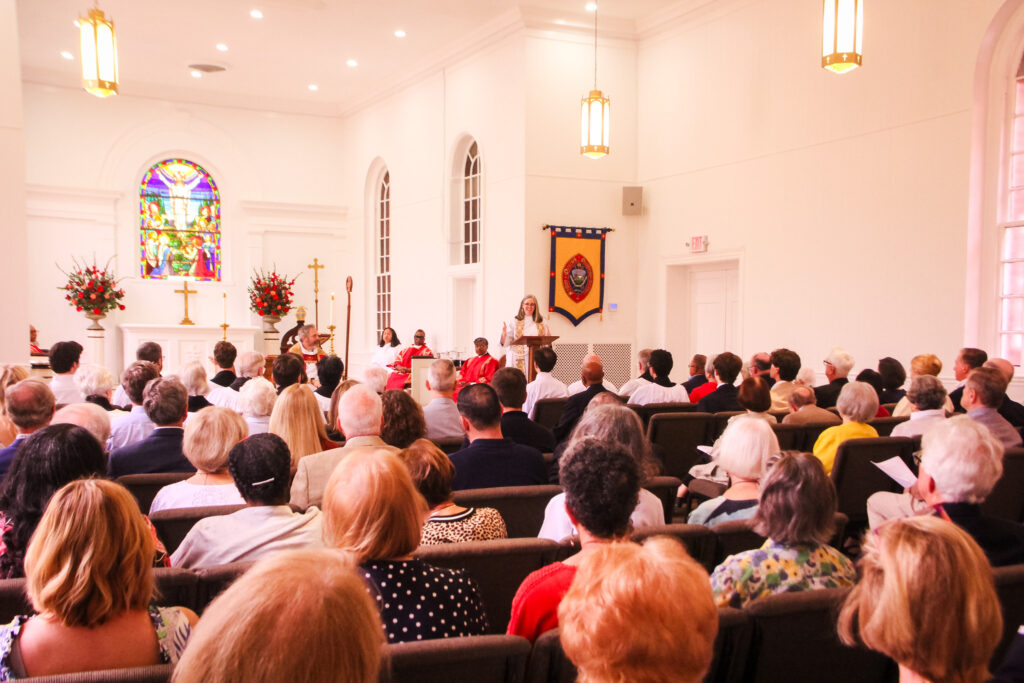
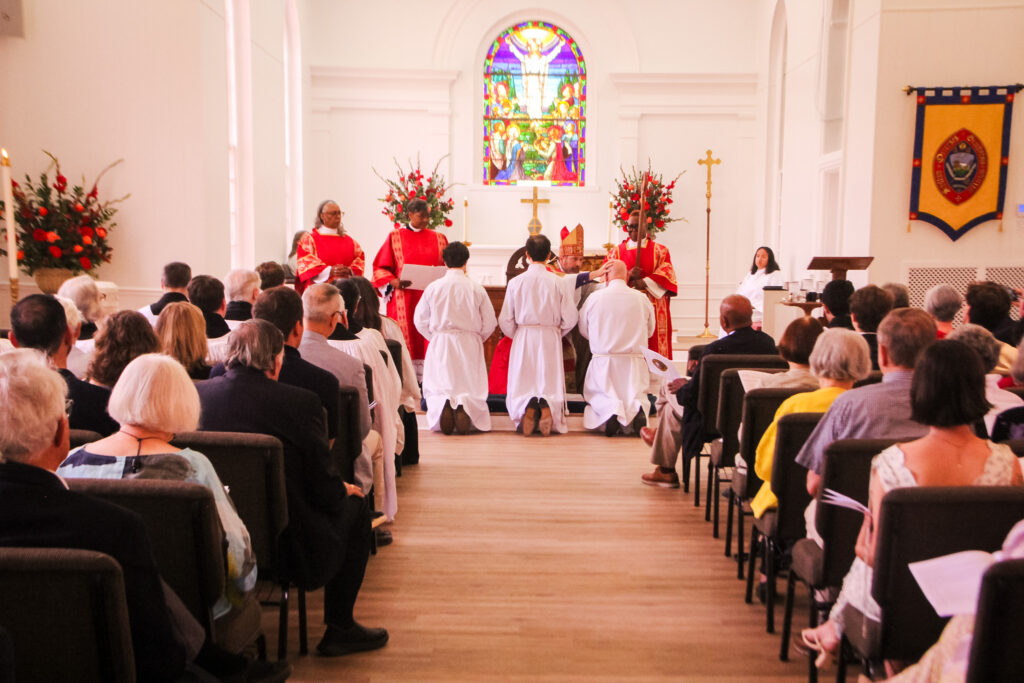
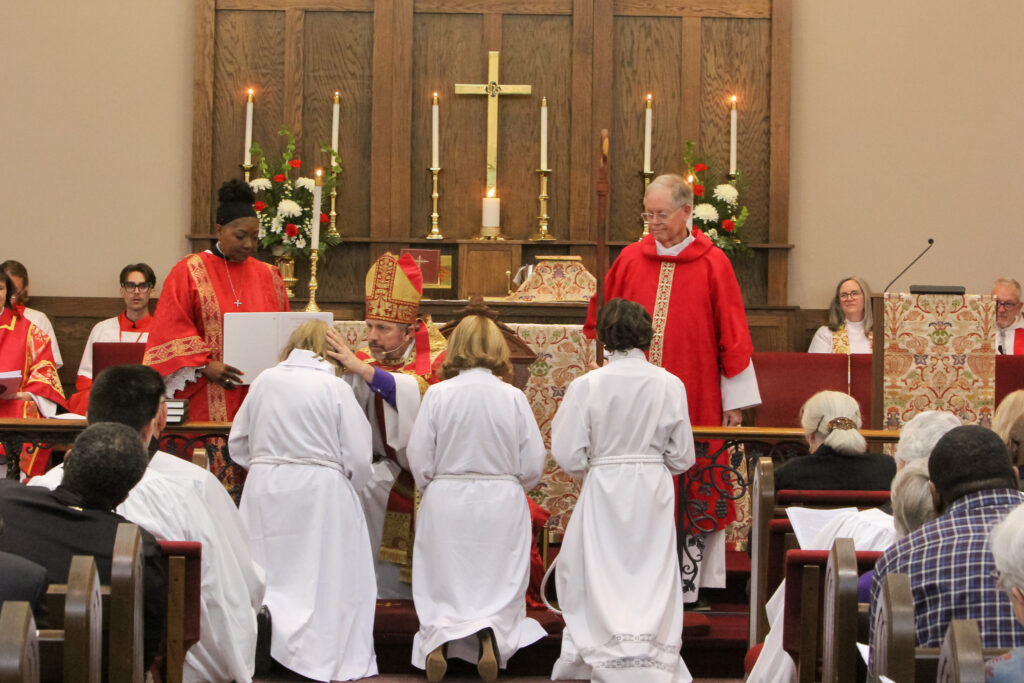 This is the outside-in message of the Kingdom of God that Jesus proclaimed to a world turned from God. Like the last being first and the humble being exalted, Jesus put the margins in the center. This is the ministry of a deacon. In the words of the Ordination Rite for a Deacon, “
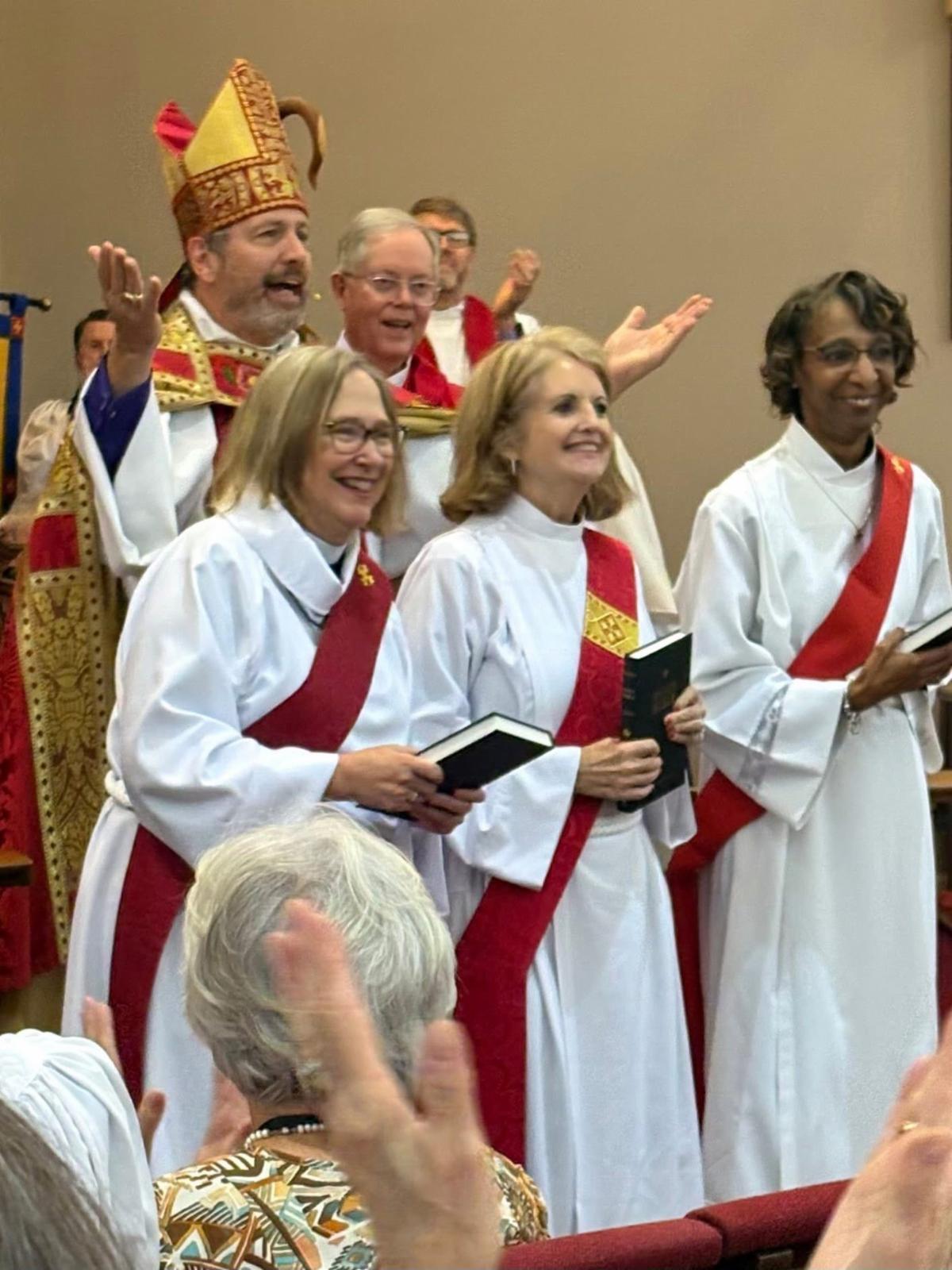 The Holy Spirit led each of these women to use their considerable gifts in service of others. This is, of course, what we are all to do as baptized Christians, to serve others as if we are serving Jesus and we are also to allow others to serve us. This mutual care best reflects the love of the Holy Trinity.
 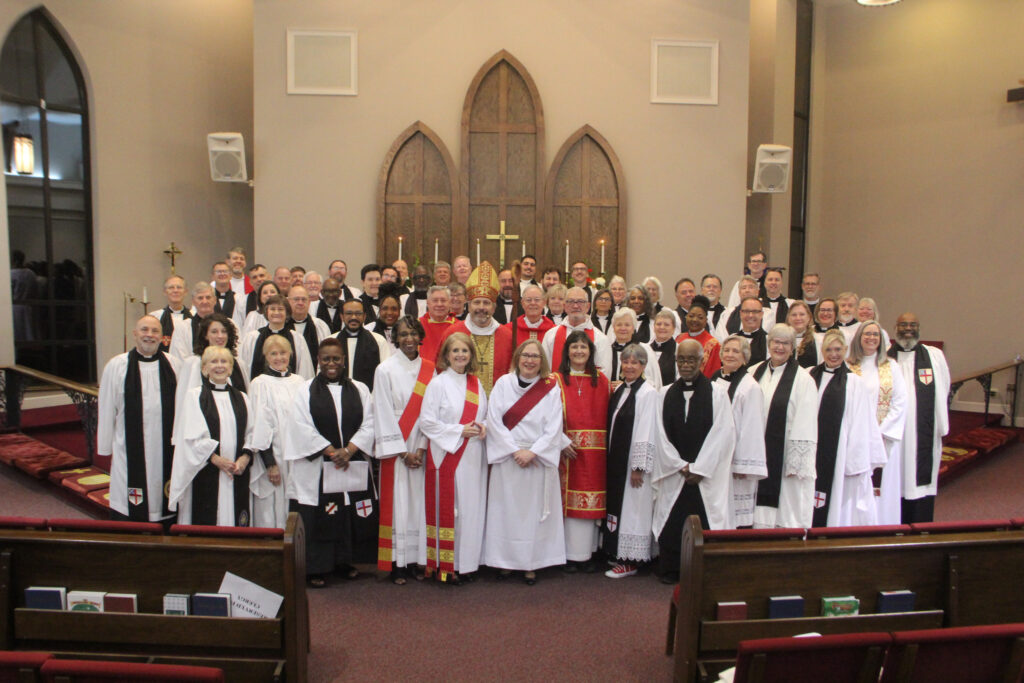 Deacons are icons of the servant ministry that embody this call. When deacons are doing their work of taking the church out into the community and bringing the needs of the community into the church, more of the congregation is challenged to join them or to find their own way to serve. This is how deacons encourage and strengthen the faithful into loving one another as Jesus loves us.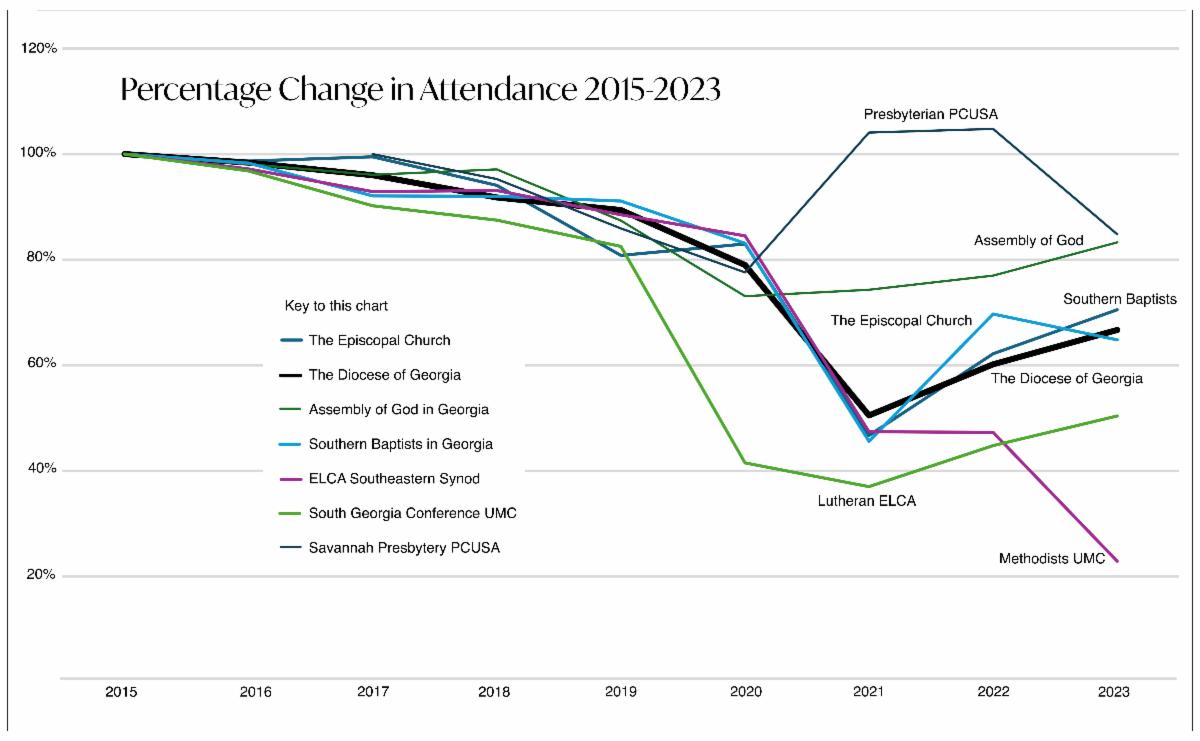
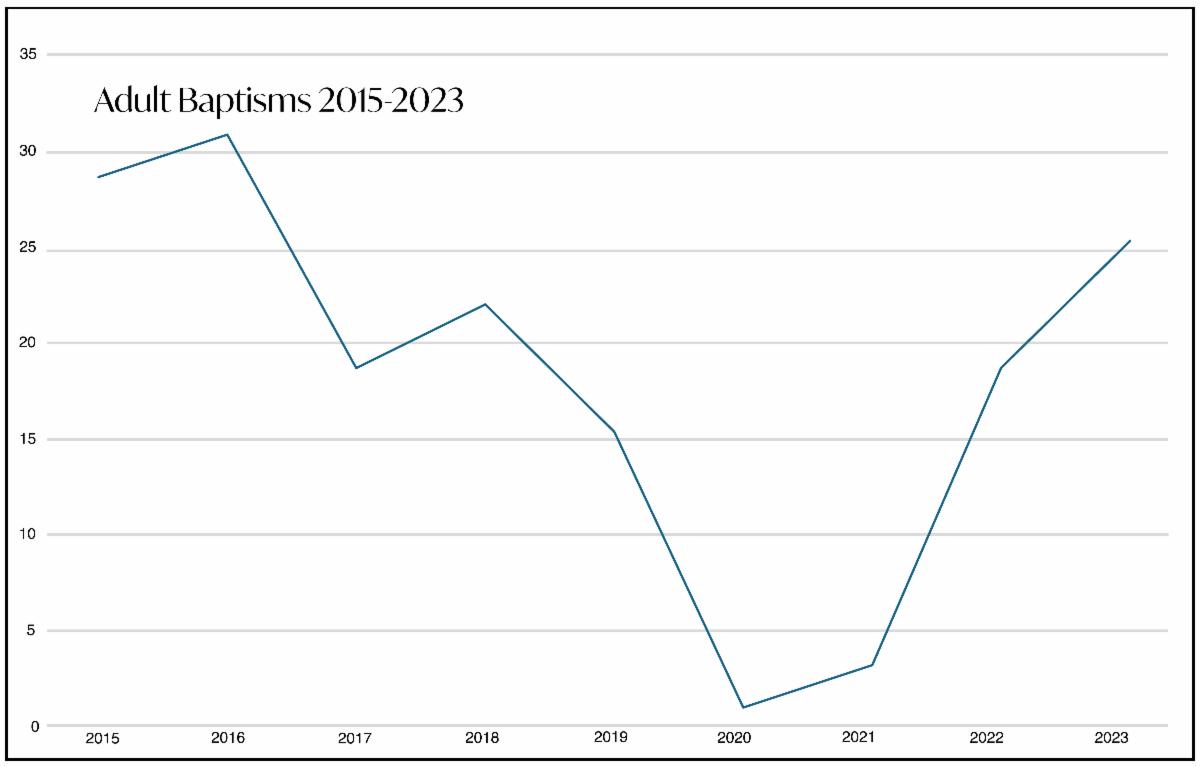 You will find charts of confirmations and receptions, alongside baptisms, and adult baptisms in the book as well. Even with declining attendance, we see those numbers bouncing back now in ways that fit what I am seeing in my travels. We have also seen Cursillo thriving once more with two weekends a year bearing the fruit we have come to expect from those retreats. Yes, attendance is not back to where we were and yes, the number of lives changed by the Gospel of Jesus Christ is more than we should expect given that decrease. God is not done with the Episcopal Diocese of Georgia. The Holy Spirit is working in and through us and sometimes in spite of us to touch the lives of people who need the grace, mercy, and forgiveness we have found.
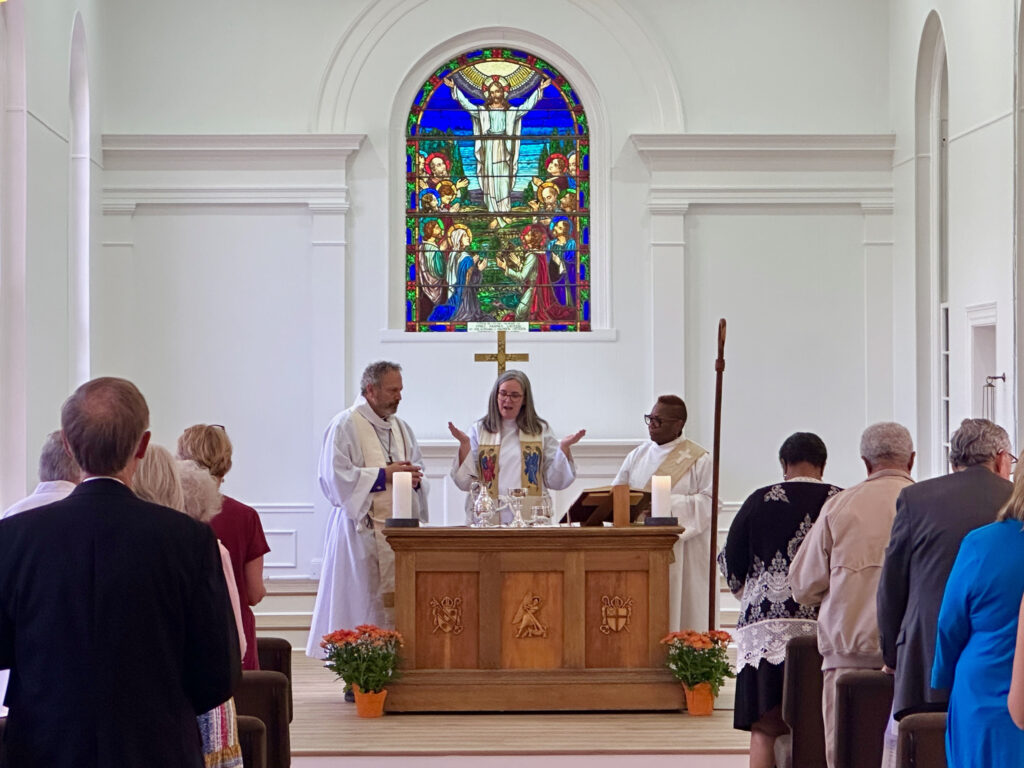 This consecration of space is an ancient practice. Our Old Testament lesson describes King Solomon consecrating the Temple in Jerusalem. Before that, Moses had consecrated the Tent of Meeting that served as the focal point of worship for the people of Israel. In each case, they offered sacrifices to God as they prayed for the ground and the tent and temple to be hallowed by the presence of the Spirit of God. This way of setting aside space for holy purpose has continued through the millennia.
 I hope that this dedication will also inspire us as a Diocese of Georgia to stand against the type of injustice that Deaconess Alexander faced through her entire ministry. Her years as a Deaconess from 1907 to her death in 1947 coincide exactly with the dates that our Diocese held segregated conventions with a separate, but not equal, meeting for black Episcopalians. Anna had to work hard to earn extra money, including through cooking meals for our summer camp that was on St. Simons Island in her day. While Camp Reese had an Anna Alexander Cabin it was described in a 1945 article in The Living Church as “a servants’ house built by the young people and named in honor of Deaconess Alexander.”
 In 2025, we will also offer a 1Book1Diocese read for Easter through Pentecost of Holy Mysteries: Encountering the Risen Jesus by Frank and Victoria Logue. As with their Advent through Epiphany devotional
 The 1Book1Diocese read for Lent 2025 will be Rowan Williams’ deeply wise book Passions of the Soul. In this brief text the former Archbishop of Canterbury tells how self-awareness about our instincts and emotions can offer practical assistance in diagnosing what is binding us to unhelpful and potentially destructive patterns of thinking. In the process, Williams shows how these thoughts like pride or anger are not necessarily wrong in themselves if we attend to these thoughts properly. He states, “For the Eastern Christian writers, ‘passion’ is the whole realm of instinct, reaction, coping mechanisms, and this is the level at which complications arise. We cannot live without these things if we are to be human at all; yet unless we understand and in some degree transfigure them, we are trapped in something less than human.”
 Callie Swanlund
 Anders found the camera loaded with color film and quickly captured the view in a photo called Earthrise. Everything any human had ever known could be seen in what looked to all like a blue marble hovering over the bleak lunar landscape and otherwise alone the vast emptiness of space. That startlingly new perspective, seeing earth from space, made all of human existence appear smaller, more fragile, than ever before.
 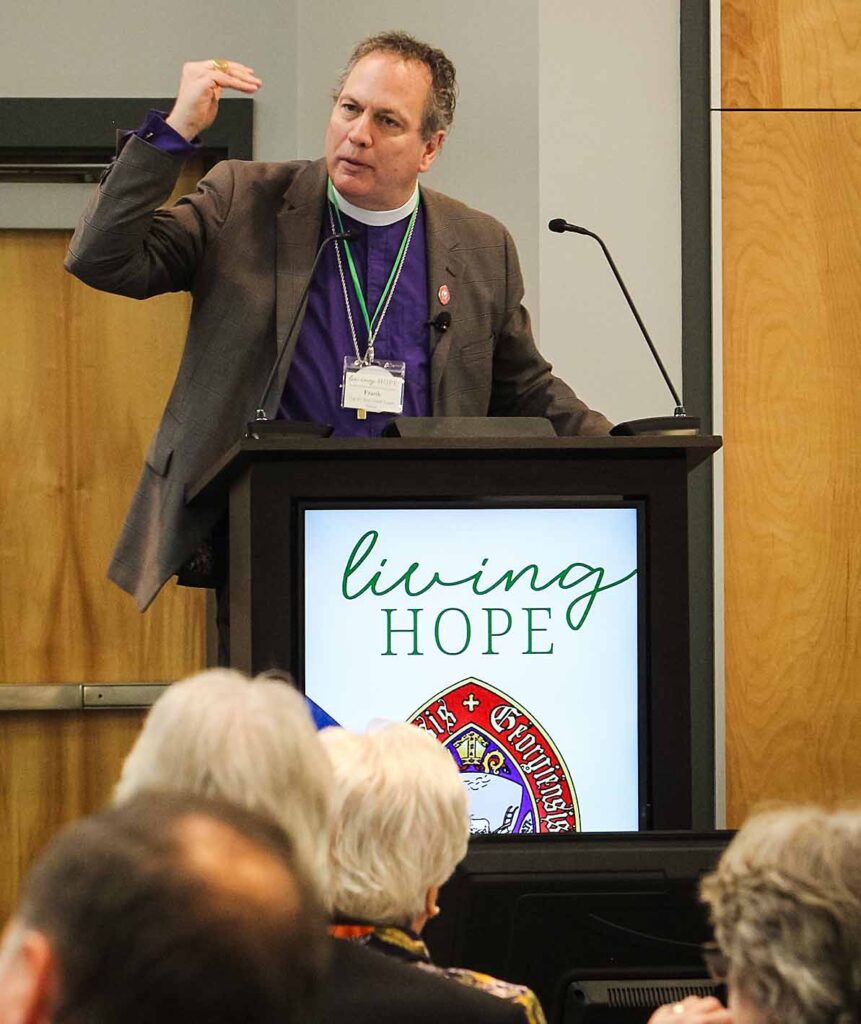 We see this in the Acts of the Apostles as in the first seven chapters of this story of what happened to Jesus’ followers after his resurrection we see how they preach with boldness and thousands come to faith. Then as that seventh chapter is ending, the Deacon Stephen is stoned to death. A persecutation breaks out against the Jesus Movement and the community scatters. Then in Acts 8, we see how God uses this tragedy to spread the Gospel. Disciples who would have stayed together in Jerusalem are soon spreading the grace, mercy, and forgiveness they have found to people who would have remained lost and left out if the faith had stayed within that small geographic area.
 This sea anchor stops the craft from drifting downwind. The sea anchor keeps the bow pointing windward, facing the waves head on. The reason this image speaks to me is that it shows that we are not being blown about by the winds of the culture or doing what the open water equivalent is of an ostrich burying its head. A sea anchor offers real stability, keeping a boat from being tossed to and fro and blown about by every wind. Anchored to the sea itself, the boat is not pushed off course, but turned into the storm in what could otherwise be an overcoming sea, we can not only endure, but in the words of the hymn Joyful, Joyful, we can experience the “Wellspring of the joy of living, ocean-depth of happy rest.”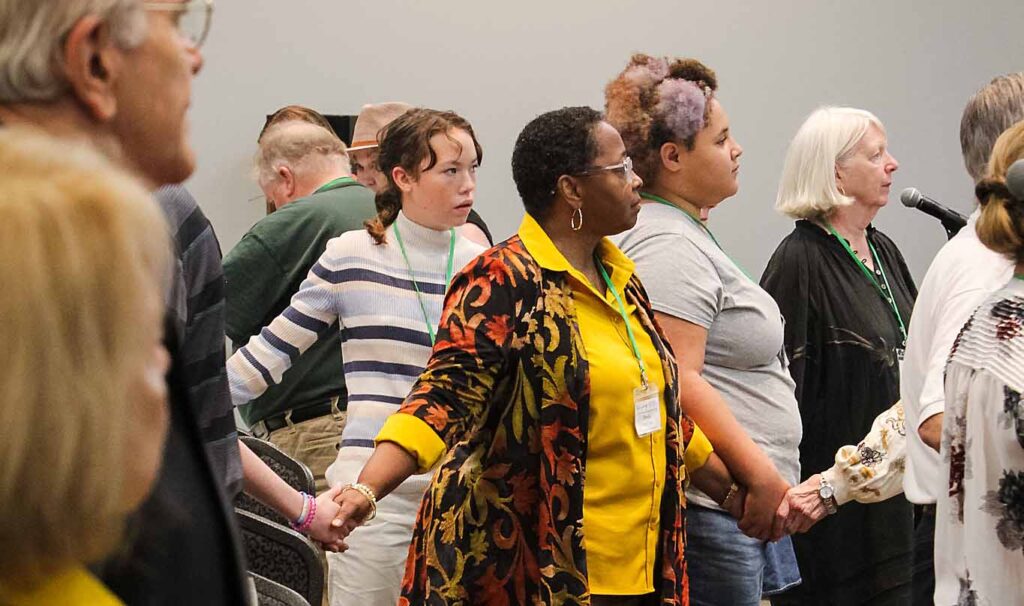
 Since we last met in convention in Augusta, that city has been hit hard by Hurricane Helene. As I said in my sermon this morning, the aftermath showed Episcopalians serving their neighbors including at Saint Paul’s where our previous convention Eucharist was celebrated and the Byllesby Center which is supported significantly by Good Shepherd where the convention met in the school gym. While many of us have been able to move on, it will be quite a while before many people in Central and South Georgia can say their lives are back to normal. Crisis reveals what is already present in a community and the Hurricane revealed the faith and resilience of our people and communities.
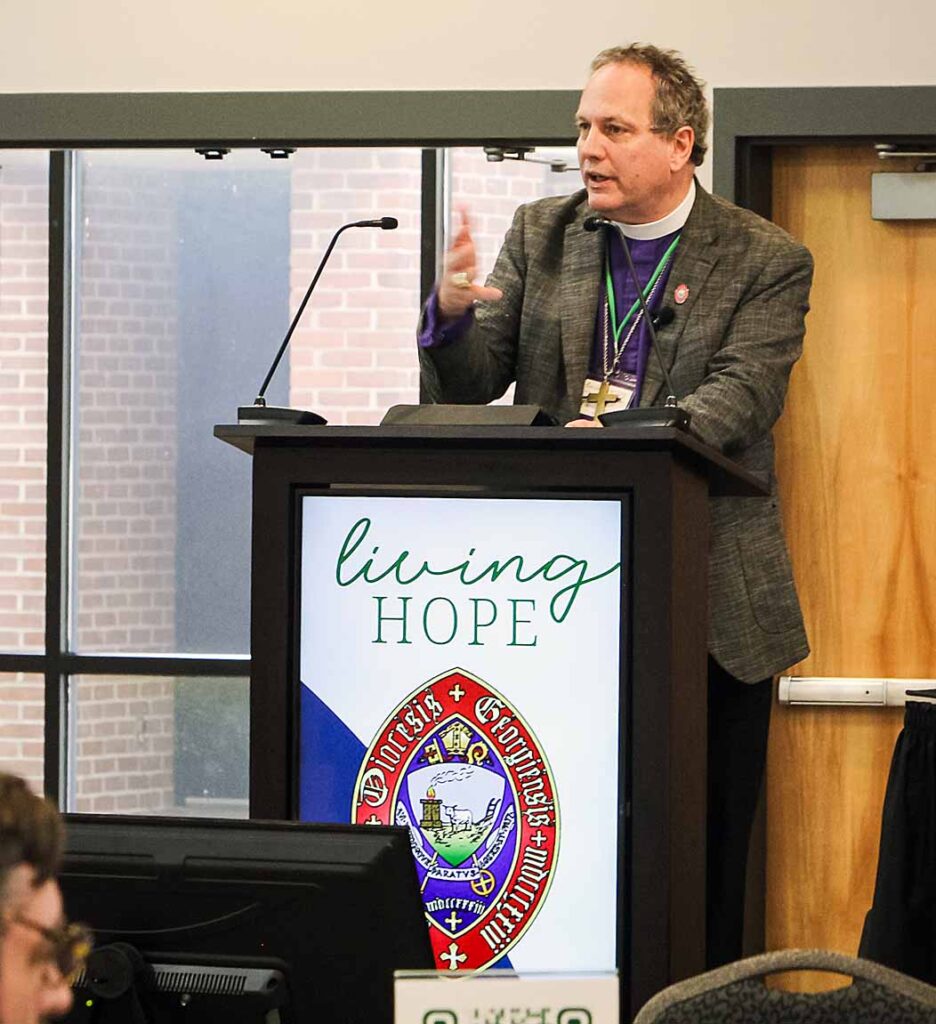 As I have been getting feedback from the listening sessions and the survey, I have seen the direction the Diocese wishes to move. While there is more to hear, I already see clearly the ways in which the diocesan staff has to be more responsive to you, the people of the Diocese. There are two tiers in the Diocese—those who know staff well and have no trouble getting what they need from staff and those who don’t know who to call or how to learn where to go for help. This is not based on the size of a congregation, but the familiarity with the team. This cannot continue. To address this, I am taking a multi-pronged approach. We are making which staff to call for what is more readily evident on the website. We will also have a complete website redesign in 2025 with the sole goal of making it easier for you to find who you need and what you need. In addition, our phone system now lets a caller more easily reach the person you need. Additionally, I know that I need a Chief of Staff as my travel schedule has me away from the office enough that the staff needs a leader who is with them when I am traveling. Some other changes on staff are taking some responsibilities off of Canon Loren Lasch’s load and I am naming her the Canon to the Ordinary and Chief of Staff. This acknowledges some of what has already been a part of her work with the staff and leaning into it more.
 Now, Jesus joins Cleopas and the unnamed other disciple on the road. They are in the depths of despair as they walk toward Emmaus. Neither of these first followers of Jesus know this seeming stranger on the road to be their Rabbi. This lack of recognition reveals the way despair clouds our vision and hinders us from seeing rightly.
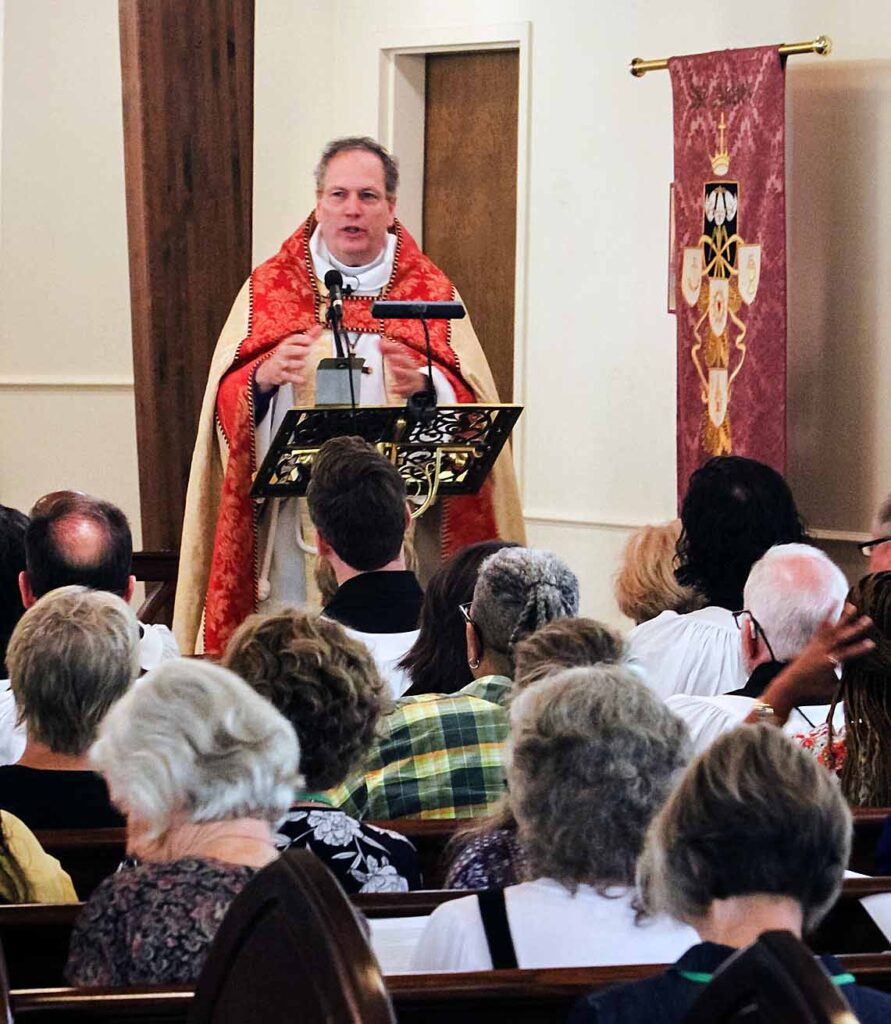 I want to pause here to note how the Enlightenment that led to the gifts of modernity also found its way into our faith. The Desert Mothers and Fathers saw the struggle of good and evil playing out not just in their lives as they saw the cosmic struggle of good and evil playing itself out within their own hearts as they sought through their prayers and fasting to overcome temptations. They lived in a world shot through with a sense of transcendence, the knowledge that what we see is not all that exists in the universe as the time we live in is held in eternity.
 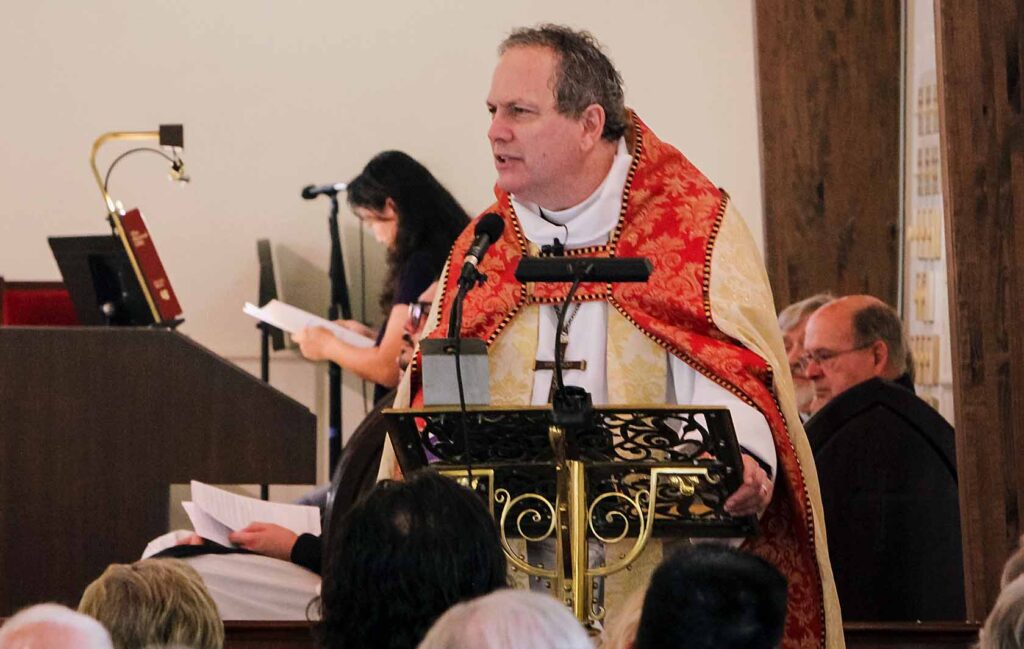 Seeing the ways God has broken into your life before gives confidence when looking to an uncertain future. For example, we can look at decline in church participation across the generations and join others in despair. Or we can look to the ways that the living God has been present with us in the past, is with us now, and already holds the future. That perspective makes it possible to be both realistic about where we are and what we face while remaining hopeful about the future. Whatever causes us to despair, when we tap into the certainty that God can, does, and will show up, we have a reason to hope.
 We have received a number of inquiries from outside of the Diocese about where to send donations for Disaster relief. The first way to do this is to donate directly to the Bishop’s Fund for Disaster Relief. This money will go directly to helping our parishes and Honey Creek in meeting their deductibles as they repair damages to their properties, which is a needed type of aid that is not covered by other grants. Once those initial costs are covered, any leftover donated funds will be used for additional assistance as needed.



 We are receiving surveys now through October 31 for our strategic planning process. Take the survey online here:
 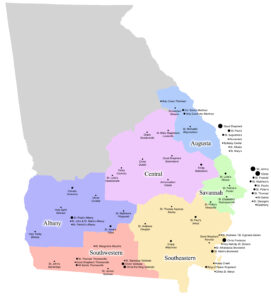 Strategic Planning Committee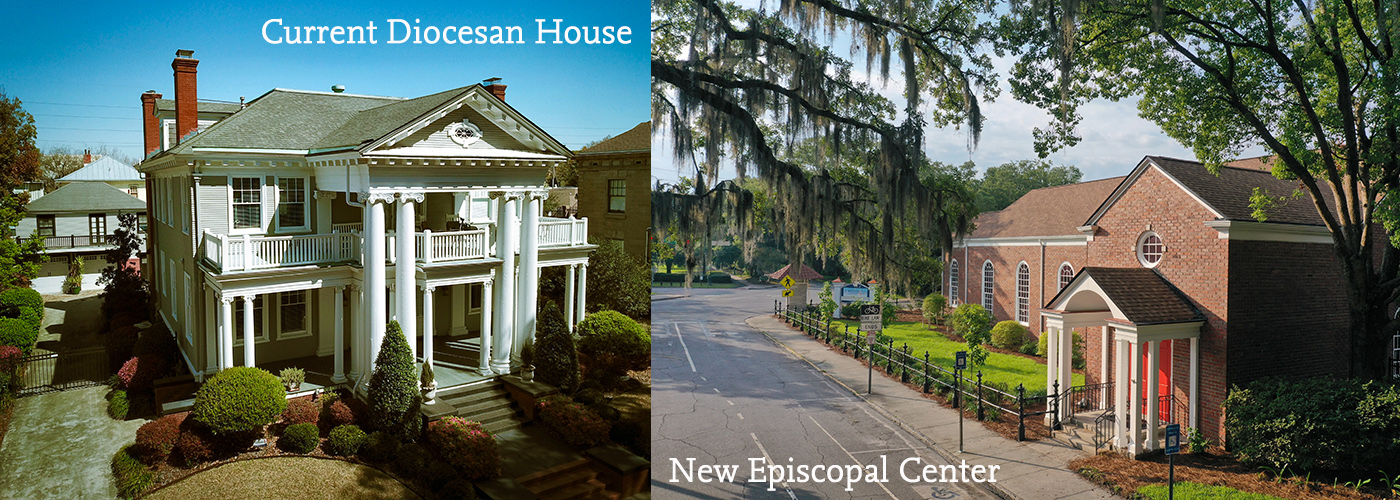
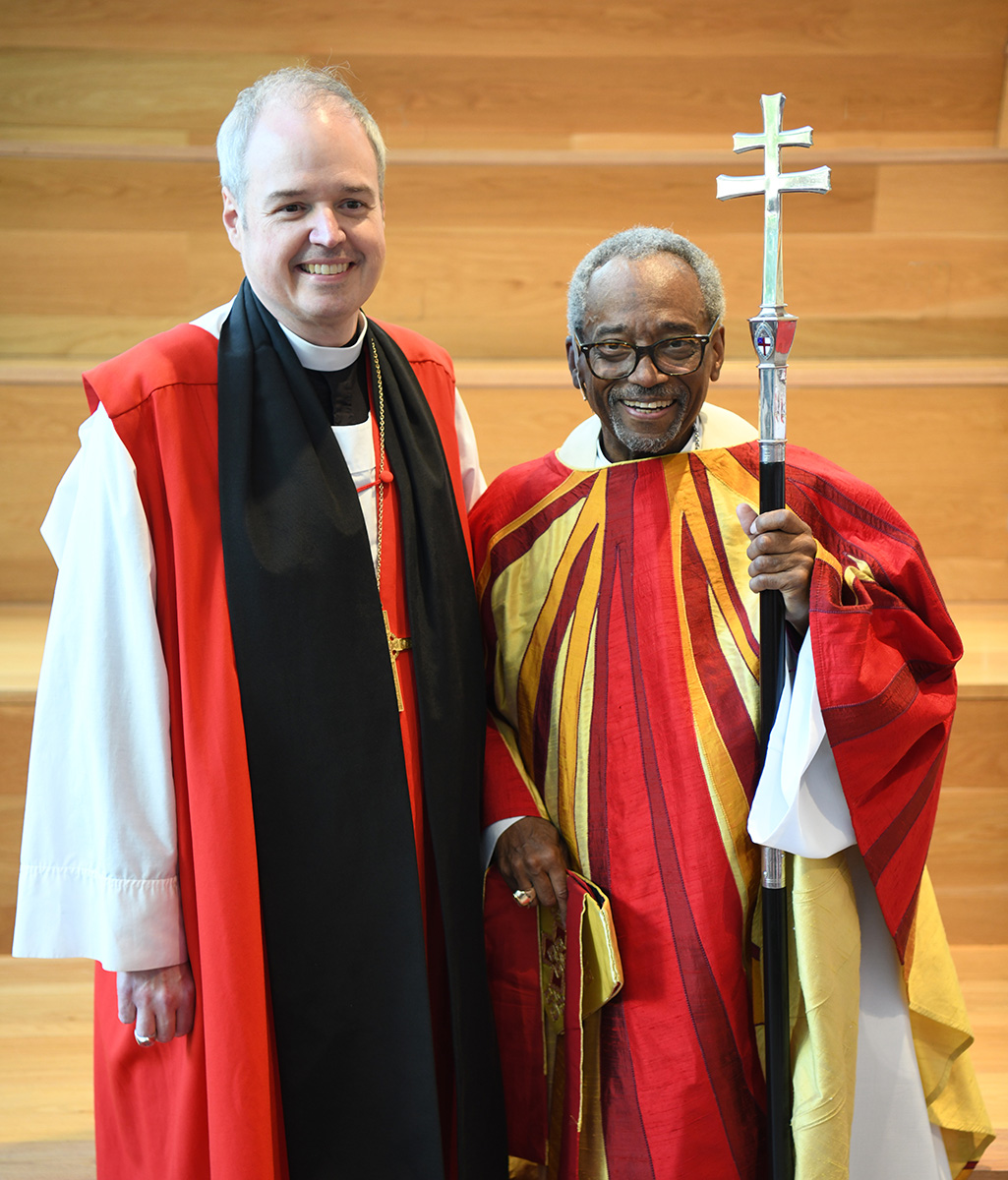
 Sean said, “And finally, what about our idolatry of structures and practices that exclude and diminish our witness? We have to get it together. That’s going to mean laying some things down.” By the end of the day, an announcement went out to the church that our Presiding Bishop-Elect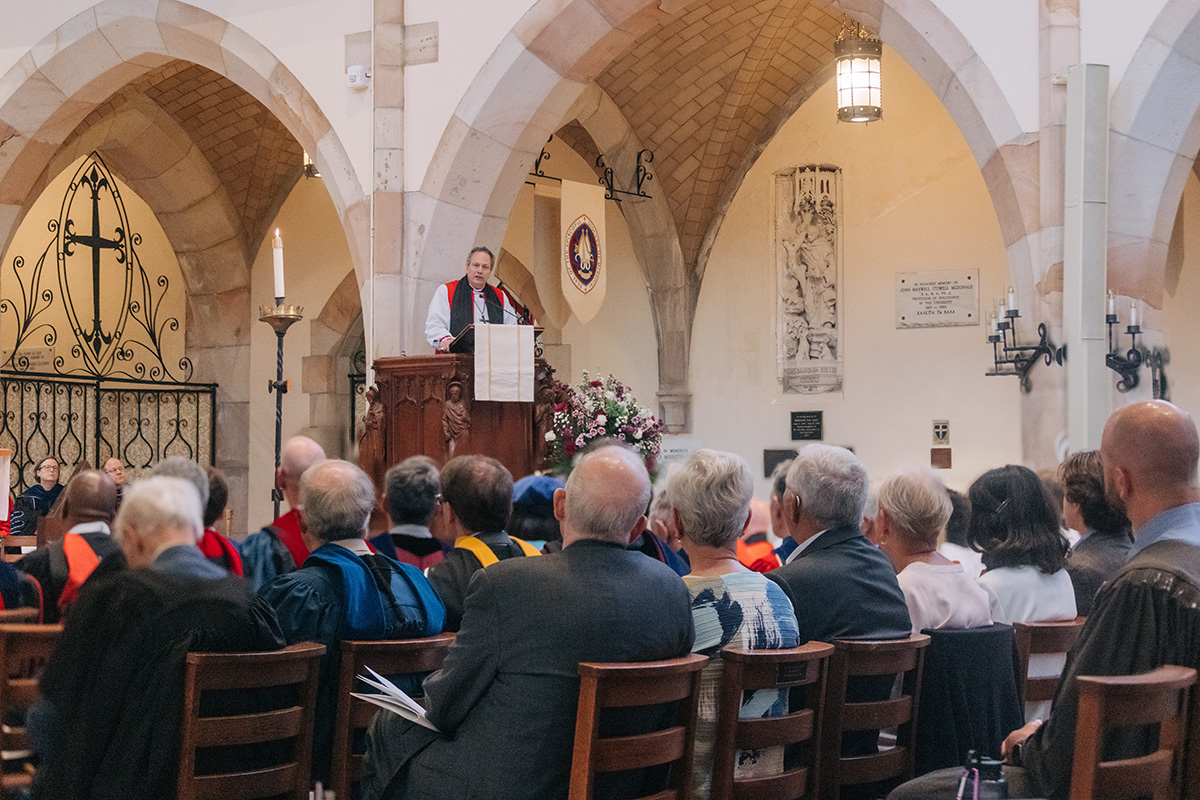
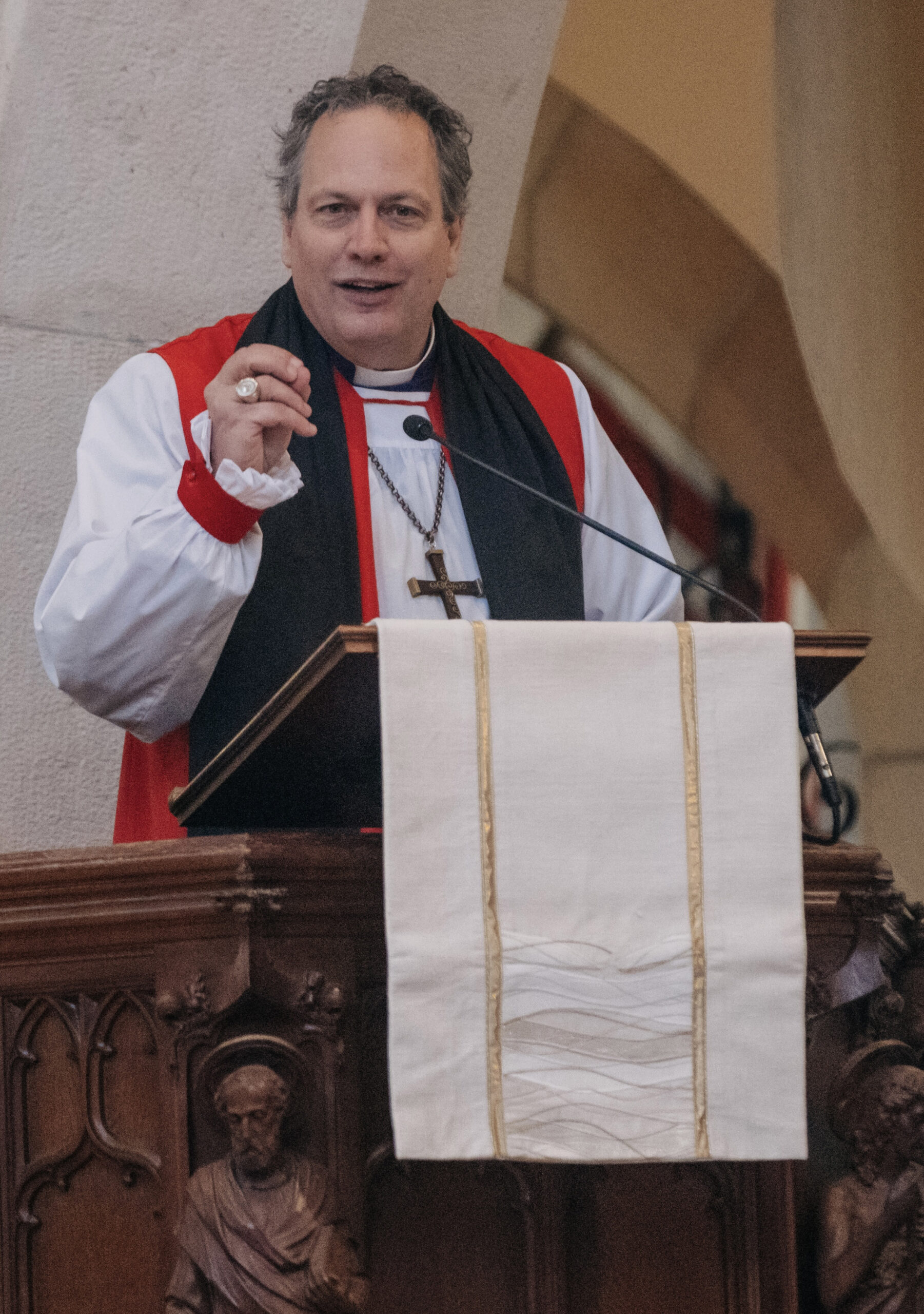 The gift nestled in our propers for this commencement is clarity that while we long to see lives changed by the Good News of Jesus, that
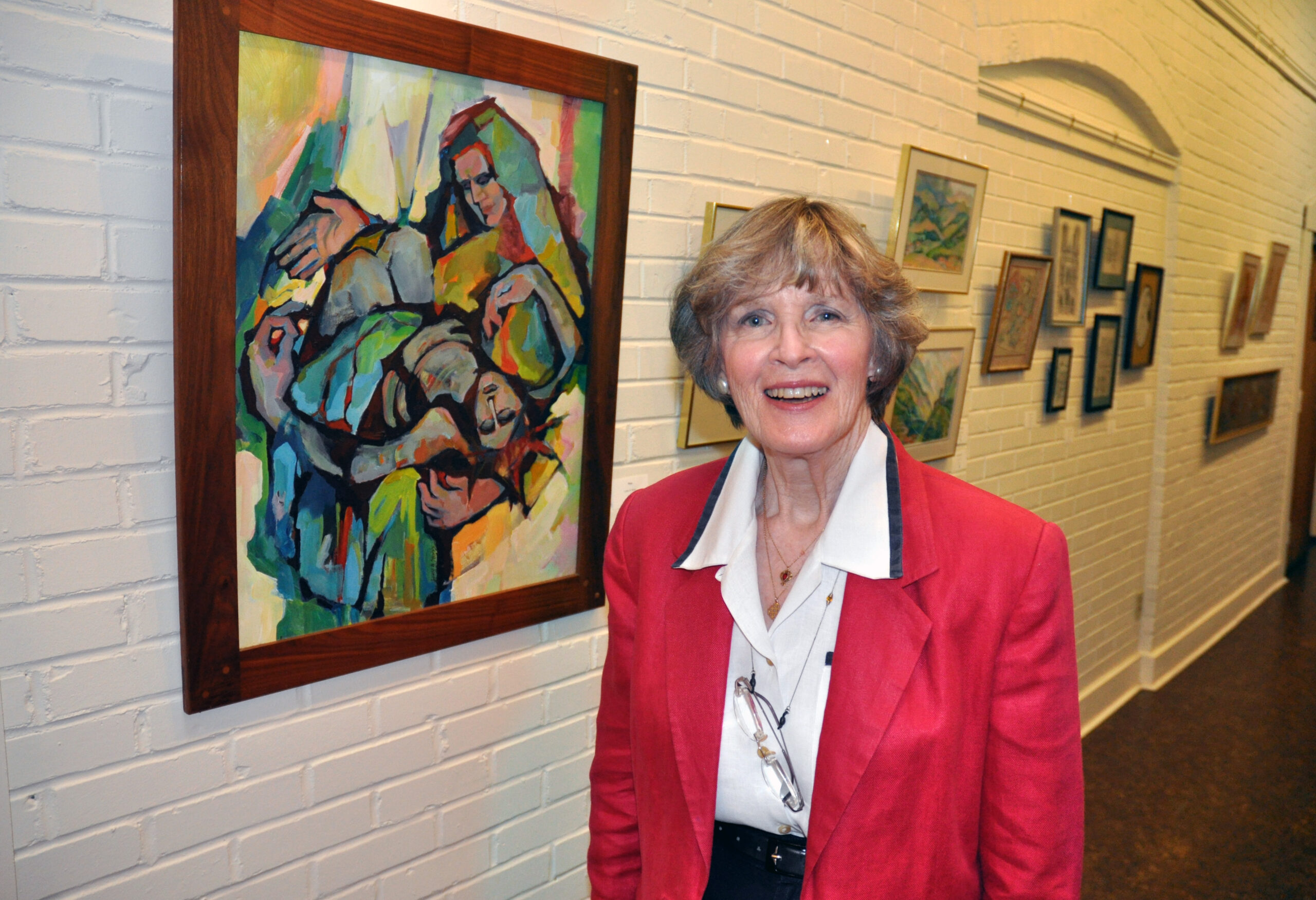
 This Lent, the Diocese of Georgia offers a study using a book The Good Life written by the directors of a more than eight-decade-long study of what makes for a fulfilling life. The Harvard Study of Human Development offers a window into lives of meaning and purpose through the data they have collected. The book also looks at what is gleaned from similar studies around the world. While the book itself does not make connections to our faith in Jesus, the discussion guide does.
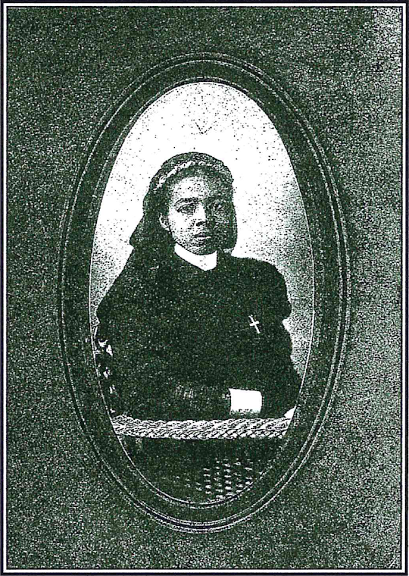 The delegates to the 2023 diocesan convention unanimously voted to name Deaconess Alexander as the Patron Saint of the Diocese. Deaconess Anna Ellison Butler Alexander (1865-1947) has been recognized as a saint by the Diocese of Georgia since 1998 and by the General Convention of The Episcopal Church since 2018, with her feast day celebrated on September 24.
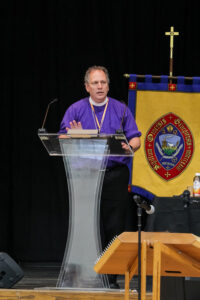 Kindle our hearts and awaken hope.
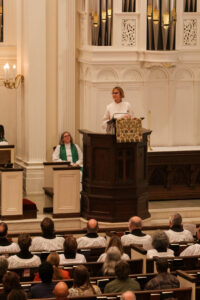 Speak God, for this servant is listening.
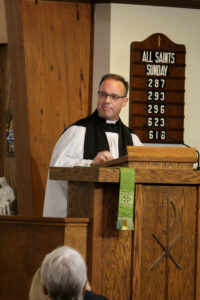 When the weather is nice, one of the things I enjoy is grilling on the back patio of our home. When cooking outside, I use lump charcoal, which means that the process of starting the fire is not immediate like with a gas grill. Those of you who are familiar with lump charcoal know that it is not uniform in shape like manufactured briquets that are mostly the same size. I sometimes think of this form of grilling as being similar to cooking over a campfire. The lumps of charcoal, in a variety shapes and densities, must be stacked in such a way as to allow for air to flow through the heap. After lighting the stack, I make sure the bottom and top vents are open to allow for the greatest amount of air to flow and feed the smoldering flame. After about 15 to 20 minutes, I usually return to find the embers ablaze with fire and ready for whatever needs to be cooked.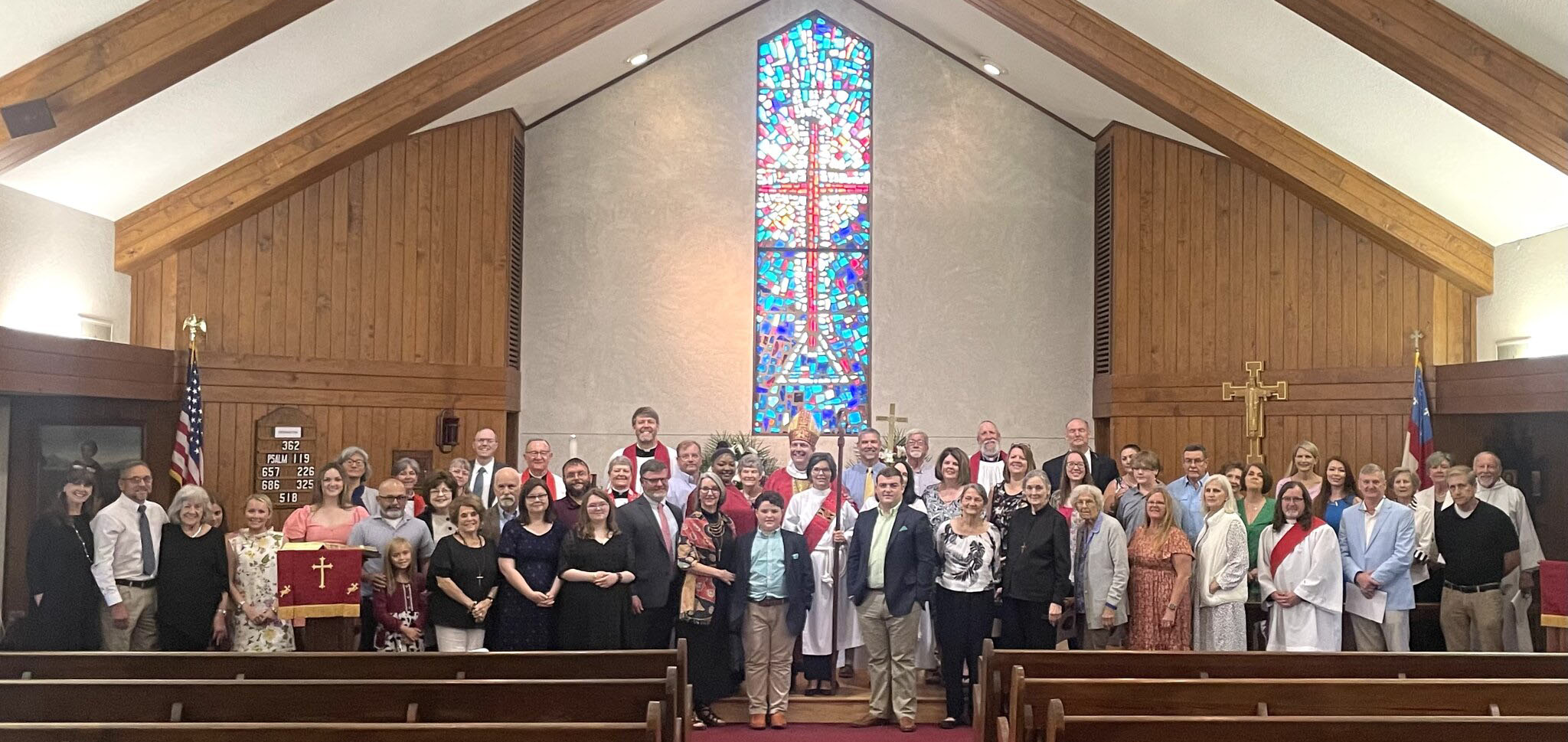
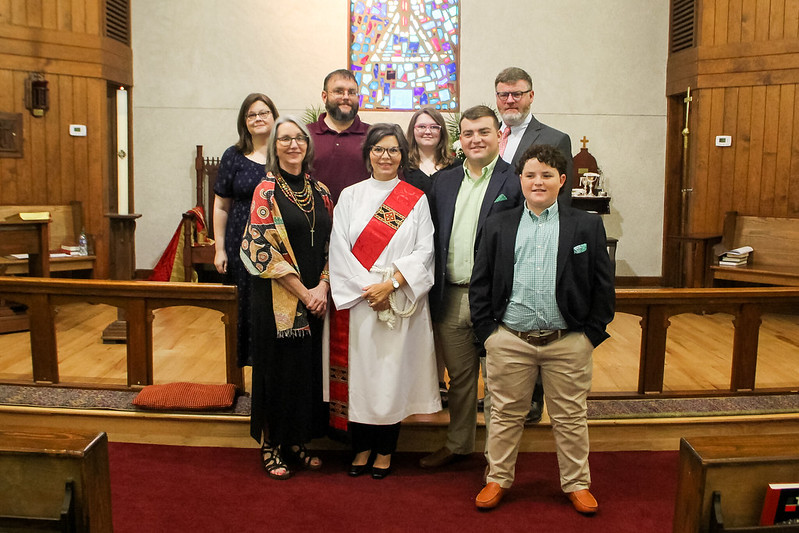 After meeting Dave at college, falling in love and marrying, the two tried to find a church home only to discover that they were miserable sinners as they had their feet metaphorically dangled over the flames of hell. While raising kids, they took a break from church. That is when Shayna’s old softball coach’s pleas to go to church with him broke through. Dale Jones persistent invitation finally reached the point where she could not keep turning him down. Shayna says of coming into this beautiful church, “I remember that first visit so well. Yes, we were a little overwhelmed with keeping up with the prayer book, and the kneeling and standing. But, [she added] we felt the love, the genuine spirit of the people, the closeness of God. I truly felt the spirit of Jesus.”
 This was faith he learned in the cradle. Born at home, in the little Central Florida settlement of Clay Sink, the entire population were his family by blood and marriage. He was at birth added to the cradle roll of Clay Sink Baptist Church. While his family would move around the Lakeland area, church was a constant for his parents, for Johnny, and his four brothers and three sisters. He was a steady presence in Sunday School, sang in the youth choir, and took part in all the activities for youth. He made his public confession of faith at the church in Kathleen, Florida, where four generations of his family are buried.
 Yet this fails to capture the liveliness of a woman of great depth. With a playful spirit and a great sense of humor, you just never knew what she was going to say. Of George’s call to ministry coming after he had settled well into the family’s furniture business, she said, “We were convinced it was a call from God, because we would have never thought of it.”