
A change of perspective in the House of Bishops
A report from Bishop Logue on the 80th General Convention held in Baltimore, MD July 8-11, 2022.
 This General Convention was the seventh I have traveled to on behalf of the Diocese of Georgia, but my first in the House of Bishops. The General Convention is sometimes compared to the US legislature with a larger House of Representatives and small Senate. In the General Convention, the House of Deputies comprises four lay persons and four clergy persons from each diocese for more than 800 deputies in a typical convention. Every convention has a lot of first time deputies learning their way around. The House of Bishops, which is more analogous to the Senate, has less than 150 members and most have previously taken part in a convention.
Beyond this, the bishops meet at round tables with 5-6 bishops at a table. These table groups meet for the three years leading to a General Convention so that the group knows each other well before considering any legislation together.
 This familiarity changes the nature of debate on resolutions in the House of Bishops as you are speaking to a smaller group of people who you know well, creating a higher level of trust and allowing deeper conversations.
When we took up a resolution setting the pattern for revision of the Book of Common Prayer, we could hear concerns raised in the room about the process not be clear enough as written. We moved to table discussions and then asked a few bishops who had been very involved with the committee that drafted the resolution to speak to us about the intent. We discussed how best to clarify the text. Then we tasked a smaller working group with drafting a revision overnight that would take our discussion into account. Bishops raised concerns and tasked a smaller working group to draft a revision overnight. We returned to the matter led by Bishop Andy Doyle of the Diocese of Texas who was on that working group. We spent two more hours discussing the important matter that ended with greater clarity.
The resolution we ultimately passed with slight revision from the deputies, would not change the status of the 1979 prayer book or of the various liturgies authorized by General Convention that are not in it. It would, however, set the canonical framework for future evaluation and reorganization of those liturgies. The goal was to rein in a situation in which more than a dozen liturgical texts have been “authorized” – for trial use, experimental use, or simply “made available” – by General Convention over the years without clear guidance. The change to the constitution and this convention requires a second reading in 2024. At that convention, additional canonical provisions will be added after due consideration providing even further clarity. The resolution leaves in place the requirement that any prayer book changes must be approved by two successive General Conventions, and specifies that any changes must be authorized for trial use first meaning a new prayer book is at least eight years away and more realistically would take 11 years. Both the 1979 and 1928 prayer books would remain authorized for use.
I found the lengthy process of discussion helpful and saw how the ongoing relationships among bishops make this possible in a way difficult to achieve in the larger House of Deputies meeting only once for four days. I am grateful to get to represent you with my colleagues.
+Frank
Bishop Frank Logue
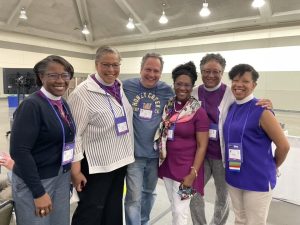
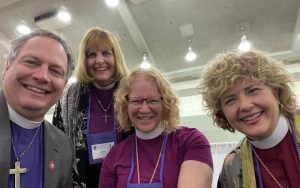
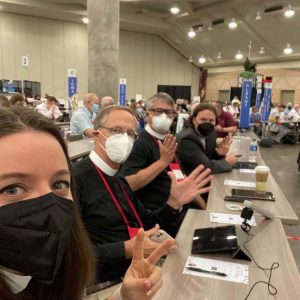
Pictured at top: Bishop Logue with the five bishops in the book This Band of Sisterhood written by St. Peter’s Savannah parishioner Dr. Westina Matthews. They are Bishops Jennifer Baskerville Burrows (Indianapolis), Carlye Hughes (Newark), Shannon MacVean Brown (Vermont), Phoebe Roaf (West Tennessee), and Kymberly Lucas (Colorado). Pictured below: Bishop Logue with table mates Bishops Betsy Monnot (Iowa) and Ruth Woodliffe-Stanley (South Carolina) in the foreground and Bishop Susan Brown Snook (San Diego) standing to Frank’s right.
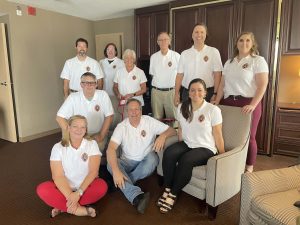 Having attended four prior General Conventions in the past (twice as an ECW Triennial Delegate and twice as a Deputy’s spouse), I felt somewhat prepared to serve as a first time Deputy for GC80. I was quite overwhelmed, however, with the rapid pace of voting on legislation on the house floor, with over 400 resolutions to be considered in only four days (and nights!). Just the time involved in searching the Virtual Binder to review the resolutions, the explanation of the resolutions, the floor amendments, the calendars, the agendas, the committee reports, and listening to the debates both for and against the resolutions, then being prepared to vote, was enough to make this first time Deputy’s head spin! Whew! It looked so much easier from the observer’s point of view! And then there were reports, memorials, elections, worship, and late evening deputation meetings, not to mention the daily Covid testing and wearing masks. But it was truly a privilege and a blessing to have the opportunity to do this work on behalf of our Diocese, and I am so very grateful for the support and assistance I received from my fellow deputies and from our Bishop, and for the opportunity to share this experience with them.
 It was the best of times. It was the worst of times. It was technology at General Convention. The 80th General Convention was the shortest in generations due pandemic concerns, only four days rather than the usual eight to ten days. How was this possible? The answer was technology. In particular, the committees of General Convention, which have previously only met in-person at convention, accomplished their tasks via zoom meetings in the three months leading up to the in-person meeting in Baltimore. Committee work is essential to the functioning of General Convention and thus the Church. Without technology, ie. the availability of zoom, it is possible that General Convention would have had to have been postponed another year. Technology, however, was not all good. General Convention has gone paperless with every deputy being assigned an iPad for access to the resolutions under consideration and for voting. Great idea, but an iPad is useless without reliable WIFI, and reliable WIFI was in short supply. A meaningful portion of those precious four days was squandered due to this problem. For all of its good and bad, technology is here to stay at General Convention. One of the resolutions passed was a change to the rules of the House of Deputies that will allow the use of zoom meetings in future conventions, not just in the extraordinary circumstances of this pandemic shortened meeting. This will allow more people to give input into the workings of the church—people can participate in committee without having to travel to convention for committee hearings—but we may lose the substantial benefit of people meeting face-to-face with all of the interactions that provides. Having been a deputy at four General Conventions. Technology, for good or for ill, will be playing an ever expanding role in the governance of the Episcopal Church.
  One of the recurring themes at this 80th General Convention has been racial justice and equity. The Episcopal Church has been on a journey in this regard for some time, having addressed matters of race consistently for decades. Much of this work has accelerated in recent years because of what has gone on in our nation, and the leadership of Presiding Bishop Michael Curry. While the General Convention has previously established educational offerings and encouraged the Beloved Community model as an aspiration for the Church, we have now committed to a time of study and introspection about our own specific history with race as a church. This includes evaluating the sources of Episcopal Church financial resources and beginning to allocate future funds to building up historically underrepresented peoples. We have also called for an honest evaluation of the Church’s role in facilitating indigenous boarding schools, where indigenous children were often abused. Understanding our history and the actions of previous generations is not about guilt, but about healing. If we do not know or admit the legacy of the Church’s historic actions we will continue to struggle to facilitate healing and reconciliation. Much of that history is recent enough that Deputies gave personal testimony on such matters. Before the 81st General Convention such investigations should give us a full sense of where we’ve been in the hopes that we can form a future that is defined by reconciling love.
 In Austin, at the 79th General Convention, Georgia’s Deputy the Rev. Cynthia Taylor was working with a group of lay and clergy women to bring forth reckoning and healing regarding gender-based abuse with the ultimately passed set of “#metoo” resolutions. Principle in the coordination of those successful efforts was Cynthia+ and others’ testimonies, which came forth through the collaborative organization of Executive Council member Julia Ayala Harris among a few others.
 While the entire experience of my first General Convention was illuminating and inspiring, I was especially excited about legislation that advanced two of my own areas of ministry, immigration and Creation Care.
 There were two particularly important pieces of legislation involving our Indigenous brothers and sisters that passed at the 80th General Convention. On the first legislative day, the House of Deputies heard testimony from some of our indigenous sisters who had been personally affected or whose family members were affected by their experiences in Episcopal boarding schools. The testimony was heartfelt and impassioned, and sometimes difficult to hear. To hear about incidents of abuse that happened to indigenous students “on our watch” was disturbing and eye opening. It was important for all of us for these testimonies to be given. It is a step toward much of the focus of this convention – Truth Telling and Reparation. We must know our entire past to be able to have a stronger future.
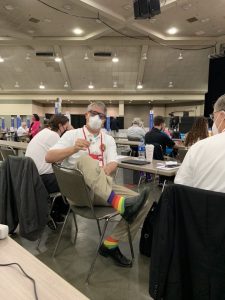 As a first-time deputy, it was a joy to attend and represent this diocese that has become home to my family and me. One of the truly refreshing aspects of General Convention was its inclusive nature. Inclusion wasn’t something simply given lip-service, but intentionally lived out in multiple aspects. From the ASL interpreter and captioning on every screen; worshiping in multiple languages; deputies who were in their teens to deputies who had been to 15 conventions; diversity among deputies including a high number of deputies of color, women, and deputies who are part of the LGBTQ+ community; one could not fail to notice the work that has been done to truly give voice to as broad a spectrum as possible.
 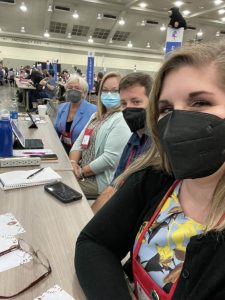 As the former Nominations Chair and Elections Czarina for the Diocese of Georgia, I’ve had the opportunity to facilitate the elections of our General Convention deputies the last few General Conventions. It was always an honor to send our deputation off to the infamous General Convention, and when I decided to run, it was with great respect and excitement. As a self proclaimed Church Nerd, arriving to the floor of convention was overwhelming. And getting to vote for the first time? Pure giddiness! Each session I grew more comfortable with the process and the flow of convention. We passed a lot of resolutions, had interesting conversations, and held elections. But more importantly, I came away with an even greater love for our church and the people in it. We continue to see where we have wronged others and how we can make amends, we continue to work towards proclaiming that the love of Christ is not exclusionary, and we look towards the future of the church. For all of this, and more, I am grateful to have been a member of our diocesan deputation.
 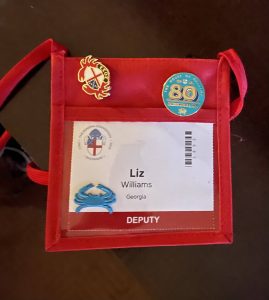 After a one year delay due to the pandemic, we returned to General Convention masked, vaccinated and ready to do the work of the Church. As Chair of Credentials, I had the unique opportunity to oversee the “checking in” of all deputies to ensure voice and vote of the dioceses. At last count, 802 deputies (clergy and lay) representing 107 dioceses were seated. My committee worked long hours on registration day, and then every day of sessions, as deputies checked in and alternates and deputies switched in and out. With shortened time frame and increased Covid restrictions, I knew this Convention would be different, and it was. Having been a deputy before, I missed the expanded worship services, the fellowship gatherings, the exhibit hall, and the in-person legislative hearings (and the snacks at the tables!). We still gathered together to accomplish the necessary tasks required by our constitution and canons. In spite of the differences between this Convention and others, great work, positive changes, and history-making elections were the result.