
Holy Purpose – Our patron saint, Deaconess Anna Alexander
The Rt. Rev. Frank S. Logue preached this sermon on September 25, 2025, for the dedication of the chapel at the Episcopal Center in Savannah to the patron saint of the Diocese of Georgia, Deaconess Anna Alexander.
Holy Purpose
I Kings 8
Set aside for holy purpose.
This is what we do when we consecrate a building to serve as a church: we set the church aside solely for the holy purpose of housing our worship of the living God.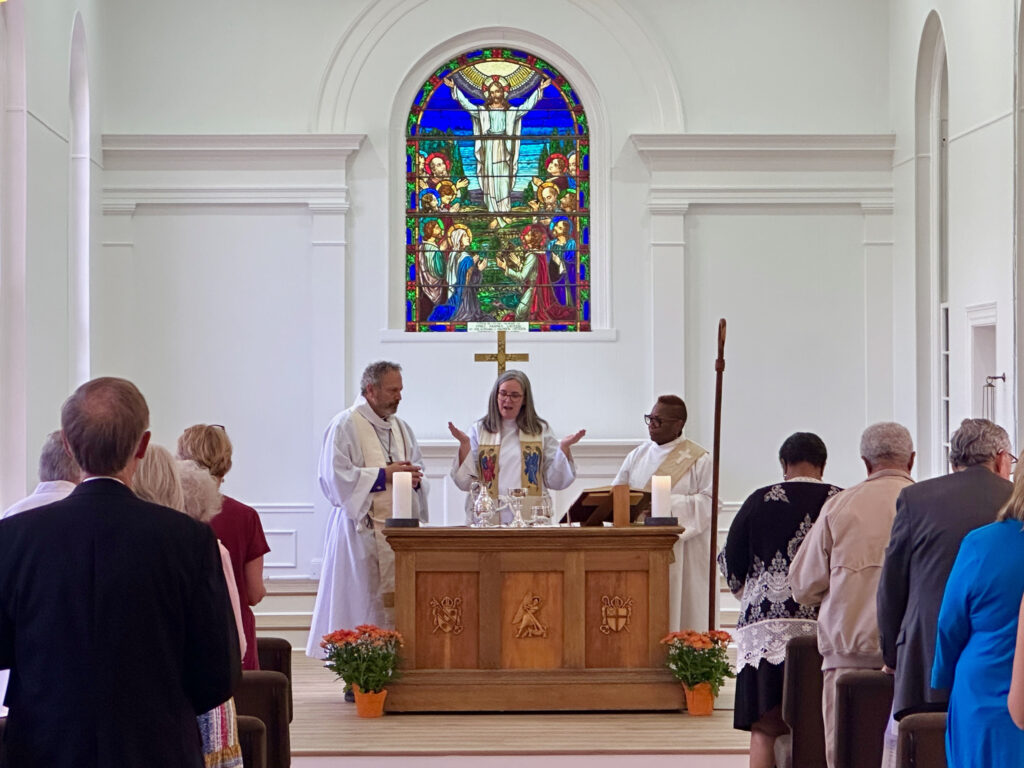 This consecration of space is an ancient practice. Our Old Testament lesson describes King Solomon consecrating the Temple in Jerusalem. Before that, Moses had consecrated the Tent of Meeting that served as the focal point of worship for the people of Israel. In each case, they offered sacrifices to God as they prayed for the ground and the tent and temple to be hallowed by the presence of the Spirit of God. This way of setting aside space for holy purpose has continued through the millennia.
The Episcopal Church, and other liturgical churches, has a service to dedicate and consecrate a new church building. We are not using that liturgy this afternoon, as Bishop Middleton Stuart Barnwell dedicated and consecrated this holy space for the congregation of St. Michael and All Angels at the 11:30 am service on November 26, 1944. In the many years since the liturgy that set aside the church, this place has been consecrated by the ongoing prayers or the people of that parish. We can recall today all the many occasions the people of St. Michael and All Angels celebrated in this place, the many joyous Easters and Christmases, the solemn services on Ash Wednesday and Good Friday. The many, many baptisms, weddings, and funerals. Those prayers have soaked into these walls, continuing the consecration that began with the church being first dedicated and consecrated.
This afternoon, we undo none of what came before as we dedicate this chapel to the Patron Saint of the Diocese of Georgia, Deaconess Anna Ellison Butler Alexander. We add to all that has come before with prayers to dedicate this chapel to a woman whose steadfast faith in Jesus offers an inspiring example of all that Jesus can and will do through us if we dedicate our lives to God.
Anna Alexander was herself set aside for holy purpose in a liturgy on May 7, 1907. That day at Good Shepherd Episcopal Church in Thomasville, Georgia, Anna knelt as Bishop C.K. Nelson prayed over her asking that “God the Father, God the Son, God the Holy Ghost, bless, preserve, and sanctify you” as she was set aside for her work. That liturgy was meant to consecrate Anna, yet in the service the church was acknowledging what was already true as Anna had already dedicated her life to serving God.
The service used that day as Anna knelt surrounded by black Episcopalians who held her in high esteem joined in prayer was the one used for the many women set aside as deaconesses in our church. The Order of Deaconess is mentioned in the Bible, but it died out in the 500s. Beginning in the 1800s, there was a move to recover this ancient order. The first six women were set aside as deaconesses in Baltimore in 1857, so Deaconesses were a part of the Episcopal Church for Anna Alexander’s whole life. Yet though she joined an order that included hundreds and hundreds of other women, Anna’s call was unique.
Yes, she was the only African American in the order of Deaconess, but that is not the distinction I am holding up. In the history of this order that would continue until women were ordained as deacons in the 1970s this was clear, Deaconesses never did anything liturgical. They founded and operated schools, hospitals, orphanages. They had a servant ministry outside of the church. In the church, they participated in worship led by men. This was well-recalled by Deaconess Priscilla, who was the last living woman set aside as a Deaconess until her death in 2022. I met Deaconess Priscilla on a couple of occasions, one in the Dominican Republic and then later at the Community of the Transfiguration in Ohio, where she retired for her last years. She said that to be a Deaconess, “You had to be a pious lady. You had to be a member in good standing in the Episcopal Church. No scandals in your life. You had to have an orderly life.” Deaconess Priscilla also noted that Deaconesses did not have a role in the liturgy of the church.
But this was not true of Deaconess Alexander. While she was already a teacher at the Mann School at St. Cyprian’s Episcopal Church in Darien, before she was the founder of a school, Anna was a church planter. In the fall of 1894, thirteen years before she would consecrate her life to the ministry of a Deaconess, Anna started a church. The school on Pennick Road in west Glynn County would not open until 1902. The church came first. When she was made a Deaconess in 1907, she continued to have a role in the liturgy for many of the services at the Church of the Good Shepherd and all of them in her Parochial School.
Deaconess Alexander described the worship on the school in 1910 writing, “There are many children, large and small, who walk daily for miles to attend the school. They will be in time for devotions in the morning. Just to hear them respond in the Litany on Wednesday and Friday mornings, and to see and hear them find and read the Psalter for the day, will bring tears to the eyes.”
In so many ways, the Deaconess was a singular person whose ministry went well beyond all expectations. On her death in 1947, the Episcopal periodical The Southern Churchman ran a notice of her funeral saying that they had received word of the death of Deaconess Anna E.B. Alexander. They noted, “Deaconess Alexander was a very consecrated woman and the work she did among the people of her race in the little backwoods town of Pennick was very wonderful.”
A very consecrated woman. Consecrated. Devoted to the God that she knew loved the children of her community as she did. Dedicated to serving Jesus and set apart for a holy purpose.
So we gather this afternoon, to dedicate this sacred space, long consecrated by the prayers of those who worshipped here for decades, to a unique leader in our church whose dedication to God assisted her in lifting up her community.
The prayers that hallow these walls have continued since the Parish of St. Michael and All Angels voted to turn the care of this building and grounds over to the Diocese of Georgia. The Church of the Epiphany has found a home in this diocesan chapel and continues the worship. Beyond this, removing the pews has allowed this holy place to house other events. Just last week, Migrant Equity Southeast distributed food to families who have someone in held in detention because of their immigration status. Jesus told us to feed the hungry and in this place where the spiritual hunger of so many people has been fed, we also offered essential food for families in need.
As volunteers and those in need entered and left this chapel, I saw many pausing to look at the interpretive sign in the entrance that in words and photos shares the story of Saint Anna. In this way, many more people will come to be inspired by a woman who dedicated her life to holy purpose, just as we dedicate this chapel to holy purpose in her name.
I trust that some people will enter this chapel and discover a saint who looks more like them so this dedication to her will offer an effective witness to the God who made Anna, gifted her in a unique and powerful way, and used her to holy purpose to raise up generations of children who would have gone by the wayside if not for her loving care. I hope that this dedication will also inspire us as a Diocese of Georgia to stand against the type of injustice that Deaconess Alexander faced through her entire ministry. Her years as a Deaconess from 1907 to her death in 1947 coincide exactly with the dates that our Diocese held segregated conventions with a separate, but not equal, meeting for black Episcopalians. Anna had to work hard to earn extra money, including through cooking meals for our summer camp that was on St. Simons Island in her day. While Camp Reese had an Anna Alexander Cabin it was described in a 1945 article in The Living Church as “a servants’ house built by the young people and named in honor of Deaconess Alexander.”
Though her work was extolled by the bishops, she was not supported by the diocesan budget, largely raising money from benefactors in the north. We can’t simply hold her up as a paragon, we must also continue to work for justice.
For the work that fell to her to lift-up generations in the years before public education would be offered equally to all is not our work now. Yet, there is much that remains for us to do in order for our churches and communities to reflect the coming Kingdom of God. In that ongoing work, this chapel is an important witness to what God did in our midst through The Deaconess even as this dedication challenges us to dedicate ourselves to holy purpose.
Amen.
Follow this link to learn more about Deaconess Anna Alexander, including a short documentary on her life and ministry as well as information on our work to restore her schoolhouse: