New Beginnings is a youth retreat led by high school youth for middle school youth. During the retreat participants have a chance to hear talks from their peers about issues in their lives, and discuss them together. They also pray, play, and sing together, and enjoy time at Honey Creek!
The retreat begins at 7:00 p.m. (after supper) on Friday, and finishes with a 12:30 p.m. Closing Eucharist on Sunday, to which all parents and friends are invited!
Current cost is $135 for the weekend. However, cost should never be an obstacle to attendance! The Diocese seeks to partner with local congregations and families to divide the cost as necessary in order to enable young people to attend.
While we still encourage masking while indoors, the Diocese is not currently requiring it of all participants and staff. Covid-19 Vaccinations are still required at this time. All such requirements are subject to change depending on public health conditions.
Follow this link to register for New Beginnings: https://bit.ly/NewBeginnings58. To register you will need to pay at least the non-refundable deposit (approximately $45), or the entire cost of the event. You will also need to provide basic information such as name and pronouns, as well as t-shirt size, health, allergy, and emergency contact information. If the deposit is a financial hardship, please contact Canon Varner at jvarner@gaepiscopal.org and we will work things out!
Happening 106 takes place August 12-14 at Honey Creek! Participants must have completed Grades 9-12 in order to attend this event, which is led by high schoolers for high schoolers. More information is available at www.georgiahappening.com, and the direct registration link is at https://bit.ly/Happening106Candidates.
Jake Diamond, of Christ Church, Valdosta, is the Rector (teen-in-charge) for this event. Sarah Brittany Greneker serves as the Diocesan Happening Coordinator.
Please note that all Youth Events in the Diocese of Georgia require participants to wear masks while indoors and to test negative for Covid the week prior to the event.
“Baptized for Life: A Lay Ministers’ Conference” will take place September 9-10 at Honey Creek! This conference is intended for any lay person in the Diocese who is in any active ministry in their congregation. Examples of such lay ministries include those who assist or lead worship, serve on the Vestry, serve on committees, teach Sunday School or lead youth activities, serve on the Altar Guild, care for the buildings and grounds, lead outreach activities, and more. This conference will be led by Dr. Lisa Kimball, the Vice President for Lifelong Learning and the James Maxwell Professor Chair of Lifelong Christian Formation at Virginia Theological Seminary. “Dr. Kimball has focused her teaching and research on lifelong, life-wide, and life-deep discipleship and Christian vocation…She is a passionate advocate for lay ministry, the full inclusion of all generations, digital literacy, and leaders who are confident teachers of the faith.” For more information about Dr. Kimball’s background and history, click here.
This conference will focus on the ministry of the laity, including its joys and challenges especially over the past two years. It will frame our various calls in the context of our Baptismal identity and the vows we make at Baptism, and will give participants an opportunity to think toward the future in their own specific contexts.
There will also be time to rest, relax, worship together, and enjoy simply being together at Honey Creek! The event begins with Evening Prayer at 5:30 p.m. on Friday and ends at 3:00 p.m. on Saturday. Registration is available here. You may choose to register for a single or double occupancy lodge room. If you choose double occupancy, be sure to name your roommate in the registration.
Contact Joshua Varner, Canon for Program and Liturgy, at jvarner@gaepiscopal.org with any questions about this conference.
The Lambeth Conference—as an introvert, I both looked forward to and dreaded attending. From meeting with other spouses of Bishops (via Zoom instead of in-person because of Covid), I learned that we would be broken into small groups of 8-10 with other spouses from around the globe. Which meant, I was sure, that I would have to hear the simple phrase that accelerates the hearts of introverts: Let’s go around and introduce ourselves.
Because I am on the board for the Spouses Planning Group as their new tech person, I was asked to set up a WhatsApp group for spouses attending Lambeth, which turned out to be really helpful for a number of things from setting up a luncheon for what we termed the “mauve spouses”, the partners of gay and lesbian bishops who were uninvited to Lambeth (although four spouses did show up and were invited to tea by Caroline Welby, wife of the Archbishop of Canterbury) to tracking down a Bishop who had unintentionally left her vaccine card in an airport lounge at Heathrow.
Working with the app also helped me to acquaint myself with some of the spouses attending Lambeth. So, the first time I was asked to introduce myself, I was already familiar with a number of spouses. (photo of Caroline Welby)
The second time was when we began our spouses retreat and we were separated into small groups. “Table 26,” my badge read so I found my table and sat. At that point, there was only one other person at the table. By the time the retreat began, we’d been joined by two more spouses. We were the smallest small group at the Conference, which turned out to be a blessing for both me and Apollo, the husband of the first female Kenyan Bishop, who is also an introvert. Also in my group were Flora, the wife of a Bishop from Zimbabwe, and Steve, the husband of a Bishop in England. Interestingly, and we couldn’t discover another group that had a similar situation, Flora’s and Apollo’s spouses were in Frank’s small group.
Once the retreat was over, we fell into a more regular pattern for our remaining time at the Lambeth Conference. I found that what we did fit in well with the Five Marks of Mission, something talked about regularly around the Anglican Communion, though rarely in America.
Tell: To proclaim the Good News of the Kingdom Each day, a Plenary session or two would be held in the largest venue (Venue 1) in which both bishops and spouses were invited to attend. There, speakers would talk about the subject for the Lambeth Call that day. This varied from Mission and Evangelism to Christian Unity.
Teach: To teach, baptize and nurture new believers. Every morning, we would start the day with a Bible Exposition on the verses from I Peter that we were reading that day. This was for both bishops and spouses in Venue 1 and was usually led by Archbishop Justin Welby.
Tend: To respond to human need by loving service. We would then break up into our small group Bible studies with the Bishops crossing the street to gather at the Parkwood Apartments in small groups and the spouses hurrying over to Venue 2 to gather at our round tables. Here we would look at the verses we had just heard about and speak to them in what became the favorite phrase at the Lambeth Conference: in my context. Because the gathered bishops and spouses were from more than 160 countries from around the world, the context for a spouse in South Sudan was different than the context for a spouse in Pakistan, which was different for a spouse in Malaysia, which was different from a spouse in America . . .
We were able to share within our small groups just how the verses from I Peter spoke to where we were from. We also heard testimonies from spouses around the Communion on everything from their personal relationships with God to the persecution they suffered for being Christian in a Muslim country. Each Bible Study ended with a different Diocese or Country entertaining us with Christian songs from their area in their language. Among those who sang were spouses from South Sudan, the DRC, and Ghana.
Transform: To seek to transform unjust structures of society, to challenge violence of every kind and to pursue peace and reconciliation. While the bishops worked on these subjects in their Lambeth Calls sessions, spouses were offered a chance to attend what were called “Strengthening Sessions”. These were courses broken up into four sessions of three subjects: Personal Wholeness, Leadership, and Community Action.
As an introvert, I took that time to be alone and recharge my battery for the following day’s program. I did this with the knowledge that all sessions would be available to me online to “attend” once I returned home. In addition, on some days, bishops and spouses were given the time to attend panel discussions on everything from safe church to menstruation.
Treasure: To strive to safeguard the integrity of creation and sustain and renew the life of the earth. This was the subject we learned about on the day that we were invited to Lambeth Palace in London. After walking an outdoor prayer path and enjoying the gardens and lunch, we gathered to attend a short service as a tree was planted as part of what is known as The Communion Forest. This is a global initiative that will include local activities of forest protection, tree growing, and eco-system restoration that is to be undertaken by provinces, dioceses, and individual churches across the Anglican Communion in order to safeguard creation. Our Creation Care Commission will be working with this initiative in the Diocese of Georgia.
This is just a taste of the many things we were able to do together as bishops and spouses of the Anglican Communion. It was an eye-opening experience as the more than 1,100 of us ate together in the dining halls of the University of Kent and worshipped together at Canterbury Cathedral, taking away memories that will last a lifetime.
In every congregation of the Diocese of Georgia, I know people who disagree with each other profoundly on politics (and sports which is even more difficult) who are grateful to worship together and miss one another if someone is not in church. I value this so much. We differ in many ways, but we all know that we need Jesus and we need each other. I have seen this writ large in gathering with more than 650 bishops from 165 countries at the Lambeth Conference.
One reminder that kept popping up throughout the Conference is the Five Marks of Mission, which are a common framework for Anglicans from the Melanesian Islands to Angola to Brazil but virtually never referenced in the Episcopal Church. The content will not surprise you:
The mission of the Church is the mission of Christ
Tell: To proclaim the Good News of the Kingdom
Teach: To teach, baptise and nurture new believers.
Tend: To respond to human need by loving service.
Transform: To seek to transform unjust structures of society, to challenge violence of every kind and to pursue peace and reconciliation.
Treasure: To strive to safeguard the integrity of creation and sustain and renew the life of the earth .
And this is what binds us when unanimity fails: one Lord, one faith, one baptism. We are all reformed and catholic, we love the scriptures and the sacraments and at our best we love one another.
When we gathered here, Archbishop Welby said, “You are the shepherds of your flock as I am the shepherd of the flock that I serve. Let us not act in a way that disgraces our witness. Speak frankly, but in love.”
I know we have been candid with one another. I know deep division remains. Yet, we spoke in love and honored our witness to that first proclamation, “Jesus is Lord.” While on retreat in Canterbury Cathedral, I saw graves and monuments all around, the site where an Archbishop of Canterbury was martyred and a king repented. I found myself contemplating the differences that must have existed between all the people those monuments honor. What came to mind was the praise song, “Jesus, Jesus, there is something about that name. Kings and kingdoms shall all pass away, but there is something about that name.”
Last evening, in a bit of serendipity, I came back to the dorm from the Eucharist walking, holding hands, and talking with the Archbishop of South Sudan, on a lovely late evening in Kent with Canterbury Cathedral at our backs and a return home in front of us. Two bishops from very different contexts with different views of a Jesus shaped life, but with the most important thing in common: we are both beloved children of God, united by one Lord, one faith, one baptism.
The Anglican Communion and the Lambeth Conference are contingent, temporary. As is our Diocese of Georgia. The degree to which we keep Jesus at the center determines the eternal significance of what we do. This time away has me longing to be with y’all as we continue following Jesus in this Anglican way that connects us to siblings around the globe.
“Like living stones, let yourselves be built into a spiritual house” —1 Peter 2:5a
I am at the Lambeth Conference of Bishops of the Anglican Communion with more than 650 bishops and more than 460 spouses from 165 countries. Our time together includes a deep dive into the First Letter of Peter led by the Archbishop of Canterbury, Justin Welby. This week Bishop Hosam Rafa Naoum, the Bishop of Jerusalem and the Middle East, who I met at his church in 2018 before either of us were elected as bishops, told me then and repeated again to a gathering this week that people go to the Holy Land to see the stones, but need to meet the living stones, the Christians of the Holy Land. Now here at Canterbury Cathedral, an ancient site of pilgrimage, I have enjoyed this historic place, but am being transformed by the living stones, the bishops and spouses from around the world.
I am in a small group Bible Study like no other as the Archbishop of Canterbury, who as an evangelical places a very high priority for scripture, opens up a passage for us. Then I gather with a group facilitated by a bishop from Kenya and meet with bishops from Northern India, South Sudan, Zimbabwe, and England. You get a passage to consider and soon you are hearing about a group of people faced with: how can we forgive the people who killed our families as we think God is calling us to do? Or how do I navigate my role as President of the Council of Churches with a Dictator who does not want to hear the truth, but my role is to speak it? There are so many more transformative conversations I have enjoyed in my time here. Like Sunday evening when I had a long talk with a 21-year old man from Sri Lanka who is a cradle member of our Church of South India, and learned of the ways his faith has been tested and yet he hears the Holy Spirit calling him to reach those hurt by the church who struggle with the same questions he encountered.
I am finding this time so humbling. The problems we face in Central and South Georgia are put into perspective by dedicated followers of Jesus who love Word and Sacrament as we do and face daily challenges we can not imagine. This is the 15th Lambeth Conference since the first in 1867. While the provinces of the Anglican Communion, such as our Episcopal Church, are independent, we are also deeply interdependent and while this conference has no authority over us, the moral authority over time makes a difference.
I have so enjoyed seeing people around our church, like Bishop Lloyd Allen of Honduras who is part of the Episcopal Church. I enjoyed serving with him on Executive Council and we both have daughters in Vet School. And then there is Bishop Mark Strange the Primus of Scotland who was in my Zoom small group in the lead up to this conference and who took part some in our pilgrimage to Scotland before Lambeth. I have also been amazed by the providence of finding myself in line for the procession on Sunday alongside a bishop to whom I introduced myself. I learned he is an assisting bishop in Kibondo, Tanzania, where I served as an intern while in seminary in 1998. We have never met and yet we know so many of the same people! What a delight.
I am here because you elected me as your bishop and I represent you here in a worldwide gathering. I remember Bishop Harry Shipps talking glowingly of meeting colleagues from around the world and coming home to share his joy in being a member of the Anglican Communion. I remember Bishop Henry and Jan Louttit being here in 2008 for the last Lambeth Conference on our behalf. (The Lambeth Conference was not held during Bishop Scott Benhase’s episcopacy).
Know that you are connected to millions of followers of Jesus around the globe who get what it is to be Prayer Book people. They face hardships we don’t have to endure and are supported by the same Jesus we know and love. This is such a comfort, a gift, and a sign of grace.
As the Bishops of the Anglican Communion meet together for the first time since 2008, Bishop Frank and Victoria Logue are representing the Diocese of Georgia at the historic meeting. First convened by the Archbishop of Canterbury in 1867, these conferences are an essential part of establishing and maintaining connections with Anglicans around the world. With the theme of ‘God’s Church for God’s World – walking, listening and witnessing together,’ the conference will explore what it means for the Anglican Communion to be responsive to the needs of a 21st Century world.
The conference takes place across venues at the University of Kent, Canterbury Cathedral, and Lambeth Palace from July 26 through August 8. The more than 650 bishops and 460 spouses represent dioceses from around 165 countries of the Anglican Communion – one of the largest Christian communities in the world.
Victoria is on the leadership team for the “House of Spouse” as the spouses of the House of Bishops are known. She will take part in a variety of events at Lambeth that will include any of the spouses of the Episcopal Church who will be present for the conference as well as spouses from around the Communion. The spouse gatherings are an important part of the meeting.
Bishops of Georgia have made the trip since our second bishop, the Rt. Rev. John W. Beckwith (1831-1890) attended two Lambeth Conferences. Bishop Logue began his preparation last August when he started meeting online monthly with a group of 15 bishops from northern India to the Yukon, including the primates of the churches of Scotland and Canada. This week, that group will meet in person for a Bible Study and then a retreat within Canterbury Cathedral to begin the meeting.
The announced goal of the conference is to resource, inspire, and encourage Bishops in their local ministries; supporting their pastoral and leadership roles in church life and mission as we all follow Jesus. In an unexpected move, the Archbishop of Canterbury sent out a 58-page document to affirm as a body. The text is problematic as it asks for clear stands together where there are deeply held differences. Most notably, it initially asked those in attendance to reaffirm Lambeth resolution I.10, from 1998, which is against extending all of the sacraments to all baptized Christians. The concerns many bishops raised, including Bishop Logue, led to a revision, which itself may be the subject of further debate. This late change is shifting the character of the meeting even as bishops are checking in on site for the conference. Please hold the Logues in prayer as they worship and discern alongside their colleagues from around the world a faithful way to continue to walk together given these differences, while honoring the dignity of all God’s children.
+Frank The Rt. Rev. Frank S. Logue, Bishop of Georgia
This week, Bishop Frank and Victoria Logue travel to the Diocese of Aberdeen and Orkney in Scotland as part of a journey to further renew an historic connection. This trip is thanks to his ordination and consecration as bishop being significantly downsized to prevent spreading COVID-19.
In the spring of 2020, Presiding Bishop Michael Curry saw how the pandemic led to history was repeating itself when planning was underway to consecrate a handful of bishops with only the minimal people present as required by canons. He was reminded of the Scottish Episcopal Church’s cathedral in Aberdeen where a small gathering consecrated Samuel Seabury as the first American Bishop in November 1784. Bishop Curry referred to the liturgies in pandemic as “Aberdeen Consecrations.” When Bishop Logue became the first person made a bishop with a congregation largely online, the image was even clearer as Communications Manager Liz Williams’ photo of the moment with just three bishops laying on hands looked more like a stained glass window in Aberdeen than any consecration in memory.
Today, Seabury is better know as being a rival to Alexander Hamilton thanks to a Broadway Musical, but his consecration in Scotland became a catalyst for the interconnectedness we see Anglicanism developing in the centuries. Seabury had been duly elected Bishop of Connecticut, but when he went to England seeking consecration, he was told he would have to pledge allegiance to the King of the consecration to go forward. This was a non-starter for a bishop of the new nation. The independent streak that runs deep in Scotland, made it natural for the bishops there who had refused to swear and oath to William and Mary to consecrate a bishop with no such requirement. The Scottish Episcopal Church and the Episcopal Church in American forged close ties in the 18th century that have remained.
To honor this history and further renew the connection, Bishop Logue, together with Bishop Deon Johnson of Missouri, Bishop Glenda Curry of Alabama, and Bishop Craig Loya of Minnesota will travel this week to Scotland for a series of visits in the Diocese of Aberdeen and Orkney. Bishop Logue will preach at St. Andrew’s in Alford this coming Sunday as a part of this visit.
From Scotland, the Logues will travel south to England to represent the Diocese of Georgia at the Lambeth Conference, a gathering more than 650 Anglican bishops from around the world. Bishop Henry and Jan Louttit attended the most recent Lambeth meeting in 2008. We will share more on the Lambeth Conference in next week.
A report from Bishop Logue on the 80th General Convention held in Baltimore, MD July 8-11, 2022.
This General Convention was the seventh I have traveled to on behalf of the Diocese of Georgia, but my first in the House of Bishops. The General Convention is sometimes compared to the US legislature with a larger House of Representatives and small Senate. In the General Convention, the House of Deputies comprises four lay persons and four clergy persons from each diocese for more than 800 deputies in a typical convention. Every convention has a lot of first time deputies learning their way around. The House of Bishops, which is more analogous to the Senate, has less than 150 members and most have previously taken part in a convention.
Beyond this, the bishops meet at round tables with 5-6 bishops at a table. These table groups meet for the three years leading to a General Convention so that the group knows each other well before considering any legislation together.
This familiarity changes the nature of debate on resolutions in the House of Bishops as you are speaking to a smaller group of people who you know well, creating a higher level of trust and allowing deeper conversations.
When we took up a resolution setting the pattern for revision of the Book of Common Prayer, we could hear concerns raised in the room about the process not be clear enough as written. We moved to table discussions and then asked a few bishops who had been very involved with the committee that drafted the resolution to speak to us about the intent. We discussed how best to clarify the text. Then we tasked a smaller working group with drafting a revision overnight that would take our discussion into account. Bishops raised concerns and tasked a smaller working group to draft a revision overnight. We returned to the matter led by Bishop Andy Doyle of the Diocese of Texas who was on that working group. We spent two more hours discussing the important matter that ended with greater clarity.
The resolution we ultimately passed with slight revision from the deputies, would not change the status of the 1979 prayer book or of the various liturgies authorized by General Convention that are not in it. It would, however, set the canonical framework for future evaluation and reorganization of those liturgies. The goal was to rein in a situation in which more than a dozen liturgical texts have been “authorized” – for trial use, experimental use, or simply “made available” – by General Convention over the years without clear guidance. The change to the constitution and this convention requires a second reading in 2024. At that convention, additional canonical provisions will be added after due consideration providing even further clarity. The resolution leaves in place the requirement that any prayer book changes must be approved by two successive General Conventions, and specifies that any changes must be authorized for trial use first meaning a new prayer book is at least eight years away and more realistically would take 11 years. Both the 1979 and 1928 prayer books would remain authorized for use.
I found the lengthy process of discussion helpful and saw how the ongoing relationships among bishops make this possible in a way difficult to achieve in the larger House of Deputies meeting only once for four days. I am grateful to get to represent you with my colleagues.
+Frank Bishop Frank Logue
Pictured at top: Bishop Logue with the five bishops in the book This Band of Sisterhood written by St. Peter’s Savannah parishioner Dr. Westina Matthews. They are Bishops Jennifer Baskerville Burrows (Indianapolis), Carlye Hughes (Newark), Shannon MacVean Brown (Vermont), Phoebe Roaf (West Tennessee), and Kymberly Lucas (Colorado). Pictured below: Bishop Logue with table mates Bishops Betsy Monnot (Iowa) and Ruth Woodliffe-Stanley (South Carolina) in the foreground and Bishop Susan Brown Snook (San Diego) standing to Frank’s right.
The 80th General Convention of the Episcopal Church met in Baltimore July 8-11. The typically once-every-three-years meeting was postponed a year because of COVID-19 and shortened from eight days to elect persons for office, approve a budget, and to attend to other essential matters. Yet, the convention still considered 436 resolutions.
Online meetings permitted the legislative committees to make decisions prior to arriving for the in person portion of the meeting. The House of Deputies and the House of Bishops then met in person solely for floor debates, rather than any committee work. Most of the resolutions were approved in larger batches placed on the consent calendars to allow time for debate only on more controversial measures or on actions that they wanted to raise to greater prominence.
Reflections from the Deputation
First Time Deputy Submitted by Cissy Bowden
Having attended four prior General Conventions in the past (twice as an ECW Triennial Delegate and twice as a Deputy’s spouse), I felt somewhat prepared to serve as a first time Deputy for GC80. I was quite overwhelmed, however, with the rapid pace of voting on legislation on the house floor, with over 400 resolutions to be considered in only four days (and nights!). Just the time involved in searching the Virtual Binder to review the resolutions, the explanation of the resolutions, the floor amendments, the calendars, the agendas, the committee reports, and listening to the debates both for and against the resolutions, then being prepared to vote, was enough to make this first time Deputy’s head spin! Whew! It looked so much easier from the observer’s point of view! And then there were reports, memorials, elections, worship, and late evening deputation meetings, not to mention the daily Covid testing and wearing masks. But it was truly a privilege and a blessing to have the opportunity to do this work on behalf of our Diocese, and I am so very grateful for the support and assistance I received from my fellow deputies and from our Bishop, and for the opportunity to share this experience with them.
Pictured: The Diocese of Georgia deputation
Technology at General Convention Submitted by the Rev. Ted Clarkson
It was the best of times. It was the worst of times. It was technology at General Convention. The 80th General Convention was the shortest in generations due pandemic concerns, only four days rather than the usual eight to ten days. How was this possible? The answer was technology. In particular, the committees of General Convention, which have previously only met in-person at convention, accomplished their tasks via zoom meetings in the three months leading up to the in-person meeting in Baltimore. Committee work is essential to the functioning of General Convention and thus the Church. Without technology, ie. the availability of zoom, it is possible that General Convention would have had to have been postponed another year. Technology, however, was not all good. General Convention has gone paperless with every deputy being assigned an iPad for access to the resolutions under consideration and for voting. Great idea, but an iPad is useless without reliable WIFI, and reliable WIFI was in short supply. A meaningful portion of those precious four days was squandered due to this problem. For all of its good and bad, technology is here to stay at General Convention. One of the resolutions passed was a change to the rules of the House of Deputies that will allow the use of zoom meetings in future conventions, not just in the extraordinary circumstances of this pandemic shortened meeting. This will allow more people to give input into the workings of the church—people can participate in committee without having to travel to convention for committee hearings—but we may lose the substantial benefit of people meeting face-to-face with all of the interactions that provides. Having been a deputy at four General Conventions. Technology, for good or for ill, will be playing an ever expanding role in the governance of the Episcopal Church.
Pictured: The screen of the iPad during the wifi issues.
Racial Justice and Equity and the Episcopal Church Submitted by the Rev. Tom Purdy
One of the recurring themes at this 80th General Convention has been racial justice and equity. The Episcopal Church has been on a journey in this regard for some time, having addressed matters of race consistently for decades. Much of this work has accelerated in recent years because of what has gone on in our nation, and the leadership of Presiding Bishop Michael Curry. While the General Convention has previously established educational offerings and encouraged the Beloved Community model as an aspiration for the Church, we have now committed to a time of study and introspection about our own specific history with race as a church. This includes evaluating the sources of Episcopal Church financial resources and beginning to allocate future funds to building up historically underrepresented peoples. We have also called for an honest evaluation of the Church’s role in facilitating indigenous boarding schools, where indigenous children were often abused. Understanding our history and the actions of previous generations is not about guilt, but about healing. If we do not know or admit the legacy of the Church’s historic actions we will continue to struggle to facilitate healing and reconciliation. Much of that history is recent enough that Deputies gave personal testimony on such matters. Before the 81st General Convention such investigations should give us a full sense of where we’ve been in the hopes that we can form a future that is defined by reconciling love.
It is also important to note that the House of Deputies also embodied some of this work at this Convention by its historic election of a Latina lay woman, Julia Ayala Harris as it’s President, and an ordained indigenous female priest, Rachel Taber-Hamilton as its Vice President!
Pictured: The clergy of the deputation on the floor of the House of Deputies at General Convention.
The Election of Julia Ayala Harris as the President of the House of Deputies Submitted by the Rev. Kelly Steele
In Austin, at the 79th General Convention, Georgia’s Deputy the Rev. Cynthia Taylor was working with a group of lay and clergy women to bring forth reckoning and healing regarding gender-based abuse with the ultimately passed set of “#metoo” resolutions. Principle in the coordination of those successful efforts was Cynthia+ and others’ testimonies, which came forth through the collaborative organization of Executive Council member Julia Ayala Harris among a few others.
Back in 2018 in Austin, after the #metoo resolutions were sent along, I heard then-Deputy Ayala Harris talk excitedly late into the night about the ways to pull the levers of our governance to “do the right thing” for those wronged, and not only for the church’s #metoo movement. She was determined to help usher the church into better alignment with discipleship of Jesus while elevating those historically left behind, all while making our governance more adaptive to our present and future needs. As an obviously perceptive, collaborative, and generous person, I trusted Julia to do just that on Executive Council. As a former fellow Executive Council member seeing her work and promise, Bishop Logue convinced her to stand for election.
Even after years of hard work in the trenches with the highest form of church governance, she is someone who reads the Constitution & Canons of our church “for fun”. It was clear then and now: Julia was and is a workhorse for Jesus and a true force for inclusive and adaptive church leadership. I have the highest trust in her tenure, which will be like putting “new wine into new wineskins” (Luke 5:33-39).
Ayala Harris won by 37 votes above Ryan Kusumoto, also lay, with the three clergy candidates trailing them by 300 votes, signaling a desire to elevate lay leadership in the typical alternating pattern. Additionally, the House of Deputies elected The Reverend Rachel Taber-Hamilton as Vice President of the House of Deputies, the first Indigenous woman and first ordained woman in that role. Both President Ayala Harris and Vice President Taber-Hamilton will began their tenures at the final gavel on July 11, 2022. I am confident about their ability to handle the challenges and gifts of the coming biennium as our officer of the House of Deputies.
Photo by Deputy News/Scott Gunn: Julia Ayla Harris receives the gavel from former President of the House of Deputies, the Rev. Gay Clark Jennings, at the end of General Convention.
Creation Care and Immigration Submitted by the Rev. Leeann Culbreath
While the entire experience of my first General Convention was illuminating and inspiring, I was especially excited about legislation that advanced two of my own areas of ministry, immigration and Creation Care.
Immigration
A courtesy resolution (A167) commending the work of Episcopal Migration Ministries named staff and volunteers who have led their work with refugees, immigrants, and asylum seekers in the past several years. I was honored to be personally named in the resolution, recognizing my work as a co-founder and co-facilitator of EMM’s Asylum and Detention Ministry Network. Members of that network developed a resolution (D031) to oppose detention and surveillance of immigrants and asylum seekers, which passed both houses. This resolution establishes a clear position for the church on this issue, thus enabling the church to advocate for and develop humane alternatives to these abusive and exploitative practices.
Creation Care
Numerous resolutions addressing the care of God’s Creation set clear goals for the church’s ministry of healing and justice for the non-human world and for humans harmed by environmental degradation. Resolution A087 commits the church to “a goal of net carbon neutrality in its operations and the work of staff, standing commissions, interim bodies, and General Convention by 2030, through a combination of reducing emissions from travel, reducing energy use, increasing energy efficiency in buildings, and purchasing offsets from duly investigated, responsible, and ethical partners” and “encourage parishes, dioceses, schools, camps, and other Episcopal institutions to pursue their own goal of net carbon neutrality by 2030 through a combination of reducing emissions from travel, reducing energy use, increasing energy efficiency in buildings, and purchasing offsets from duly investigated, responsible, and ethical partners; and be it further.”
Resolution A088, “Commit to the Pressing Work of Addressing Global Climate Change and Environmental Justice,” recommits the church to the work and policies affirmed in previous conventions and encourages church advocacy ministries to advocate for policies and legislation that mitigate climate change, especially among marginalized, Indigenous, and frontline communities. Details on all Creation-centered resolutions can be found here: https://www.episcopalnewsservice.org/2022/07/11/general-convention-affirms-series-of-environment-creation-care-measures/
Pictured: The Diocese of Georgia marker with a peach and Georgia peanuts on top on the floor of the House of Deputies.
Indigenous People and the Episcopal Church Submitted by Molly Stevenson
There were two particularly important pieces of legislation involving our Indigenous brothers and sisters that passed at the 80th General Convention. On the first legislative day, the House of Deputies heard testimony from some of our indigenous sisters who had been personally affected or whose family members were affected by their experiences in Episcopal boarding schools. The testimony was heartfelt and impassioned, and sometimes difficult to hear. To hear about incidents of abuse that happened to indigenous students “on our watch” was disturbing and eye opening. It was important for all of us for these testimonies to be given. It is a step toward much of the focus of this convention – Truth Telling and Reparation. We must know our entire past to be able to have a stronger future.
The second piece of legislation of particular importance for our indigenous brothers and sisters was a resolution that was on the consent calendar on the final day of legislation, involving the churches in Navajoland. Generally, there is no discussion on individual resolutions that have been put on the consent calendars. However, during a “Point of Personal Privilege”, a young woman was given permission to stand to thank the House of Deputies for including and passing the resolution that called for the people of Navajoland to have a voice in and be part of the process when choosing a bishop to serve their people. The person speaking is an indigenous woman who is an Episcopal priest who heeded the call to serve her people in Navajoland, and whose father had been a bishop.
When we listen to the reasons and stories behind resolutions that are part of legislation, so much can be learned!
Pictured: The deputation on Camp Day with Honey Creek t-shirts in the House of Deputies.
LGBTQ+ Representation in the Episcopal Church Submitted by the Rev. David Rose
As a first-time deputy, it was a joy to attend and represent this diocese that has become home to my family and me. One of the truly refreshing aspects of General Convention was its inclusive nature. Inclusion wasn’t something simply given lip-service, but intentionally lived out in multiple aspects. From the ASL interpreter and captioning on every screen; worshiping in multiple languages; deputies who were in their teens to deputies who had been to 15 conventions; diversity among deputies including a high number of deputies of color, women, and deputies who are part of the LGBTQ+ community; one could not fail to notice the work that has been done to truly give voice to as broad a spectrum as possible.
As the parent of a child who is part of the LGBTQ+ community, I was especially encouraged to be part of this convention with its more inclusive nature. Instead of arguing and endless debate focused only on creating winners and losers, what came forth was discussion on how best to engage in advocacy for, support, evangelism, and ministry to and with members of the LGBTQ+ community. Resolution A063 emerged as one tangible step forward emerging from this General Convention; the creation of a new staff person on the Presiding Bishop’s staff to focus on LGBTQ+ & Women’s ministries. A063 will focus on research and data collections, creation of resources, and forming networks to carry on this work. It is encouraging that as more and more of our parishes in the Diocese of Georgia begin to create space for increased ministry to and with our fellow LGBTQ+ parishioners and clergy colleagues, we don’t step out into this work alone, but with support from GC fellow Episcopalians around the world.
Pictured: The Rev. David rose with his rainbow socks.
From the sidelines to the field Submitted by Liz Williams
As the former Nominations Chair and Elections Czarina for the Diocese of Georgia, I’ve had the opportunity to facilitate the elections of our General Convention deputies the last few General Conventions. It was always an honor to send our deputation off to the infamous General Convention, and when I decided to run, it was with great respect and excitement. As a self proclaimed Church Nerd, arriving to the floor of convention was overwhelming. And getting to vote for the first time? Pure giddiness! Each session I grew more comfortable with the process and the flow of convention. We passed a lot of resolutions, had interesting conversations, and held elections. But more importantly, I came away with an even greater love for our church and the people in it. We continue to see where we have wronged others and how we can make amends, we continue to work towards proclaiming that the love of Christ is not exclusionary, and we look towards the future of the church. For all of this, and more, I am grateful to have been a member of our diocesan deputation.
Pictured: The lay deputies on the floor of the House of Deputies.
A General Convention like none other Submitted by Jody Grant
After a one year delay due to the pandemic, we returned to General Convention masked, vaccinated and ready to do the work of the Church. As Chair of Credentials, I had the unique opportunity to oversee the “checking in” of all deputies to ensure voice and vote of the dioceses. At last count, 802 deputies (clergy and lay) representing 107 dioceses were seated. My committee worked long hours on registration day, and then every day of sessions, as deputies checked in and alternates and deputies switched in and out. With shortened time frame and increased Covid restrictions, I knew this Convention would be different, and it was. Having been a deputy before, I missed the expanded worship services, the fellowship gatherings, the exhibit hall, and the in-person legislative hearings (and the snacks at the tables!). We still gathered together to accomplish the necessary tasks required by our constitution and canons. In spite of the differences between this Convention and others, great work, positive changes, and history-making elections were the result.
Pictured: The credentials for Liz Williams that designated her as a deputy and gave access to the convention center and the floor of the House of Deputies.
To view all of the resolutions that were part of this year’s General Convention, you can find them in the virtual binder here.
These events will be held on Friday, April 26, 2019 at St. Augustine’s
8:00 – 9:15 Registration and Continental Breakfast 9:30 – 9:45 Worship 10:00 – 12:00 Thistle Farms and Healing Oils- Rev. Becca Stevens 12:00 – 1:00 Lunch in parish hall 1:30 – 2:30 Drinking Tea in Community – Rev. Becca Stevens 2:30 – 3:00 Break and shop at the Thistle Farms table! 3:00 – 4:00 The Bazaar Model of Service – Rev. Becca Stevens
These events will be held on Friday, April 26, 2019 at Church of Our Savior
5:00 – 6:00 The Order of the Daughters of the King Spring Assembly–Stuart 6:00 – 7:00 “Gathering” at Our Savior – casual dress 7:00 – 9:00 BBQ Dinner with Keynoters The Rev. Becca Stevens and The Right Reverend Scott Benhase
Episcopal Church Women Retreat & Daughters of the King Spring Assembly April 26 – 27, 2019 Augusta, GA Hosted By the Augusta Convocation Registration
Registration includes breakfast and lunch Friday, Saturday, Retreat, Reception and Banquet $70.00 Friday: Retreat and Banquet $65.00 Friday: Retreat only $55.00 Friday: Reception, and Banquet Only $40.00 Saturday Only: $25.00
Guest may register at the same price
Register online at http://staugustinesaugust.wixsite.com/staugustineaugusta/ecw
Or mail application and check made out to St. Augustine’s Episcopal Church ECW to: Linda Sigg, St. Augustine’s Episcopal Church, 3321 Wheeler Road, Augusta, GA 30909
Are you a member of The Order of the Daughters of the King?____________
Questions: Linda Sigg: sunflowerllinda@gmail.com
Accommodations: Home 2 Suites by Hilton, 3606 Exchange Lane, Augusta, GA 30909 706 738 8787
ECW Group Rate $119.00 for King or Double Queen +tax Group code for calling the hotel directly is ECW
Springhill Suites by Marriott 1110 Marks Church Road Augusta, GA 30909 706 396-6600 ECW Group Rate $105.00 for King or Double Queen +tax
A complimentary hot breakfast is offered onsite at each hotel. The hotels are located of Wheeler Road, not far from St. Augustine’s Episcopal Church. Reservations need to be made by March 31. If reservations are after that date, call the hotel and ask for the ECW rate.
This year the Episcopal Church Women’s Annual Retreat in Augusta’s theme is The Way of Love. Participants will learn about sharing God’s love for those in recovery from the sex trafficking trade. The Rev. Becca Stevens, well known advocate for women, especially women leaving the trade, will be the keynote speaker. Stevens and women from her ministry, Thistle Farms, will be at the retreat throughout the weekend.
The Saint Ruth Byllesby Chapter of The Order of the Daughters of the King® will be sponsoring a bra drive to benefit Free The Girls, an international non-profit that helps women leaving the sex trafficking trade, especially in the poorest areas of the United States, to gain financial independence and social reintegration.
By donating new or gently used bras, participants provide a chance for change. These survivors of human trafficking start their own businesses selling bras in their local second-hand clothing markets while they recover and build a new life. “We accept both new and gently used bras of all sizes and styles, including sports bras, nursing bras, and camisoles.”
Words and Worship The Right Reverend Bishop Frank Logue The Reverend Terri Degenhardt, Chaplain, Host Keynote Speaker The Reverend Kelly Steele Special Guest ECW Annual Business Meeting See agenda at www.ecw.georgiaepiscopal.org
Main Zoom Main Zoom Main Zoom Main Zoom
Additional Instructions: Please stay muted except during discussions. Thank you!
The Reverend June Johnson will speak to us at our Friday night banquet.
The Reverend June Johnson is a native Georgian, born in Albany and currently living on Tybee Island on the coast from Savannah. She graduated from University of Georgia with a degree in Music Education and from Candler School of Theology at Emory University with a Master of Divinity. Bishop Louttit ordained her as a priest in August, 2009. She is married to Kent Failing and they will celebrate their 32nd wedding anniversary in May.
June+ has served three churches in the Diocese of Georgia: St. John’s in Bainbridge (a lovely town with a terrific town square), Holy Nativity on St. Simons Island (a beach town with all the amenities plus HN has a beautiful Christus Rex in their prayer garden) and now serves All Saints on Tybee Island (her home church and a wonderfully annoying and quirky town). June+ says that these are the three best churches in the Diocese and is so blessed to have served in each.
Life on Tybee is hardly slow! In addition to her parish work, June+ serves as a Trainer for LWG, a member of RJGA (Racial Justice Georgia) and is currently the Chaplain for the Diocesan DOK. She also devotes time to the Tybee MLK Human Rights Organization and Forever Tybee (a group working for transparency in city government) and is newly appointed to the Ethics Commission for the City of Tybee. She is participating in a study from the Clinton Foundation for intervention in drug addiction, is active in the Tybee Island Ministers Association. This year Tybee is returning to its traditional Easter Sunrise Service on the Pier – Hallelujah!
With all these wonderful things to do, June+ feels her primary occupation is providing daily and lengthy belly rubs to two rotten spoiled and useless dogs, Marley and Dylan. She believes that there would be world peace if everyone had a puppy or kitty belly to rub every day!
To register please call GeorgeAnne at 912-265-9218
Happening #102 will be held Thursday, August 2 through Sunday, August 4, 2019, at Honey Creek Camp and Conference Center. Staff arrives on August 1. For more information and to register, go here.
New Beginnings #55 will be held September 6 through 8, 2019 at Honey Creek Camp and Conference Center. For more information and to register, go here.
The Winter Youth Event offers youth a chance to come away and rest for a while. In a time when they are often over-scheduled and deeply stressed, this event gives them a chance to play, pray, and just be for a while. The Revs. Joshua Varner and David Rose will be coordinating this event, and will be exploring how we cope with stress, and show God’s grace and love even to ourselves. Cost for this event is $115, or $125 after January 3. Registration is open now at http://bit.ly/WinterYouth2020
Happening #103, Grades 10-12, February 21-23, 2020
Happening is an experience designed by teenagers for teenagers. It offers high school youth a chance to consider the deep questions about God, Jesus, the Church, Faith, Prayer, Love, and more. All of this is done in a way that allows youth to learn from each other, and to experience the love of God throughout the weekend. For more information about Happening, or to apply to serve on Staff, visit http://georgiahappening.com. In order to register as a Candidate (participant) for Happening, visit http://bit.ly/Happening103.
New Beginnings, like Happening, is an experience led by teenagers for teenagers. New Beginnings allows high school youth to work with middle school youth as they encounter the daily realities of growing up in the 21st century. Youth reflect on their relationships, with God, with their families and friends, with their peers in school and beyond, and more. They support each other in prayer and worship, through small group work, led by high school staff, and by playing and praying together!
Register now for New Beginnings #56! This event, led by high school youth for middle school youth, offers young people a chance to step back from their daily lives and reflect on some of the big issues of life, such as Family, Peer Pressure, Friends, and how the Love God has for all of us is unconditional and everlasting. New Beginnings #56 is open to all youth currently in Grades 7-9. The Lead Teen is Annabel West, of Good Shepherd, Augusta. New Beginnings Co-Coordinators are Allen Lamb, of St. Anne’s, Tifton, and Karen Bell, of Christ Church, Valdosta.
We had hoped to hold Happening #104 in September. However, given the surge in Covid cases caused by the Delta variant, we feel like the better choice is to postpone Happening until November 19-21. This will allow us to prepare thoroughly so that we can hold this amazing event as safely as possible! All vaccination, testing, and masking requirements will still be in place in November (see below for more details).
Happening is an event presented by teenagers for teenagers. It is intended to offer young people an experience of the love of Christ, as shown through the ministry of their peers and adults, in prayer, worship, music, and more.
Please note that in order to keep everyone as safe as possible at youth events, the Diocese of Georgia is instituting the following policies at all Diocesan youth events, including Happening:
All eligible participants and staff must be vaccinated against Covid-19.
All participants and staff must best tested for Covid within 96 hours of the event (this test can be an at-home antigen test or a PCR test administered in a medical setting).
All participants and staff will wear masks while indoors at all times during the event except while eating or sleeping.
Our next in-person New Beginnings event has been scheduled! We plan to hold New Beginnings this coming January and we’re excited! New Beginnings is an event for middle school youth led by high school youth. It offers participants a chance to step away from the challenges of school family, friends and more, and experience themselves as God’s Beloved. It also gives them time to reflect on the role God plays in their lives, in scripture, in community, and in nature.
Participants and staff in New Beginnings play, pray, and sing together, and come away from the weekend refreshed and renewed!
Please email Canon Joshua Varner with your question at jvarner@gaepiscopal.org!
The application to serve on staff is also open! Apply for staff at https://bit.ly/NBStaff.
Participant Registration for Happening #105 is now open! Happening is a weekend retreat for youth, led by youth. Each weekend features youth on staff giving talks that offer their reflection on their lives, their struggles, their joys, and their faith. Small group reflection time allows participants to talk, laugh, and play together. Worship is central to the weekend, and there are times for music and games, and several surprises throughout!
The event begins after supper on Friday night, and ends with a Closing Eucharist, to which family are invited, on Sunday afternoon.
Participant Cost is $125 for the weekend with a minimum deposit of $45 due at registration. However, we do not want cost to be an obstacle to participation, so if there is a need for scholarship assistance, please reach out to Canon Joshua Varner at jvarner@gaepiscopal.org.
For questions about the weekend, please reach out to our Happening Coordinator, Sarah Brittany Greneker at sbsandbach@gmail.com.
You may not like who you’re about to become. – David Brooks
David Brooks wrote an insightful piece in the New York Times recently entitled, “Pandemics Kill Compassion, Too.” He recalls the 1918 Spanish Flu pandemic and how it created in many people a desire to look only after themselves and what was theirs and ignored their neighbors’ plight. He pointed out that when the pandemic was over, “people didn’t talk about it. There were very few books or plays written about it. Roughly 675,000 Americans lost their lives to the flu, compared with 53,000 in battle in World War I, and yet it left almost no conscious cultural mark. Perhaps it’s because people didn’t like who they had become. It was a shameful memory and therefore suppressed.”
Brooks continues: “Frank Snowden, the Yale historian who wrote Epidemics and Society, argues that pandemics hold up a mirror to society and force us to ask basic questions: What is possible imminent death trying to tell us? Where is God in all this? What’s our responsibility to one another?” In this current crisis those indeed are the questions people are asking. We’re all fearful. I have no doubt it’ll bring out the best and worst in us as human beings. Crises tend to do that, whether we want them to or not.
Right now, I’m no braver than the next person. Recently, all I’ve wanted to do is put on a HAZMAT suit and wait for this to be over. Yet, I’m very aware of my scared, inner child and know how selfish I’m capable of being, especially when it comes to protecting myself and those I love. We’re all tempted, if only in our thoughts, to be Social Darwinists during this time, trying to be “fitter” than the next person so we might survive (even if they don’t). While I’m washing my hands and practicing “social distancing” during this time, might I also be mindful of my fears, set them at least temporarily aside, and practice compassion for my neighbor who is just as afraid?
There’s no way to ensure that we won’t become what we don’t like, especially if we don’t keep ourselves mindful of such a danger. That’s why we must pay attention to our fears and the reactivity inside ourselves. In the fear that pervaded after September 11, 2001, we became overly vengeful. Many Arab-Americans were treated shamefully and discriminated against without warrant. At the time, I was Rector of St. Philip’s in Durham, North Carolina and heard the ugliest words come out of some of my parishioners’ mouths. One wanted to “bomb the hell out of the Arab world and let God sort them out.”
We don’t want to contract a “moral disease” that might eventually be worse than this virus, where we lose our capacity for neighbor-love as we give into our fears. I get it. We’re all scared. It’s probably good to acknowledge that. But we shouldn’t become victims of our own worse impulses. Because on the cross Jesus became the victim on our behalf, we’re liberated from being victims of our sin. He took all our shame on his shoulders. We’re free to love our neighbor even in these trying times. Let’s do that and we’ll like what we’ll become.
Medical anthropologist Monica Schoch-Spana has studied how the 1918 flu epidemic affected Baltimore. It overwhelmed the city’s medical system. There were reports of people desperately begging for help, even trying to bribe doctors for treatment. In one month alone, 2000 people died of the flu. Funeral homes didn’t have enough caskets and when bodies did reach cemeteries, there weren’t workers available to bury them. This all happened, with the ability of 20-20 hindsight, because there was so much pressure on business owners to remain open. People didn’t heed public health experts, which would’ve slowed the flu’s transmission. This epidemic also evidenced people at their best. People sewed medical masks and extra hospital sheets. People shared food. The epidemic also showed the worst in people. Rumors spread that German-American nurses were deliberately infecting people (some things never change) and African-Americans, this being the Jim Crow era, were denied medical treatment.
A classic episode (“The Monsters Are Due on Maple Street”) of The Twilight Zone popped into my head after reading about 1918 Baltimore. It plays out entirely on one block of Maple Street, a peaceful suburban enclave. When all the electricity goes out at dusk, neighbors spill into the street. Soon, a rumor spreads that aliens have invaded and taken over the power grid. Then one family’s house has their power return and they’re accused of being aliens. This being America, people go get their guns. They begin threatening one another. They all stop when someone shouts: “Who’s that?” Down the block, a lone figure walks toward them. Someone yells: “It’s an alien!” Someone then shoots the “alien.” They run to where the “alien” has fallen and discover it was just one of their neighbors coming home. A riot ensues of neighbor vs. neighbor. The camera then pans to a hill overlooking the street. Two real aliens have witnessed the mob. They have a device that’s able to manipulate the power grid. One alien says: “All we have to do mess with their lives and they’ll take care of the rest with their paranoia and panic. We can conquer Earth one neighborhood at a time that way.”
People are beginning to declare “we need to get the economy going again,” something we’d all like to see happen. But those people are using a rather unchristian philosophical ethic to justify doing so. It’s called utilitarianism, which in its most heinous application, is a form of Social Darwinism. It posits that the probable deaths of many elderly and health-compromised people are worth it in the long run; that it’s a sacrifice society needs to make for the sake of us all. Such thinking masquerades as “doing the most good for the most people,” but in reality, it’s just a distant cousin of Hitler’s Final Solution where some are deemed more socially valuable than others.
There are no aliens (Deep State or otherwise) manipulating us. God has given us all we need, and that’s one another, to love and cherish. But we can be our own worst enemies when we give into paranoia and panic. I trust we all will resist with every bone in our bodies this profoundly unchristian ethic. The economy isn’t an idol to be worshiped. Yes, waiting longer to go back to work may deepen the economic hill we must climb later, but we’ll be able to look at ourselves in the mirror without shame or guilt.
In the days ahead we’re all going to get a crash course in Philosophical Ethics 101. Universities and governmental organizations for years have engaged in simulation “games” where people are brought together and asked as a team to make decisions to address a hypothetical crisis. Years ago, I was a participant in such an exercise. The “game” laid out a grave scenario where my team had to decide about who would get aid and resources and who wouldn’t. It is what leaders do in a crisis. It doesn’t do any good to find who’s to blame for the crisis (they’ll be time for that later). As a participant in the “game,” I found my moral convictions based on my faith in God’s Good News in Jesus served me well in how I participated, but that faith also caused me a great deal more anguish than I perceived my teammates were having. Each time we were asked to ration aid we had to show preference to one group over another. We were doing what medical professionals call “triage,” which, if we’re brutally honest, asks humans to behave inhumanely to one another. That’s why it’s important to know where one stands before being thrown into such decision-making. Otherwise one is left to radically utilitarian decision methods or to simply follow whoever has the loudest voice in the room. What I learned from that exercise is that everyone has a moral code by which they make decisions (even if they don’t name it as such), but I should never be under any illusion that their code is the same as mine or that it even remotely reflects the Gospel.
In the COVID-19 crisis, we’re not just at risk for virus exposure. We’re also at risk of moral exposure, or immoral exposure, as the case may be. We’ve already seen great acts of courage and sacrifice by countless health care workers, some of whom have died, sacrificing their lives to save for others. And there are others making lesser sacrifices, but still exhibiting great courage simply by doing their jobs. We’re also being “exposed” to selfishness and greed by those who seem to care more about their personal fortunes than they do about people’s health and safety. For example, employees at a McDonald’s restaurant near San Francisco left their jobs claiming their employer wasn’t protecting their safety. Workers at a Perdue chicken factory did the same here in Georgia. And even though Instacart and Amazon said they were ensuring their employee’s safety, some of them said it wasn’t nearly enough. Some people have even been fired for raising safety concerns. And then there are dangerous crackpots like Alex Jones and Pat Robertson who seek their own personal profit by hawking “snake oil” cures for COVID-19. I don’t know how they look at themselves in the mirror.
Unlike COVID-19, which is too small to see with the naked eye, our immoral exposure will be available for all with eyes to see. Going forward, it’ll be important that we name it when we see it, not for the purposes of shaming, but so that we don’t lose our own moral bearings in this crisis. It has been said that the first casualty of war is truth. Now more than ever, we must insist on the truth. There may be seemingly impossible choices ahead. Let’s hope they’re not like “Sofie’s Choice,” but they will still be stark and painful. Indeed, doctors and nurses in New York are already there. Pray for the moral wisdom of our leaders and our faithfulness to the Gospel of Jesus Christ.
The Cross was the loneliest place in the world on Good Friday. A few people were present near the Cross, but only One was on the Cross. Jesus hung there alone. Mother Mary and a few brave souls were there keeping vigil. Everyone else fled the night before. It’s the loneliness of the Cross we should see today. It had to be that way. Humanity could not save itself. Only Jesus alone, who was fully God and fully human, could save us. Jesus took on the loneliness of the Cross so we might not have to. Because we couldn’t. We couldn’t bear it. He bore that loneliness so that we would never be alone again, left to our own devices.
And yet, people are lonely, or at least many people report they are. And apparently, it’s as deadly as COVID-19. Ezra Klein, writing in Vox, recently reported on the health outcomes of people who describe themselves as lonely. He wrote: “Social isolation has been associated with a 50% increased risk of developing dementia, a 29% increased risk of coronary heart disease, a 25% increased risk for cancer mortality, a 59% increased risk of functional decline, and a 32% increased risk of stroke.” And that doesn’t even include the mental health risks. Scientists in dozens of studies have found a “consistent relationship between social isolation and depression, anxiety, and suicidal ideation.” While we’re in this time of “physical distancing,” we need to look out for our neighbors, making sure they aren’t “social isolating.” Their physical and mental health depends upon it, now more than ever.
Kathy Mathea sings of going “through life parched and empty,” all the while “standing knee deep in a river and dying of thirst.” The vivid irony of being thirsty while standing in water should wake us up. Even during this time of physical distancing, you and I are standing knee deep in people who would care for us, if we’d let them. Are we too afraid to ask for help? Are we so fearful that others might see us as weak, if we admitted out-loud we can’t go it alone? Is having our vulnerability exposed too high a price to pay? The legendary John Prine, who died this week of COVID-19, wrote of such lonely, fearful people in his song Bruised Orange (Chain of Sorrows):
You become your own prisoner as you watch yourself sit there Wrapped up in a trap of your very own chain of sorrows
Jesus became lonely so we’d never have to be alone. The “traps” we’ve created for ourselves don’t need to keep us “prisoner.” We don’t need to stay stuck in our “very own chain of sorrows.” Jesus hung on the Cross to liberate us from such deadly shackles. That’s what you and I need to share with others, rather than, as some of our fellow disciples do, lecturing them about their faults, threatening them (“You better get right with God!”), or perniciously judging them. None of that’s helpful. Never was. Never will be. No one I know is desperate for more judgment (we get plenty every day). We want to know we’re loved, that we matter. Lonely Jesus dying on the Cross was God’s eternal declaration that we’re loved, that we matter. Please share that Good News.
Resurrection isn’t resuscitation. It isn’t returning to life from death. It’s coming into a whole new life. That’s the promise of Easter. Jesus promises us new life through resurrection, but not through a reworking of the old life we now have. It’s not just our old lives made better. What an amazing promise that is, because I don’t need my old life reworked or made a little bit better with a nip here and a tuck there. There isn’t enough “spiritual plastic surgery” Jesus could possibly do on my old embodied life to fix it up perfect. And I’m not only referring to my old football knees when writing that. I’m talking about the whole enchilada of who I am. It would take Jesus an eternity to fix all that and he still might run out of time.
So, I don’t need improvement or enlightenment. I need resurrection. And so do you. What Jesus promises us is just that: Resurrection to a whole new life. That’s a promise worth contemplating right now as we shelter-in-place. While we don’t know exactly when, the time will come for us to resume our everyday lives once again. What part of our old life do we want resuscitated? There are probably some aspects of our lives B.C. (Before COVID-19) that we’re eager to resuscitate (and should) when the time comes. We all long to hug our friends and family, to gather for worship with our sisters & brothers in Christ, and to have the opportunity once again to serve, hands on, our neighbors in need.
There are, however, other aspects of our lives that probably aren’t worthy of resuscitation. Those things need to stay dead in our tombs. As we burst forth from our physical distancing graves, what will our resurrections look like? When we rise from the grave of COVID-19, will we simply be resuscitated back to those old patterns of anger and bitterness that trapped us? Or, might we envision ourselves resurrected to a new way of being in relationship with one another that leaves buried our old resentments and fears? In this very special, unusual Eastertide, what if we trusted Jesus to pull us out of our graves to new life and not merely to a resuscitation of the same old, same old?
God makes that same offer to us as the human family. B.C. we were, as a society, buried in the grave of extremes. We’d anxiously fly back and forth between panic and neglect. We’d panic about what was happening around us, and then racing to the other extreme, we’d neglect to do anything about what was happening. For example, when there was yet another mass shooting, remember how we’d bewail the tragedy, offer our thoughts and prayers for the victims and their families, and then promise to have a conversation about gun violence? We’d go into panic mode, but then when our attention spans were diverted by one thing or another, we’d neglect to change anything about that evil. As Pete Seeger sang: “When we will ever learn?”
Maybe A.C. (After COVID-19) we’ll embrace resurrection to the new life Jesus promises? Maybe we won’t settle for the mere resuscitation of our old selves? As my Mama used to say: “Wouldn’t that be somethin’?”
In 1954, research psychologists heard about a cult leader who was prophesying the end of the world on December 21st of that year. Apparently, the cult leader had received messages from another planet that gave her a heads up for that date. So, pretending to be true believers, the researchers infiltrated the group to study how the group would respond, when, let’s say, the world didn’t end when the cult leader said it would. Their hypothesis was that the followers wouldn’t abandon their leader when she proved to be a charlatan. Rather, they’d find rationales and justifications for her mistake and afterwards they would even deepen their trust in her as their leader. And that’s what happened. They had invested their lives in her being right. They couldn’t begin to think otherwise. Later, when another cult leader, Jim Jones, went even more wrong in Guyana, the term was coined: “They drank the Kool-Aid.”
In 1960, English psychologist Peter Wason was the first to use the term “confirmation bias.” It’s a psychological condition that leads us to hold fast to false beliefs even when the overwhelming evidence indicates we shouldn’t. In the midst of “confirmation bias” we’ll not only discount evidence that contradicts our beliefs, we’ll also search out any information that confirms what we already believe. So, when we’re trapped in such bias, we’ll first discount what contradicts our beliefs and then we’ll go to great lengths to find information that undergirds what we want to believe. We drink the Kool-Aid.
And that brings us to the poor souls who recently gathered at state capitals to protest state government’s restrictions on physical distancing and businesses. Those gathered flaunted the norms put in place to protect them and their fellow citizens from viral spread. Many gathered believe the virus isn’t as deadly as scientists are saying. It’s just an excuse for the government to take away their rights. People, of course, are welcome to put their own lives in danger, but what about the people they might infect? Their right to have what they want ends when exercising that right could put other people in harm’s way. But they’ve drunk the Kool-Aid. Then came the tweet responding to these protests: “save your great 2nd Amendment. It is under siege!” How does protecting public health during a pandemic threaten anyone’s 2nd Amendment rights? The answer doesn’t matter to the Kool-Aid drinkers. It’s feeding their bias and the tweeter certainly knows that.
Expertise in infectious disease and epidemiology isn’t a matter of biased opinion. It’s science. Scientific research doesn’t always have answers, but scientists pursuing answers do so on the basis of verifiable studies, historical patterns, and tested outcomes. A man at a protest in Kansas said he wants to get business open again. He says he follows “all sides of the issue,” but he worries “in general, we are hearing the science-only side.” What other side should there be in a viral pandemic? For those who have drunk the Kool-Aid, facts don’t matter. They may “feel” a certain way about the scientific facts of this virus, but how they “feel” about those facts is immaterial. The virus just is and our opinion about it doesn’t change its ongoing infection rate and death toll. I don’t like the current situation any more than the next person, but for heaven’s sake, let’s heed the public health experts. And let’s not drink the Kool-Aid.
To believe in this livin’ is just hard way to go – the late, great John Prine
On this Mayday, a traditional day throughout the world for workers to celebrate their lives, their livelihoods, and their right to earn a safe, decent wage, it’s appropriate for us to reflect on the nature of work during this pandemic. Those who can telecommute (like me) and still maintain their livelihoods have had it relatively easy. It’s been frustrating and, at times, boring (“There’s no way I’m watching Tiger King, dear”), but whatever frustration and boredom we’ve experienced is hardly noble or sacrificial. Medical professionals, police officers, EMTs, grocery workers, delivery drivers, and other essential workers have been putting themselves on the line for weeks on end. And my complaints are as small-minded and petty as they seem.
In Georgia, businesses are now allowed to reopen, even those that can hardly be labeled essential to our health and safety (tattoos anyone?). We should realize the outcome of the decision to lift many pandemic restrictions won’t be evenly felt among our people. Those who have the luxury of working remotely won’t return to in-person work. As David Frum wrote in The Atlantic: “Those who can telecommute, who can shop online, or who work for health-conscious employers like public universities will be better positioned to minimize their exposure than those called back to work in factories, plants, and delivery services. The economy will be further divided along its widening class fault: those who can control their contacts with others, and those who cannot.”
As infection rates and deaths rise in the coming weeks, the Governor is gambling people either won’t notice or they’ll conclude it doesn’t personally affect them. The U.S. data shows that 27% of those killed by this virus are African American, and yet they comprise only 12% of U.S. population. The CDC reports 50% of all virus deaths in Georgia are African American even though they make up only 30% of the state’s population. Also, statistics clearly show that people who work outside their homes are getting infected at a much higher rate than those who have the luxury of sheltering-in-place. They’re also disproportionally lower income, like grocery workers. And since Georgia hasn’t expanded Medicaid coverage, many don’t have health insurance. As Georgia opens back up, CEOs will telecommute, but their secretaries and those who clean their offices won’t. Reopening before the infection rate peaks, according to the CDC, will certainly cause higher mortality in Georgia. We don’t know yet just how much higher. The Governor’s gamble isn’t with my life or the lives of people who have my privileges, but with people’s lives whose type of work gives them a higher likelihood of infection.
We’re about to see an example of what ethicists call lifeboat ethics, where some people get a place in the lifeboat and others have to swim on their own. The Governor’s decision de facto classifies some people as less worthy to be in the lifeboat than others (i.e., privileged folk like me). Jesus tells us in Matthew 25 that God will judge the nations by how they treat what he calls “the least of these,” that is, the poor and the less powerful. God will judge us if this gamble with other people’s lives causes more poor and marginalized people to get sick and die.
Ahmaud Arbery should still be alive and with his family. But he isn’t. On the afternoon of February 23 of this year he was jogging, as was his custom, in Satilla Shores neighborhood of Brunswick. While jogging, two men approached him in a truck, believing he fit the description of someone they’d seen on a surveillance video who might have engaged in criminal behavior in the neighborhood. And here’s where we need to exercise empathy for Mr. Arbery or, to put it another way, place ourselves in his shoes. Imagine you’re jogging where you regularly jog and two men, who you don’t know, follow you in a pickup truck trying to stop you. They don’t appear friendly. They aren’t the police. And they have guns. So, you try to avoid them by jogging in the opposite direction. But they cut you off. What do you do when you have nowhere to run to get away from these strangers? My hunch is you would “stand your ground” and defend yourself, if possible.
The recently released video of the altercation shows one of the men in the bed of the pickup truck and the other outside the truck confronting Mr. Arbery. Again, put yourselves in Mr. Arbery shoes. You don’t know these men. They aren’t police officers. And they have guns. One comes at you. You have no idea what this about, but you’re a young black man and these two white men have guns. You know the history of how these encounters have gone before. Is it any wonder why Mr. Arbery “stood his ground” to defend himself when approached by strange white men with guns? The video shows Mr. Arbery struggling with one of the men trying to take away his shotgun. Shots are then fired. Mr. Arbery tries to get away, but he’s mortally wounded and falls to the ground. That’s where the video ends.
And what transpires afterward makes this tragedy all the more bizarre, but historically predictable. The police don’t even arrest the two men who were involved in the killing of Mr. Arbery, pending a full investigation of what happened. They just drop it. No arrests. But wait: The two white men were the aggressors (by their own account). They sought out and confronted Mr. Arbery. They came at him with guns. He had done nothing wrong. And now he’s dead. Due to this incident getting some attention, it now appears the local prosecutors are going to convene a grand jury to investigate. Two and a half months after the killing, they’re now going to have a criminal investigation.
To be sure, all the facts aren’t known. I’m not rushing to judgment. I’m not suggesting these two men should be convicted by any court, especially the court of public opinion. But seeing the video and reading the two men’s own account of what happened (which doesn’t align with what’s on the video) should lead anyone, especially law enforcement and prosecutors, to have serious doubts that no crime was committed against Mr. Arbery. What’s clear and indisputable is that Mr. Arbery didn’t deserve this fate. Two white men, acting as vigilantes, killed a black man they thought might be someone who looked like someone they’d seen on a surveillance video. And the authorities file no criminal charges? And some white people still wonder why black people don’t trust the justice system. This is why.
In spite of ourselves, we’ll end up a’sittin’ on a rainbow Against all odds, Honey, we’re the big door prize.
– The Legendary John Prine
This past Tuesday, Kelly and I celebrated 36 years of marriage. And although we’ve been married continuously for 36 years, we’ve had many marriages during that time. No, I’m not hinting at some previously unacknowledged polygamy (although I think historically the Mormons had it backwards: In polygamy, women should be the ones with multiple spouses). All I’m noting is the reality that our marriage hasn’t been the same one during that time. Indeed, no marriage can be. When our marriage was a “baby,” we had babies. As our marriage became a “teenager,” teenagers infested our house. And now, our marriage is approaching “middle age.” We’re no longer new at this. We’re entering the mature years of our covenant together.
Anyone married for a long time knows they’re in many different marriages during their married life, because they haven’t been married to the exact same person all that time. Yes, in one respect, they have, but it’s also true the other person has matured, learned new things about themselves and their relationship with the world, and through the day in and day out of marriage, has become a new, and perhaps a better, human being as a result.
Although we have different marriages during our marriages, it’s actually an aspect of a marriage’s “sameness” that allows for the possibility of becoming better human beings. If we came home each night to a totally new spouse (a warped Ground Hog Day), then we’d never have the time or space to really know one another, and in the process, know ourselves in a more honest way. Each night, we’d have to do the dance of courtship, wondering if the other person noticed the piece of lettuce stuck in our teeth or if our underarms didn’t smell quite “fresh.” It’s the sameness of marriage that gives us the time and space to get through all that so we might become new and different.
When we first say, “I will” at the church altar, we may be ignorantly thinking “I can.” That illusion gets shattered pretty quickly when we learn how hard it is at times to live with one another. Marriage, maybe more than any other relationship, helps us learn what God intends for us through the imputation of the grace given in Jesus. By grace, we receive undeserved mercy and hopefully from that we learn how to share undeserved mercy to another soul. Mercy (which is grace operationalized to another) is a virtue that needs cultivation. Where best to cultivate it than between two sinful people who’ll at times behave in selfish, petty ways? Each time we receive mercy, God gives us an opportunity for renewal, so that we may forgive and love one another more deeply.
So, since I’m in constant need of mercy, I’m thankful to have had so many different marriages. By the grace of God, Kelly and I have been able to love ourselves through each one. I hope we have many more marriages ahead.
If you stand out in a crowd it is only because you are standing on the shoulders of others. – Desmond Tutu
Bishops should consider in themselves not the authority of their rank but the equality of their condition. – Gregory the Great
The above quote from Bishop Tutu reminds us that our life in the Church is never about one person, even someone as important to history and the Church as he. None of us is a “lone ranger.” We’re always dependent on those who came before us and we pray we won’t mess things up for those who come after us. Whether we acknowledge it or not, we’re always “standing on the shoulders of others.” Bishop Gregory’s quote admonishes bishops never to exercise power for its own sake. Bishops must remember we’re “miserable offenders” (BCP 1928 Morning Prayer Confession) just like everyone else. Bishops, or anyone exercising authority in the Church, should always focus on helping others thrive in their ministry, especially when they’re unable to help themselves.
Life in the Church should teach us these truths, that is, if we’re paying attention to our lives. I’ve tried to pay attention to my life. As I have grown older, I’ve realized I’ve had to relearn those truths again and again (I’m a slow learner). You’ve helped me do that these last ten plus years as have countless other Disciples of Jesus who’ve been part of my life. John of the Cross wrote: God has so ordained things that we grow in faith only through the frail instrumentality of one another. That’s how I’ve experienced it. Our faith grows as we experience one another’s witness, even as that witness remains fragile because such fragility displays God’s power and not our own (2 Corinthians 12:9-10).
Verna Dozier wrote: The Bible has given me all the help it can by offering me the story of God acting in history. The Bible cannot tell me what to do on Monday morning, because the Bible tells me that there is a God who calls me to humanity, and my humanity means that I have to make decisions and live in the terror of making those decisions. I know the terror of which she writes. I’ve often wished the Bible were a rule book, but it’s not. “We see through a glass, darkly” (1 Corinthians 13:12), St. Paul reminds us. We do the best we can, given our personal limitations and the material with which we get to work. God makes do, even when we fall short. And we often do.
There’s a tendency among bishops as they retire to say in so many words: “look how hard I’ve worked and sacrificed for you in this ministry!” Me? I’m still surprised you allowed me to do this. Yes, at times it was an “impossible vocation,” but it was always more privilege than burden. That’s not to say I don’t have some wounds from my time as bishop (I do), but as Alan Paton in Cry, the Beloved Country writes: I don’t worry about the wounds. When I go up there, which is my intention, the Bid Judge will say to me, “Where are your wounds?’ And if I say I haven’t any, He will say, ‘Was there nothing to fight for?’ I pray the wounds I incurred as bishop were for what was right in God’s eyes and, in some way, furthered your faith in Jesus, who is our only true help.
As we approach the bicentennial of our founding in 2023, we will share the story of the Diocese of Georgia. This week we remember Selina Hastings Countess of Huntingdon who funded the Bethesda Orphanage in Savannah as she guided an Evangelical movement.
The philanthropy of Countess Selina Hastings (1707–1791) made it possible for the Rev. George Whitefield (1714–1770) to found the Bethesda Orphan House in Savannah even as she was shaping the Methodist movement. Hastings was one of three daughters born to an English noble family. At 21, she married to Theophilus Hastings, the ninth earl of Huntingdon. In the next ten years, she would give birth to seven children, four of whom died quite young, which had an impact on her religious thought.
After her husband died in 1746, Hastings increasingly connected with Methodism through the Rev. John Wesley, who she met after his return from Georgia. In published letters, Wesley credited the Countess with convincing him to preach to miners in the open air, telling him “They have churches, but they never go to them! And ministers, but they seldom or never hear them! Perhaps they might hear you.” He tried her plan and found his preaching transformed.
At the time, the Church of England was not licensing evangelicals to preach and she discovered a loophole that allowed their preaching at private chapels. She would create and fund 64 such chapels, making room for thousands to hear an evangelical presentation of the Gospel.
The Countess of Huntingdon would later move on from Wesley to George Whitefield as John emphasized our need to strive for holiness in this life. She found the goal of perfection was far from the grace she had found in salvation coming through faith alone.
Whitefield had followed John Wesley as the Rector of Christ Church Savannah, serving here from 1738 until 1740. During that time, he would found Bethesda. The Countess’ financial support was vital to the orphanage.
Her views on slavery were inconsistent and her work in Savannah was part of that story. She promoted the freedom of formerly enslaved Africans and supported publication of two slave narratives, written by Ukawsaw Gronniosaw and Olaudah Equiano. Those 1700s memoirs published in England were the first time those in Britain heard of life directly from those who had been enslaved. On Whitefield’s death in 1770, she inherited his estates in Georgia and South Carolina, including the Bethesda Home for Boys and some enslaved persons who worked at the home. She then added to their number, approving the purchase of more enslaved persons to work at Bethesda. She continued to support and oversee the orphanage until the newly formed State of Georgia confiscated the property after the Revolution.
The Countess would become an increasingly influential and controversial figure. As bishops of the Church of England worked to close the loophole for private chapels, she started “the Countess of Huntington’s Connexion” which was her own denomination. When she died in 1791, she left debt rather than an estate as she spent every bit of her considerable fortune to advance the gospel. In an obituary, Horace Walpole named her a “Patriarchess” for her philanthropy especially in the funding and supervision of her chapels that led to an expansion of Methodism.
The Seventh Sunday of Easter St. Thomas Isle of Hope, Savannah May 29, 2022
The Rev. Canon Loren Lasch
This past Thursday was Ascension Day, a very important day in the Church year. This principal feast, which is on par with Christmas and Easter, commemorates the day when Jesus completed his earthly ministry and ascended into heaven. It is a day of great joy, a day to celebrate the fact that our God, who lived among us, who died and rose again, has returned to a place of great glory and honor.
Two readings on Ascension Day tell the story of Jesus’ ascension. In the account from Luke’s Gospel, we are told that Jesus led the disciples “out as far as Bethany, and, lifting up his hands, he blessed them. While he was blessing them, he withdrew from them and was carried up into heaven. And they worshiped him, and returned to Jerusalem with great joy; and they were continually in the temple blessing God.”
In the account from the Acts of the Apostles, we are told “While he was going and they were gazing up toward heaven, suddenly two men in white robes stood by them. They said, ‘Men of Galilee, why do you stand looking up toward heaven? This Jesus, who has been taken up from you into heaven, will come in the same way as you saw him go into heaven.’”
Personally, I feel like the account from Acts is a bit more realistic, with the disciples gazing toward heaven, probably open mouthed with confused faces, watching their Lord and teacher and friend grow smaller and smaller until they could no longer see him. Obviously we know that they didn’t just stand in the place, forever, but I imagine it took them some time before they could unroot themselves from the spot and head out into the world, not quite knowing the way without THE Way to guide them.
Jesus, of course, had told them this was going to happen. We just heard it in last week’s Gospel reading, which ended with him saying “And now I have told you this before it occurs, so that when it does occur, you may believe.” But, I wonder if they still didn’t see the Ascension coming. Maybe they just weren’t listening, or thought Jesus was speaking in metaphor when he said he was going to return to the Father. I think it’s more likely they were willfully trying to pretend it wasn’t going to happen. After all, they had already experienced a world without Jesus, and it had left them broken.
I think that’s why the account of the Ascension from Acts feels more likely to me, because I can easily imagine them standing there that day, unable to move, feeling the weight of Holy Saturday enshrouding them once more as they watched Jesus leave them forever. Leaving them utterly bereft.
That image of the disciples especially resonates with me this week, because that is how I have been feeling, as though I’ve been watching goodness and mercy and love slip away, ever since I first heard the news about the unbearably tragic killing of 19 children and 2 teachers at Robb Elementary School in Uvalde, Texas. Utterly bereft.
I’ve felt other things, too, of course. Overwhelming grief. Paralyzing fear. Pounding anger. Over and over again, in turn, as more details come to light. And I’ve found myself searching for Jesus, desperately, as I’ve prayed for these families and this community. As I’ve hugged my two elementary aged children as tightly as I can. As I’ve searched for the right words, or even any words, to say after such a horrifying moment in our shared lives.
But, I will freely admit, I’ve felt like the disciples after the Ascension, like I’ve been gazing up into heaven in vain. Not because Christ isn’t there. Because of course he is. But at times it’s been almost impossible to glimpse him through the tears.
As a preacher, I’ll often go back to previous sermons about certain readings or topics, to see which ideas still speak to me. And it’s always a delight to find words previously preached which could work again, reworked to fit a different context, at a different time. But it’s almost unbearable to know that I could have looked back and found a sermon for something so horrifying, preached after the massacre at Sandy Hook Elementary School almost a decade ago.
I imagine I’ve not been alone this week. I imagine I’m not the only one who has wondered how, HOW to get through something like this…again, in the midst of all of the rest of the pain and sorrow in the world. I imagine I haven’t been the only one who has been, like the disciples, desperately trying to see Jesus.
Here’s the thing about the disciples, though. Bereft though they likely were, they knew, on some level, that they weren’t really alone. For starters, they were in community. They were connected by their shared experiences as followers of Jesus, shared moments of sorrow and joy, shared yearning for continued communion with Christ. The bonds they had formed didn’t cease to exist in the face of uncertainty. They could lean on each other, look to each other for comfort and guidance as they together worked out what they would do next.
But they also knew that they weren’t alone because Jesus promised that they would soon receive the gift of the Holy Spirit.
“And I will ask the Father, and he will give you another Advocate, to be with you for ever.”
“But the Advocate, the Holy Spirit, whom the Father will send in my name, will teach you everything, and remind you of all that I have said to you.”
“You will receive power when the Holy Spirit comes to you”
This may have seemed like a nebulous promise at the time, but it was a promise, and Jesus has shown them time and again that he was trustworthy and true. So they knew that the Spirit would be coming, help would be coming, power would be coming, to move alongside them and through them as they continued to spread the Good News of God in Christ throughout a pain and sorrow-filled world. To remind them that they were not alone, would never be alone, even in the midst of the darkest of times.
And that gift of the Holy Spirit, the power of God, the promise of Christ, is with us. Always. Next Sunday is the Feast of Pentecost, when we celebrate that gift with great joy. But the Spirit is already here, will always be here, reminding us that we are not alone. In today’s Gospel reading we’ve gone back in time, and Jesus is praying to the Father, seated with his disciples at the Last Supper. He says: “Righteous Father, the world does not know you, but I know you; and these know that you have sent me. I made your name known to them, and I will make it known, so that the love with which you have loved me may be in them, and I in them.”
The Holy Spirit is among us to remind us that God’s love, Incarnate in Christ, remains with us. And not only that, but we are conduits of that love. The Holy Spirit is known as many things: the Advocate, the Helper, the Sustainer, the Comforter. The Spirit is present with us in all of those ways, and many more, and enables and empowers us to be present in those same ways in the world.
That looks different at different times and for different people of course. The ways in which we advocate for and help others, the ways in which we sustain and comfort others, are unique to each of us, and our ability to do them may wax and wane. Some days we may be ready to take on all of the injustice in the world head-on. Some days we may be able to provide words of comfort and solace to someone who is utterly bereft. And some days we may only be able to offer a hand to someone as we search for Jesus together. But the power of the Holy Spirit, moving alongside us and through us, is ever-present. Even in the darkest of times, we are not alone.
As we approach the bicentennial of our founding in 2023, we will share the story of the Diocese of Georgia. This week we remember the beginning of Saint Paul’s in Augusta.
James Edward Oglethorpe sent a party up the Savannah River in 1735 to build a fort as a refuge for settlers living near the first set of rapids. Oglethorpe named Fort Augusta for the princess who would become the mother of George III. In time, the trading post prospered. In April of 1750, the people who lived and traded in this area erected a church. Noting that their friendship with the indigenous population was “sometimes precarious,” they built the church under the shelter of the Fort.
The Trustees of the Colony of Georgia meeting in London shortly thereafter sent to Augusta the Rev. Jonathan Copp, a Connecticut native and clergyman of the Church of England. He left London in 1751 with window glass, church furniture, and a deed to 300 acres of land to cultivate for his support. We are told that he arrived full of enthusiasm, “with much the same temperament as St. Mark.”
There is a letter from Lambeth Palace in Saint Paul’s founding documents as the Archbishop of Canterbury was concerned that Mr. Cobb may not get his 20 pounds per year salary as it is based on voluntary contributions. The Archbishop feared that as there were no church wardens in Augusta how could the church function and the priest get paid? They needed strong lay leaders.
The first report from Mr. Copp came six months later when he asked for a transfer to a church in South Carolina. He did say that 80-100 people a week attend divine worship and he had baptized 30 from both Georgia and South Carolina. But he added, “Here we have been under continual fears and apprehensions of being murdered and destroyed by the [native inhabitants] there being no one within 140 miles capable of lending us any assistance in times of danger—so far are we situated in the wild, uncultivated wilderness.” He was not granted the transfer for three years.
Three more clergymen would come and go by the time the Revolutionary War ended. When the dust cleared from that conflict, there was no minister, and no church, as Saint Paul’s was burned, the parish records, and silver communion set lost. It would be five years before the church lands were sold and a new Saint Paul’s Church built. Saint Paul’s was planted in Augusta 72 years before there was a Diocese of Georgia and 90 years before there was an Episcopal Bishop of Georgia.
Pictured above: The drawing of the original Saint Paul’s; Saint Paul’s after the Great Augusta fire.
As we approach the bicentennial of our founding in 2023, we will share the story of the Diocese of Georgia. This week we remember the Rev. Bartholomew Zouberbuhler.
Three of the greatest change agents in the history of the Church spent time in the Colony of Georgia. All three belonged to the Anglican Church in the 18th century. John Wesley and George Whitefield both served as rectors of Christ Church in Savannah, while Charles Wesley working as a non-stipendiary priest established worship on St. Simons. Whitfield changed the face of American Christianity in preaching “the great awakening,” John Wesley changed the face of American Christianity and the world with the Evangelical commitment to share the Gospel with people of other classes and colors, and Charles Wesley added greatly to our hymnody. Yet not one of these three was particularly effective in their ministry in Georgia. Bishop Henry Louttit observed, “It was Bartholomew Zouberbuhler, born of German-speaking parents, who was the first great pastor in the Anglican tradition in Georgia.”
Zouberbuhler was appointed on All Saints’ Day, 1745, by the Society for the Propagation of the Gospel (SPG), to be pastor of Christ Church in Savannah. Bartholomew was the son of a native Swiss pastor who had originally served congregations of Swiss Protestants in the colony of South Carolina and then had become pastor of an Anglican parish there. Bartholomew, believing himself called to the ministry, made the long trip across the ocean to be ordained by the Bishop of London.
The trustees of the Colony of Georgia charged Pastor Zouberbuhler with ministering to the French and German inhabitants of Georgia in their own languages, as John Wesley had done, according to the ceremonies of the Book of Common Prayer. In 1748, Savannah boasted 613 inhabitants, of whom 225 were members of Christ Church and 388 were dissenters of all sorts (Presbyterians, Congregationalists, Lutheran, etc.). Under Zouberbuhler’s leadership, Christ Church moved into its first building in 1750. The congregation met in the courthouse before then.
Zouberbuhler served not just in Savannah, but also led worship in outlying villages as well as at Fort Frederica on St. Simons Island. He suffered from bad health and several times during his years of ministry petitioned to be replaced as the pastor for the colony. In the records of the SPG in London are letters from the vestry of Christ Church urging that he continue to serve as the congregation loved him and grew under his leadership. The roots of what would later become Episcopal worship really began to be firmly established during his tenure.
Zouberbuhler’s concern was not only for Christians of other languages and church traditions who had settled in Georgia, but for all the inhabitants, including enslaved persons from Africa. At Christ Church in 1750, he baptized the first enslaved African to be baptized in the colony. When Zouberbuhler died, he left a sizable portion of his estate as a trust to be used to employ qualified teachers “to teach Anglican Christianity to Negroes.” He is buried in Savannah’s Bonaventure Cemetery.
In 1999, Bishop Henry Louttit, Jr. named him a Saint of Georgia with a feast day falling on any liturgy in the week of October 22. This article was adapted from Bishop Henry Louttit’s biography of Zouberbuhler in Saints of Georgia.
Pictured above: The 1734 engraving above shows how Savannah remained a small settlement at the time Zouberbuhler became the ninth Rector of Christ Church, 12 years after the congregation’s founding in 1733; and Zouberbuhler’s grave in Bonaventure Cemetery is the second from the right. There are no pictures of the pastor.
As we approach the bicentennial of our founding in 2023, we will share the story of the Diocese of Georgia. This week we remember John Wesley and his exit from Georgia.
Though his legacy as the founder of the Methodist movement has born so much good fruit for almost three centuries, John Wesley’s ministry in Georgia went catastrophically wrong. Wesley arrived to a Savannah that was still a village of just two hundred houses. In less than two years, a 44-person grand jury, making up a significant percentage of the population, would approve a 10-count indictment against their idealistic minister.
John had been felled by a rigid faith and a broken heart. One colonist described John’s spiritual leadership as “religious Tyranny.” To make matters worse, John had fallen for Sophia Hopkey who he tutored in French on the ship from England and continued to see regularly. She even nursed the pastor through a fever. But John became convinced that marriage would get in the way of his ministry and he told the apparently equally infatuated 18-year old that he could not marry until he accomplished his mission to the Indians. Wesley’s words did not strike the young woman as the words of a soul mate. Sophia married William Williamson. John’s diary on the day he heard the news says only, “Could not pray. Tried to pray—lost—sunk.”
The pastor excommunicated Sophy a few months later citing “falseness and inconsistency of life,” creating a stir in the gossipy colony. Nine more charges flowed from his rigid religiosity.
Wesley wrote, “I shook off the dust of my feet, and left Georgia, having preached the Gospel there with much weakness indeed and many infirmities, not as I ought but as I was able.” He added, “This have I learned in the ends of the earth, that I am fallen short of the glory of God, that my whole heart is altogether corrupt and abominable.”
We know that in the fall of 1738, less than a year after he left Georgia in disgrace, John Wesley found his life transformed by grace. He heard someone read Martin Luther’s introduction to Paul’s letter to the Romans at a meeting he had attended unwillingly. He would write that as he heard the words “describing the change which God works in the heart through faith in Christ…I felt my heart strangely warmed. I felt I did trust in Christ, Christ alone, for salvation; and an assurance was given me that He had taken away my sins, even mine, and saved me from the law of sin and death.”
Wesley who had afflicted others with a rigid approach to religion was surprised by the grace of a God who knew John’s heart was altogether corrupt and abominable and yet loved the imperfect parson anyway. John would go on to travel a quarter of a million miles on horseback, delivering more than 40,000 sermons, and founding the Methodist Movement boasting 541 preachers and 135,000 members in his lifetime. There are 80 million Methodists around the world today who have found their hearts warmed by the grace John Wesley experienced.
Pictured above: Frank Logue’s photo of the monument of John Wesley in Reynold Square in Savannah; John Wesley preaching on his father’s grave on June 6, 1742
As we approach the bicentennial of our founding in 2023, we will share the story of the Diocese of Georgia. This week we remember Coosaponakessa of the Wind Clan.
Coosaponakeesa of the Wind Clan was essential to the success of the Colony of Georgia. Born in 1700 in the Lower Creek Nation’s Capitol of Coweta, she was the daughter of Edward Griffin, an English trader, and a Creek woman usually referred to as Brim, which was also the name of her relative who ruled the Creek Nation. By the time of her death in 1765, she was the largest landowner and the wealthiest person in the colony.
At the age of 10, she was sent to Charles Town, South Carolina. She would spend five years living with an English family and attending school where she learned English language and customs. There she was baptized in the Church of England, taking the name Mary Griffin.
The English Colonel John Musgrove brought his son, John, with him when he traveled to Coweta to negotiate a treaty establishing a border between the Carolinas and the Creeks. The young John fell in love with Coosaponakeesa. The two married and would have four sons in the years that followed. They lived among the Creeks until 1725, when they returned to Charles Town. When the Creek Nation invited the British to build a trading post in Creek territory, they wanted a member of their nation to run the store. John and Mary Musgrove were perfect for the work as the matrilineal Creeks recognized her as one of their own, while the British trusted John. Her relative Tomo-chi-chi gave Mary the present site of Savannah. The stage was then set for James Edward Oglethorpe to “discover” the high bluff on the Savannah River suitable for a new settlement. Mary Musgrove became not just Oglethorpe’s translator, but also assisted the colony’s founder in understanding Creek customs. Her relative Tomo-chi-chi also became an important friend to Oglethorpe.
After John’s death from fever in 1735, she ran the trading post, Cowpens, alone until 1737 when she married Jacob Matthews. Throughout this time from 1733 to 1743, she remained Oglethorpe’s chief interpreter. When war broke out in Georgia and Florida between Britain and Spain, the Creeks sided with the British and the Cowpens Trading Post prospered. The Creek Nation granted Coosaponakeesa the barrier islands of St. Catherine’s, Sapelo, and Ossabaw as well as more than a thousand acres along the Savannah River. The British did not recognize her ownership. This lack of respect insulted the Creeks, led then by Coosaponakeesa’s cousin Malatchi Brim as Chief Mico.
Jacob Matthews died in 1745. With her third marriage in 1747, Mary became the wife of the Rector of Christ Church in Savannah, the Rev. Thomas Bosomworth. The two became a power couple with strong connections in both Creek and British society. They pressed their land claim in a ten-year battle, traveling to England at one point to meet with the British Board of Trade. In 1759, a compromise resolved the issue. The Board of Trade auctioned off Sapelo and Ossabaw Islands, giving the proceeds to Mary. The land sold for £2,100, which would be worth more than half a million dollars today. She was also permitted to keep St. Catherine’s Island “in consideration of services rendered by her to the province of Georgia.” Mary moved to the island in 1760 and lived her remaining five years there.
Coosaponakeesa leveraged her connections and ingenuity to become the most influential person in the Colony. She is also likely the most unique clergy spouse in our history.
Pictured above: Coosaponakeesa of the Wind Clan; Coosaponakeesa with her third husband, the Rector of Christ Church in Savannah.
As we approach the bicentennial of our founding in 2023, we will share the story of the Diocese of Georgia. This week we remember James Oglethorpe.
Growing up in the house next door to King George’s Whitehall Palace, James Edward Oglethorpe was the youngest of ten children born to a prominent English family. Inheriting a family estate at 26, the up-and-coming Oglethorpe ran for the House of Commons. Reports say soon after the election, Oglethorpe was already drunk when he wandered into a tavern at six o’clock in the morning. He got into a heated exchange over politics with a lamplighter and killed the man in the fight that followed. A powerful friend intervened to get Oglethorpe freed from jail.
The pugilistic politician emerged as a powerful reformer after landing a seat on the committee working with problems in debtor prisons. There he met the charismatic Sir Thomas Bray, a priest of the Church of England with a heart for the underprivileged. In five years, Oglethorpe would serve on numerous committees working to relieve problems that plagued England’s poor. He managed to secure the release of 10,000 imprisoned for their debts. Concerned that the debtors were free, but without work, Oglethorpe began raising interest in a debtor colony even as he collected funds to found it. In June of 1732, King George II signed the Charter of the Colony of Georgia.
The Anne set sail with the first colonists in late 1732, arriving in Charlestown, South Carolina, in early 1733. With a small scouting party, Oglethorpe found a trading post run by Mary and John Musgrove at the Yamacraw village on a high bluff of the Savannah River. The local chief, Tomo-chi-chi, agreed to the settlement plan and by all accounts, he and Ogelthorpe became good friends. The two later traveled together to England. Though he only ever held the title of a trustee of the colony, Oglethorpe’s role amounted to being its founding governor, a role he maintained for Georgia’s first decade. His ambitious city plan remains the design of Savannah. A devoted Anglican, he placed Christ Church on a prominent square. He also made provision for Jews, Lutheran Salzburgers, and other persecuted religious minorities to settle.
Oglethorpe was a civilian with limited military experience at the time of the colony’s founding. During a return trip to England in 1737, he was appointed to the rank of Colonel and sent back with a regiment of soldiers. In 1743, Oglethorpe was advanced to the rank of General. He successfully pushed back the Spanish in the War of Jenkins’ Ear.
Living into the motto of Georgia’s Trustees—Non sibi sed aliis (Not for self, but for others)—Oglethorpe remained a tireless idealist. He wholly opposed slavery in Georgia and kept an enlightened approach in relations with the indigenous population. (The painting above shows Tomochichi and other Yamacraw visitors, being presented to the Georgia Trustees in London by James Edward Oglethorpe in 1734.)
Back in England in 1744, he married Elizabeth Wright, a Baroness. He remained in England while continuing to serve on the Board of Trustees of Georgia. Over his strong opposition, the Trustees relaxed prohibitions against owning large tracts of land, enslaving persons, and other rules intended to reflect his Christian idealism. By 1750 he was no longer involved with what was then a royal colony. The founder lived to see the colonies gain independence. He met the U.S. ambassador, John Adams, on the future president’s first trip to England. Oglethorpe died later the same month on June 30, 1785.
As we approach the bicentennial of our founding in 2023, we will share the story of the Diocese of Georgia. Looking back on our Centennial Celebration on April 22, 1923, the tone was laudatory. The fourth Bishop of Georgia, the Rt. Rev. Frederick Focke Reese (pictured here in the bishop’s chair that was in the sanctuary at Christ Church, Savannah) preached a sermon that praised his predecessors with words that made them seem so heroic as to not be real:
Speaking of Bishop Stephen Elliott, Jr. he said, “Of distinguished lineage, with a handsome and impressive appearance, with a mind richly endowed and stored with large learning, a disposition benign and gracious, a temper patient and well poised, he was naturally a leader among his fellows, and he gave himself and all that he had without stint to the Church.”
He described Bishop John W. Beckwith saying, “He was a fatherly Bishop and meekly ruled as remembering mercy. Endowed by nature with a marvelous voice that ranged throughout the whole realm of human emotions, Bishop Beckwith’s reading was so impressive that, as I have heard people say, they crowded to hear him read the service which was to them as a benediction.”
And finally, he said of Bishop C.K. Nelson, “He came to us in the full vigor of his manhood. With robust physical health and mental vigor, a stalwart and handsome presence and a zeal and industry in service that knew no limit, he gave himself to the Church in the Diocese in missionary labors.”
Starting next Wednesday, April 27, we will offer an article each week sharing our history through the people and events that have shaped the Episcopal Church in Georgia. All history is, of course, interpretive as one selects what to tell and how. In this series, Bishop Frank Logue, will share the good and the bad, with both sometimes seen in the same person or event.
When possible, these articles will rely on quotations from contemporary accounts or the person’s own words to assist in sharing history the way those who lived it told their story. Along the way, we reveal some abiding characteristics of our Diocese, in resilience and adaptability, together with where we have changed, in seeing the image of God in all people.
Is there anyone here who is a devout lover of God? Let them enjoy this beautiful bright festival. Is there anyone who is a grateful servant? Let them rejoice and enter into the joy of their Lord!
Are there any now weary with fasting? Let them now receive their wages! If they have toiled from the first hour, let them receive their due reward; If any have come after the third hour, let him with gratitude join in the Feast!
And he that arrived after the sixth hour, let him not doubt; for he shall have sustained no loss. And if any have delayed until the ninth hour, let him not hesitate; but let him come too. And he who arrived only at the eleventh hour, let him not be afraid by reason of his delay.
For the Lord is gracious and receives the last even as the first. He gives rest to him who comes at the eleventh hour, as well as to him who toiled from the first. To this one He gives, and upon another He bestows.
He accepts the work as he greets the endeavor. The deed He honors and the intention He commends.
Let us all enter into the joy of the Lord! First and last alike receive your reward; rich and poor, rejoice together! Sober and slothful, celebrate the day!
You that have kept the fast, and you that have not, rejoice today for the Table is richly laden! Feast royally on it, the calf is a fatted one. Let no one go away hungry; partake, all, of the cup of faith. Enjoy all the riches of His goodness!
Let no one grieve at his poverty, for the universal kingdom has been revealed. Let no one mourn that he has fallen again and again; for forgiveness has risen from the grave. Let no one fear death, for the death of our Savior has set us free. He has destroyed it by enduring it.
He destroyed Hades when he descended into it. He put it into an uproar even as it tasted of His flesh. Isaiah foretold this when he said, You, O Hell, have been troubled by encountering Him below.
Hell was in an uproar because it was done away with. It was in an uproar, because it was mocked. It was in an uproar, for it was destroyed. It is in an uproar, for it is annihilated.
It is in an uproar because it is now made captive. Hell took a body, and it discovered God. It took earth, and encountered Heaven. It took what it saw, and was overcome by what it did not see. O death, where is your sting?
O Hades, where is your victory?
Christ is risen, and you, O death, are annihilated! Christ is risen, and the evil ones are cast down! Christ is risen, and the angels rejoice! Christ is risen, and life is liberated!
Christ is risen, and the tomb is emptied of its dead; for Christ, having risen from the dead, is become the first-fruits of those who have fallen asleep.
A reflection for Holy Saturday, April 16, 2022 by the Rt. Rev. Frank S. Logue, Bishop of Georgia
Holy Saturday is a day easy to miss in the Church Year. Often the church building is bustling as the members of the altar and flower guilds replace the austerity of Good Friday, with the joy of Easter. And while that work is essential, it should not let us forget of the pain and tragedy of unimaginable loss experienced by the first followers of Jesus.
The women who traveled with Jesus and his disciples, some of whom assisted in financial support of his ministry had heard their cry out from the cross, “My God, my God, why have you forsaken me?” In his humanity, Jesus felt abandoned on the cross. Then on Holy Saturday, the disciples filtered back to the Upper Room in Jerusalem where they had celebrated that last Passover. There would have been the stunned certainty of Jesus’ death. They had known he was the Messiah.
I need to be honest and say that though Jesus words, “I will be with you always, even to the end of the age” are so very true, every Christian can and will face times when you feel the absence of God. This is not because God has abandoned you, but because so much is weighing you down, that you can’t, in that moment, feel God’s presence in quite the same way.
I am reminded of the Anastasis, that great icon of Holy Saturday where Jesus has descended to the dead and is bringing Adam and Eve up from the grave. In iconography, the first two humans are buried there just East of Eden, which is also the foot of the cross. Christ’s glory is bound with his degradation in this place where worlds collide, the fallen and the redeemed. Jesus’ tomb will not be empty until Jesus empties Hell.
Jesus’ burial clothes are neatly folded, never to be needed again, even as Adam and Eve’s tombs are smashed and the Old Testament figures stand in awe. Shackles lie broken as Jesus tramples death under his feet. His followers are still locked away in fear, the women are waiting until closer to dawn to go to the tomb.
Holy Saturday offers the gift of hindsight, as we see how God was faithful when all seemed lost.
We humans have yet to do anything in response to Jesus’ death on the cross and God is already making all things new. God’s love is not dependent on us. God is not waiting for us to act in human history to redeem us.
A Holy Saturday faith matters as we need to be able to hold on to the love of God as found in Jesus when life unravels. I know this from sitting at the bedside of those dying in Hospice Care or more painfully standing by parents in the Emergency Room as their child’s life slips away.
Knowing we are held in God’s presence in the shadows of life is vital in times when dawn seems far away. Holy Saturday also reveals how vital Christian community is in such trials of faith. The first followers of Jesus got one another through that uncertain time from the cross to the empty tomb. In the same way, when any of us goes through times of doubt and feelings of abandonment, we need others to hold us in prayer and to be with us, not offering pat answers, but loving presence. This too is a gift. When you get to be the person sitting with someone in their grief or loss, the Holy Spirit will be with you, which will give you more strength for when the loss is your own.
A sermon by the Rt. Rev. Albert Rhett Stuart, Bishop of Georgia given at Washington National Cathedral
At the heart of the Church’s life is the great sacrament of Holy Communion. At the climax of this act of worship is the Prayer of Consecration in which we are reminded that we are making an Offering to God “having in remembrance his blessed passion and precious death, His mighty resurrection and glorious ascension; rendering unto thee most hearty thanks for the innumerable benefits procured unto us by the same.” Benefits passion and death which took place on a Cross outside Jerusalem on a Friday. Benefits which make this Friday good.
In our time, we seem to place more emphasis on the Gospel of the Sermon on the Mount than on the Gospel of the Cross. It is the teaching of Christ – not his death – that is supposed to be of the most value to mankind.
On this Good Friday here in this great cathedral raised up to glorify Him, we will not think of Jesus as Teacher, Jesus as Example, Jesus as heroic Sufferer speaking to us moving words from the Cross. Rather we will reverently bow down before Him as the Saviour of the World who by His Cross and Precious Blood has redeemed us. We will have in remembrance His blessed passion and precious death rendering thanks for some of the innumerable benefits procured unto us by the same.
In the Gospel record of Jesus Christ practically a third of the narrative is occupied with His death. In most biographies, the achievements and teachings of a person are given greatest attention. It is what he did that matters, not how he died.
It is not so with the record of Jesus Christ. In the early Christian writings such as the Epistles and the Acts of the Apostles there is strangely little about the teaching of Christ while references to his death and its significance are on every page. Notice too these references sound no note of sorrow or regret. There is no suggestion of how much was lost to the world by the early death of Jesus of Nazareth. No New Testament writer ever says, “If Jesus had lived longer he would have transformed the world.” Instead, the writers glory in Christ’s death. They are sure he accomplished the work he came to do and that his death was an essential part of it. He came to save mankind and he accomplished that salvation by dying on the Cross. His dying words – “It is finished” mean It is accomplished.
From the outset the Church put Christ’s death in the forefront of the Gospel. It was the central point of the whole message. St. Paul summarized the Gospel when he said, “We preach Christ crucified.” Christians sing “In the Cross of Christ I glory.” By His death he won innumerable benefits for mankind chief of which are the forgiveness of sins, spiritual power, and eternal life.
This was the good tidings which Christian Missionaries carried all over the world. It was not Christ the sublime Teacher, but Christ the Crucified Saviour who by his death won for all men forgiveness, power, and life. Let us look at these benefits.
It is easy to misunderstand the phrase “forgiveness of sins.” It generally means to us getting out of consequences, being let off from penalty and obligation or the obliteration of the difference between right and wrong. It means much more than the remission of penalty and certainly isn’t the destruction of morals. This much more is the important part of forgiveness. It is the restoration of a broken or damaged relationship.
Forgiveness included the remission of a penalty which might have been inflicted. However, when there is a definite personal relationship forgiveness means much more than this. The deeper the relationship the smaller is the part of remission of penalty and the greater the part of restoration of relationship.
Here is a young man and his father –they are on the best possible terms—the son loves and admires the father—the father loves and trust his son. The son takes his inheritance and throws it away, breaks the relationship, brings disgrace on his family. The father could say, “It doesn’t matter. Forget about it. I am not going to penalize you in any way. You’ve learned your lesson. I’ll help you get straight, but of course, I can no longer think of you as I used to do—things cannot be the same between us.” Does this satisfy the son? Can he say “Father has forgiven me and all is well?” If he really loves his father, he will say—“What’s the use of all this?” I deserve any punishment I can get. I don’t want to be let off. What I want is that father should take me back and let me be to him what I was before. This is what happened in the famous parable of our Lord. The father went out to meet the boy and cried “This my son was dead and is alive, was lost and is found.” The boy was restored to his relationship.
Man was made for sonship with God. Sin makes that relationship impossible. Jesus Christ came to bring about the impossible. By His blessed passion and precious death He restored man to fellowship with God and makes possible forgiveness of sins. Our real prayer as sinners is not “let me off” but “forgive me,” “take me back.” The Cross of Jesus Christ brings to you and to me forgiveness of our sins and restoration to God. We participate in this deliverance and restoration through repentance, confession of sin, and baptism. God of his love accepts the sinner who accepts Christ in faith. This my Son was lost and is found.
Bishop Stuart also preached this sermon on 3/27/1964 at St. Matthew’s in Savannah, 3/27/1970 at St. John’s in Savannah, and on 4/9/1971 at the Church of the Good Shepherd in Augusta.
A sermon by the Rt. Rev. Albert Rhett Stuart, Bishop of Georgia
In the beginning God in love created the world and man. It is His initiative. Man rejects the love of God and separates himself from God. God takes the initiative and seeks to restore man to the purpose of His creation. This is the long story of Moses and the prophets. Finally, God still with the initiative “Made Himself of no reputation and took upon Him the form of a servant and was made in the likeness of man: and being found in fashion as a man, he humbled Himself and became obedient unto death, even the death of the Cross.”
The work of our redemption which the Lord Christ accomplished on the Cross this week is made available to us through His church. He established the Church for this purpose. It is a divine organism established by His love directed toward us for our salvation.
It is from God to us. We seem to get confused about this and think of the Church as our creation directed toward God. We are so accustomed to forming clubs and societies that we confuse the Church with this sort of thing. When we do, we are really saying that we can save ourselves. We think and act toward the Church just as we do toward any human club that we contract to organize. We are prior to it, create it, control it just as we do a garden club or service club. We can then determine its standards and decide who can belong to it. The sacraments become customs and sentimental traditions. Baptism is a pretty service where we dedicate our children to Christian ideals, which seems desirable but not really essential. Communion is a memorial or reminder of the historic event of the Crucifixion and, like Memorial Day when we annually remember those who died for their country, it is proper and fitting to do this once a year.
The Church is the Body of Christ into which we are incorporated by Baptism—it is an organism like the family which is prior to us. We are born into it by Baptism in which we are given new life in Christ. It is a means for present identification of our lives with Jesus Christ and His Victory over sin.
Ever since man has been conscious of God, he has longed to identify himself with God, but he has also been conscious of his sinfulness and unworthiness which has separated him from God. He has tried every conceivable kind of gift and sacrifice, including the willingness to sacrifice his own life, to bridge the gap. But always he has realized that nothing he could give could ever really be acceptable because his gift was spoiled by the very sin for which he was trying to atone. A sinful creature could never hope to give a perfect sacrifice for sin. For countless ages man has known this. When Jesus, the perfect man, died on the Cross, the perfect sacrifice was offered. At last, the way was open for man to offer the perfect sacrifice. In the Holy Communion we participate in the perfect sacrifice and the way of atonement with God is open to us. We join our imperfect offerings to Christ’s perfect offering and ours are acceptable and sufficient because of His.
“There was no other good enough To pay the price of sin. He only could unlock the gate Of Heaven to let us in.”
In our meditation on the sacrifice of Christ on our behalf we have noted that the essence of the sacrifice was the devotion of His will to God the Father manifested in the obedience of His life and the suffering of His death. From His first recorded words—“Wist ye not that I must be about my Father’s business?” to the high water mark on the Cross—“Father unto Thy hands I commend my spirit”—there was complete and perfect obedience of life to the will of God. If we are to participate in that victory, this sacrifice of obedience has to be reproduced in our lives. The task of the Christian is to learn to live in the service and love of God as Christ did.
The Christian life is a life of sacrifice or self-giving to God and of obedience to His will. This has been made possible by our incorporation in the body of Christ, the Church, and by the operation of His grace through the sacraments of the Church. The Holy Communion is an act of obedience. We offer to God ourselves—“Here we offer and present unto Thee, O Lord, ourselves, our souls, and bodies to be a reasonable, holy, and living sacrifice.” Humbly we lay down beside Christ’s perfect offering our own poor imperfect offering, ourselves, that it may be accepted in Him and made sufficient by His offering. Then we receive from Him the power of His resurrection that it may be possible for us in our own lives to fulfill the meaning and promise of our offering.
Here is the link between the Christian’s worship and the Christian’s life. Our worship and our life are not two different things—they are one and the same viewed from different aspects. A Christian life is a God-ward life. It is a life of faith in God and of self-offering to God. Our worship expresses the inward principle of our life. That which is expressed in our Eucharist, the attitude of prayer and faith, and self-oblation—that is to be the attitude of our life in the world. The meaning of the Eucharist is worked out in our daily life and the meaning of our daily life is focused and expressed in the Eucharist—it is all an offering to God. We lift up before God the one, true, pure sacrifice—the life and death of Jesus Christ, perfect obedience in the service of God and man. We lay down beside this spotless offering, the stained and impure offering of ourselves that it may be accepted in Him and then we go forth and spend our lives in the service of God and man.
A sermon by the Rt. Rev. Albert Rhett Stuart, Bishop of Georgia
“There is a green hill far away Without a city wall, Where the dear Lord was crucified Who died to save us all.”
How did He by dying save us all? The Cross is a symbol of victory. What is it in the death on the Cross that makes it a victory? What is meant by saying Christ on the Cross is “the power of God unto salvation?” The Cross, we have been saying this week, is the encounter of human sin and divine love. More than that, it is the greatest victory ever won. This is a great mystery and yet we must try once more to deepen our understanding of it. How did He by dying save us? How is the Cross a victory?
Jesus’ death on the Cross was neither accidental nor unfortunate. It was a divine necessity freely and willingly undertaken. Why the necessity? Why insist that there can be no forgiveness of the sins I commit apart from the Passion and Death of Jesus Christ? After all we ourselves treat those who do us wrong with an easy-going tolerance that we expect from God—“That’s all right,” we say, “I’ll forgive you—Let’s forget about it.” In the same way many people take divine forgiveness for granted.
Let’s think about that for a moment. Whenever I do anything wrong, others besides myself are involved—my family, my school, my profession, my country, my fellow Christians. If a bank clerk forges the books and embezzles funds, the bank must express its disapproval and disown the act at once by punishing the offender—otherwise it will lose its own good name. Here lies the primary necessity for all punishment. It is the means by which a community disowns certain acts done by its members in order to vindicate and maintain its standards. When we sin, God is implicated for we are all His children and His workmanship and depend on Him for every breath we draw. Whenever we use the power He gives us wrongly and commit sin with that power God Himself is involved in our sin and responsible for it unless He disowns it by some clear and definite act of disapproval. This means that sin must be punished. It cannot be ignored by a God of righteousness if He is to remain righteous. He who is of purer eyes than to behold iniquity cannot just say, “That’s all right—I forgive you.” If God is to remain good, He must disown the bad we do and bad we are.
Whatever else forgiveness means it cannot mean failing to punish sin. The Cross is sin receiving its terrible punishment. There on the green hill far away we see the wrath of God against sin. It can never afterwards be said that God ignores sin or condones it. Nor can there ever afterwards be any excuse for us to ignore or make light of sin. When the last laugh about sin has died away and the last ounces of pleasure has been extracted from it, one fact still remains—the fact of Jesus hanging on the Cross.
Sin cannot be ignored by a God of righteousness. Sinners cannot be abandoned by a God of love. So, God solves the problem by coming to the rescue Himself. “God was in Christ reconciling the world unto Himself.” In order to vindicate His righteousness and uphold the Standard of eternal Goodness, God wills that sin shall be punished. But He will also that He Himself shall bear the punishment. Punisher and Punished are one. We must constantly remember that the Father and the Son are one, acting with one mind and one will. He who knew no sin was “made to be sin on your behalf”. This is the bold way the New Testament expresses the trust that Jesus felt the burden of human sin as though it were His own. “Surely He hath borne our griefs and carried our sorrows—He was wounded for our transgressions, He was bruised for our iniquities—and the Lord hath laid on Him the iniquity of us all.” Jesus deliberately accepts the suffering and the burden of human guilt, and He staggers beneath the weight of it.
There can be no forgiveness until God has been delivered from all complicity in the sin He forgives. But even then, forgiveness is impossible until the power of evil has been broken, and the poisonous infection it sets up has been cauterized and prevented from spreading. Left to itself evil breeds further evil. Whenever we do wrong, we create an evil infection which passes beyond our control. What has been the effect of my sins in other peoples’ lives? Some have been led to sin by my example. In others the wrong I did them has borne fruit in bitterness and resentment, in others it has led to cynicism and disillusionment. Suppose I have a friend who loves me very greatly and is truly good. When I do him some wrong, he will not pretend it does not matter. He hates the sinful thing in me. He accepts the pain of the injury and bears it without allowing it to embitter him or make any difference in his love to me. Then the power of evil I initiated is absorbed and neutralized and destroyed because it is brought up against something stronger than itself which it cannot overcome and on which it has no effect, and which takes away the power to do further evil.
All our sins whoever else may be involved are ultimately sins against God. Forgiveness is solely possible if we can be assured that our sins have failed to have any effect on the divine goodness by separating Him from us. This is exactly what Christ shows us on the Cross—“Forgive them, they know not what they do”. There He bears the injury we do Him in such a way that the power of evil is neutralized, absorbed, prevented from spreading further. Throughout His Passion there was never a trace of resentment, anger, or thought of revenge. “When he was reviled, reviled not again; when he suffered, he threatened not.” Love went on loving in spite of all the hatred. Goodness continued to be good in spite of all the assault of evil. That is the victory of the Cross. Evil was conquered when instead of cursing His enemies He prayed for their forgiveness.
For the first time since man first sinned, evil failed to find any response in man. Never for a split second did the power of evil move the Christ one hair’s breadth from the Father’s will. The Cross is the crowning act of a life of undefeated goodness. The Cross is not a defeat needing the Resurrection to reverse it. It is a victory so decisive and permanent that the Resurrection follows inevitably to seal and confirm it. The shout of triumph from the Cross is “It is accomplished”—man’s forgiveness, restoration, salvation—accomplished.
The Christian Faith unhesitatingly asserts that as a result of the mighty work accomplished by Christ on the Cross, the relationship in which we stand to God has been radically and permanently changed. On the Cross, God who was in Christ reconciling the world to Himself found the means of forgiving us completely. This is the incredibly Good News. A general pardon, free and complete is granted to all who have sinned—not for anything we have done or could do to deserve it but simply of God’s love and at His own cost. He paid the price, and His free pardon is waiting for all who will accept it.
“There was no other good enough To pay the price of sin He only could unlock the gate Of heaven to let us in.”
Most ethical religions make righteousness the condition of any approach to God. There can be no divine welcome for the sinner until he has ceased to be a sinner. But the Lord Christ receives us and reconciles us first in order to reform us afterwards. He welcomes us as we are for “God commendeth his love towards us in that while we were yet sinners Christ died for us” to transform us from sinners into Sons.
A sermon by the Rt. Rev. Albert Rhett Stuart, Bishop of Georgia
The Cross of Jesus Christ is a present reality and will be until human sin is no more.
“There is a green hill far away Without a city wall Where the dear Lord was crucified Who died to save us all.”
Human sin and divine love come face to face not only once on a green hill far away. All through human history they are face to face because God is love and man is sinful.
We are fond of labelling ourselves and classifying our neighbors. We divide people into groups, classes, races, nations. The Church knows only one class – sinners by thought, word and deed. The Church takes us all in – the preacher in the pulpit, the worshipper in the pew, the man in the street 0 “there is no health in us.” If we say that we have no sin, we deceive ourselves and the truth is not in us.
We are set in a space age with fast changing horizons and social patterns. Our needs are tremendous but none is so great as the need to face the reality of our sinfulness. Unless we face this need the Cross of Jesus Christ is meaningless to us.
It is not fashionable or in good taste to many today, even in the Church, to talk about sin. We find defensive rationalizations and thought patterns in psychology to dull our sense of sin and insulate us from facing this grim reality.
One of these rationalizations has to do with the relation of sin to violation of conscience. It is far from true to say that sin means going contrary to one’s conscience. Conscience is the product of training and social custom and cannot be an infallible guide. To be conscientious is not enough, for conscience depends upon the standard in which one has been trained. Phillip the Second was very conscientious when he introduced the Spanish Inquisition into the Netherlands. There is good reason to believe that Bloody Mary and other religious persecutors were likewise conscientious. I suppose that Hitler and his Master Race theory and his liquidation of the Jews or the fanatical prejudice that bombs a Negro home are examples of conscientiousness. To let your conscience be your guide and feel that you are living an exemplary life is dubious practice. We may be guilty of grievous sin by neglecting the plain duty of educating conscience, or we may disregard conscience so consistently that our standards may have change unconsciously, or we may have developed a selective conscience which conveniently starts and stops. A conscience to be trusted must be checked with reference to some infallible moral standard. That standard for the Christian is the mind of Jesus Christ which reveals the holy will and righteous character of Almighty God. Deliberately to do violence to the mind and spirit of Jesus Christ is sin, however we much we protest that our conscience is clear.
Another realization that blinds us to the fact of sin is the way we think of the Moral Code. The word Moral comes from a Latin root which means custom or tradition. Morals are customs which have come to be considered unbreakable. It is not necessarily sinful to defy or break custom or depart from tradition. Sometimes it may be sinful no to do. It is dangerous to identify sin with violation of the Moral Code which a particular society says ought to be obeyed. St. Paul long ago made clear that legalism alone cannot justify or condemn a man. A Moral Code is a trustworthy guide only when the principles which underlie it are based on Jesus Christ – when what it bids me to do or refrain from doing jelps me to become like Jesus Christ.
The Christian has but one means whereby he can determine beyond question whether lying, cheating, envy, malice, greed, sensuality, prejudice, and sinful. If we say they are sins because moral custom says they are, it is easy to reply that fashions in conduct are no more binding than fashions in food or dress. If we say they are sins because the conscience of man condemns them, it is easy to reply that the conscience of man once approved of human sacrifice and slavery. By means of one test only may I pass judgment – will these attitudes and practices make me such a personality as revealed in Jesus Christ. Sin is anything and every thing that prevents me or, thru me, any one else from realizing in life the holy and loving purpose of Almighty God revealed in Jesus Christ.
Another rationalization which dulls our sense of sin is the relation of sin to moral choice. I suppose all of us realize that we possess a measure of freedom and that deliberate misuse of freedom is son. But it is a mistake to confine sin to the region of free moral choice. The most fatal sins are those which lie deep in our souls to which we are not ordinarily sensitive and with which we are no longer struggling. A man may be scrupulous in what he believes to be his duty but that is not sufficient. He must believe to be his duty all that actually is his duty and that more basic question he may never have truly faced. It is sin to be disloyal to such truth as one possesses, but it is also sin to permit oneself to live in such a state of intellectual and spiritual smugness that one feels no desire to possess more and higher truth. It is sin to turn one’s back on God – it is sin also and a deeper one to live so content with the Standard of the world as to feel no need of God. To be conscious of the magnetism of goodness and to resist it is sin. It is far more subtle and greater sin to live in the presence of goodness, surrounded by goodness, undergirded by goodness and never recognize it.
You are I are sinners. This self-centeredness which is the essence of sin may not have put us in the headlines of the Press as it has some of our less fortunate brethren, but there is within each of us attitudes, habits, prejudices, antipathies, resentments, jealousies, fears which are utterly opposed to the will of holy God and the blessed mind of Christ, and there is no health in us.
Sometimes cause does not seem to produce effect. Sometimes the seed may not sprout, but the surest harvest in creation is the harvest of sin. “Sin when it has conceived bringest forth death.” We may think we are a special case but there are no special cases – “The wages of sin is death.”
The universal cry of the human heart is voice by St. Paul: “O, wretched man that I am – who shall deliver me from the body of this death?” The answer to this cry of humanity, of your heart and mind is the Cross of Jesus Christ –
“Behold the Lamb of God that taketh away the sin of the world.” “he died that we might be forgiven He died to make us good That we might to at last to heaven Save by his precious blood.”
A sermon by the Rt. Rev. Albert Rhett Stuart, Bishop of Georgia
“There is a green hill far away Without a city wall Where the dear Lord was crucified Who died to save us all.”
Ever since you learned to sing this hymn for children written over 100 years ago in Ireland to explain the Passion or Suffering of our Lord, you have wondered, I am sure, as I have about the meaning of the Cross of Jesus Christ. Every year in Passiontide the Church asks us to stop and think again upon the suffering and death of Jesus Christ, knowing that the full meaning of the Cross is beyond our reach, and yet knowing that the Cross means our salvation.
Did you ever read a biography of some famous man in which no less than a third of the space is devoted to a detailed narrative of his death? So far as I know there is only one such biography. It is the Gospel Story of Jesus Christ. In most cases we read pages of a man’s achievements and in the last chapter we have a few pages about the man’s death.
Not so with the Gospel. One third of the narrative is concerned with His death. It is obvious that from the very first Christians regarded the death of Christ as of utmost importance. In our day the world acknowledges Christ as the greatest and best teacher the world has ever known. But the early Christian writings – the Acts and the Epistles – have very little about His teaching, while there are references to His death on every page.
These references sound no note of sorrow or regret. There is no suggestion of how much was lost to the world by the early death of Jesus of Nazareth. Normally when a great personality dies we think of the loss to the world and of how much might have been accomplished if he lived longer. No New Testament writer ever implies “If Jesus had lived longer He would have transformed the world.” Instead the New Testament glories in His death – never doubts that He accomplished the work which He came to do and that His death was essential to His work. He came to save mankind and He accomplished it by dying on the Cross. His dying words “It is finished” do not mean “It is ended” but “It is accomplished”.
The whole Gospel Message centers on the Cross. St. Paul summed it up by saying “We preach Christ crucified.” Missionaries went out to the world proclaiming not Christ the teacher, but Christ the Crucified Savior. By His death He won for mankind salvation and redemption. What was it in Christ’s death that made it the power of God unto Salvation? The truth is that the full meaning of the death of Jesus cannot be explained any more than any of the great truths of the Christian religion can be completely understood or explained. We can do a lot of thinking about them and we can make some advance in grasping what they mean for us but we cannot understand them completely – How God became Man in Jesus, Son of Mary – how bread and wine becomes the Blessed Sacrament of the Body and Blood of Christ, how Christ dying on the Cross brought our redemption – these are blessed truths of the Christian religion. We can understand parts of these truths, but the whole truth us more than any human mind can grasp or express.
“We may not know, we cannot tell What pains he had to bear But we believe it was for us He hung and suffered there.”
The crucifixion of Jesus Christ outside a city wall is a fact of history. It happened on a Friday some nineteen hundred and thirty years ago. It is a manifestation on earth of certain truths which are eternal. Chief among these truths are the nature of God and the nature of sin. God is love not only today but eternally. God’s love for His creatures is always poured forth as it was in the life and death of Jesus. The incarnate life was not a unique instance of Divine love. It was a unique showing forth of that love in history. When we see the love of God in Jesus we know what the love of God means always.
But the Cross reveals also the nature of sin. People talk lightly about sin as they talk lightly about the love of God. It is supposed that sin means doing evil things or at least things that cause harm and suffering. But sin is something much deeper than any outward action. It lies within ourselves. It is putting self before God. It means choosing our won way instead of God’s way. Sin is self-will. The Cross shows the real nature of sin. It shows what sun will do when brought face to face with God. Sin found Jesus standing right in its path. He would make no terms with it. So sin tried to destroy Him by nailing Him to the Cross. Sin, therefore, is something inherently hostile to God. In the Crucifixion, behind the particular sins of particular men, there was the underlying selfishness and self-will which is the essence of sin and which is rooted deep in the human heart. All the ordinary sins of ordinary men spring from this root – greed, hatred, malice, ill-will, unkindness, slander, lust, and all the rest have their source in self-will, self-pleasing, self-love. The sin that is in ordinary reputable human nature found itself face to face with the love of God in Jesus Christ and the result was the Cross.
Human sin and Divine love came face to face not once only on a green hill far away. All through human history they are face to face. And always something must happen of which the Cross is the symbol. The least part of the pain of the Cross was the physical suffering. The horror of the rejection of God’s love was the agony of the Cross. And this helps us to understand in a small way what men’s sins always mean to God. The historical fact of the Crucifixion is a symbol of what is eternally true. All men, when they sin, “crucify to themselves the Son of God afresh.” In a very real sense the Cross of Jesus Christ is a present reality and will be until human sin is no more.
“O dearly, dearly has he loved! And we must love him too And trust in his redeeming blood And try His works to do.”
On February 24-28 in 1823, Saint Paul’s in Augusta hosted the First Convention of the Protestant Episcopal Church in the State of Georgia. Clergy and lay persons from Christ Church in Savannah and Christ Church Frederica on St. Simons Island joined the delegates from Augusta in forming this Diocese. We would not be able to call our first bishop until we had the six congregations required by the Canons of the Episcopal Church. That election happened in 1841, with the Bishop of South Carolina making visitations in the intervening years.
“Our history contains remarkable stories of the resilience and ingenuity of the people and congregations of this Diocese. The gift of hindsight also reveals when we missed the ways the Holy Spirit was leading us to bring the Gospel to bear against injustice as well as when we got it right,” Bishop Logue said. “The 200th anniversary of our founding offers the opportunity to look back and discover both how we have transformed over time and what remains the same for Episcopalians in Georgia,” he added.
In preparation for a Bicentennial celebration in February 2023, From the Field will have articles sharing our history appearing each week starting after Easter.
Pictured: The Rt. Rev. Stephen Elliott, Jr. the first Bishop of the Diocese of Georgia.
“Thus in Colonial days these three churches—Christ Church, Savannah, Christ Church, Frederica, and St. Paul’s Church, Augusta—were founded. They had been supplied with clergy, who, sent out by the Society for the Propagation of the Gospel, owed their allegiance to the Crown of England. Therefore when, on July 21, 1782, British rule came to a close in Georgia, the Church, without clergy and without support, was almost annihilated. Yet the seed sown was not dead, only buried; but it was some time before a fully organized Church was developed.”
We are back!Cursillo 127 will be held April 21 – 24 2022 at Honey Creek.This is a wonderful opportunity to enter into a closer walk with Jesus and to meet new friends.
Cursillo (“little” or “short” course in Spanish) has a long tradition going back to Spain in the 1930s.It started out as Catholic retreat and was adapted by the Episcopal church.
Precautions have been taken to make this a safe gathering in the time of COVID.We are requiring vaccinations, testing (within 96 hours of event starting), and requiring masks indoors.Fans will also be running with window open when indoors.
We look forward to seeing you there.Remember Matthew 5: 14 “You are the light of the world”.Let us joint together in the spirit of Cursillo as we “be a friend, make a friend, and bring a friend to Christ”.Please check out the links below for more information and applications.
Bishop Frank Logue preached this sermon at Christ Church Episcopal in Savannah, Georgia, on February 6, 2022.
Hope for those in deep water Luke 5:1-11
For those who are stretched thin, stressed out, over-committed, and really struggling, there is some very Good News in our scripture readings. These texts offer a lifeline for those who are in too deep from the perspective of people who don’t wonder if they measure up, they each know they are not enough for what they face.
Here is the quick recap: The Prophet Isaiah starts us off by saying, “Woe is me! I am lost.” He finds himself in God’s presence and knows he is unworthy. Then Paul describes himself at “Unfit” for the work before him.
Simon Peter hasn’t had the best of nights either. He tells Jesus, “We have worked all night long but have caught nothing,” only to have the Rabbi Messiah-splain fishing to a guy who has done nothing else for a living. Then after a miraculous catch, he falls at Jesus’ feet saying, “Go away from me, Lord, for I am a sinful man!”
Nothing sounded like Good News to me until I looked at the Gospel passage from below, well below the waters of the Sea of Galilee, seeing a net descending. Okay, I know, a story of nets bursting with fish may not sound like Good News for the fish, but there is something deeper going on here. I stumbled into grace and love when I realized what Jesus did not say.
I thought Jesus was going to tell the fisher folk, “Follow me, and I will make you fishers of men.” That is not what Jesus said. Instead, as Deacon Patti read, Jesus says, “Do not be afraid; from now on you will be catching people.” I looked it up in the original Greek and found that there is even more nuance in the ancient text which says, “you will be catching people alive.”
For those of us who have often heard the phrase “Fishers of men,” fear not. That is in the Bible. In telling this story, Matthew and Mark both use that same play on words, of fishing for humans. It is in the Bible. But the Gospel writer in the physician Luke and he diagnoses what is going on here differently. At the start of his Gospel he told us that others have written the story of Jesus, but he interviewed people who were there in the beginning and is writing an orderly account of Jesus’ whole life and ministry. Luke knew Jesus to be the Good Shepherd who would leave the safe and sound 99 sheep to rescue the one left out in the night alone.
Luke saw how Jesus treated the many people who had gotten themselves in too deep—from Matthew and Zaccheus who found the tax racket unfulfilling, to a woman about to be put to death for adultery, and the thief dying next to him on a Roman cross. Luke knew that Jesus went to the lepers shunned by others and prayed for them. Jesus stopped by a well in Samaria and encountered a woman seeing herself through the eyes of a judgmental community so that she would not get water when others would be there.
Luke looked ahead to the time when these followers of Jesus would be preaching and teaching long after Jesus’ resurrection and ascension. He didn’t see a boat full of dying fish, but a church full of people scooped up to safety after having found themselves lost in the chaos of the deep. Luke emphasized the good news by saying the followers of Jesus would bring people up from the depths alive.
There is no us and them here—Us, the people who are okay, and them, the people who don’t have their lives in order. I used to think that there were two times in life—the times when I had my act together and the times when life was suddenly spinning out of control. But we all come to see that control is an illusion. For people who feel like they have everything under control and life is just perfect will come to the day when they can’t hold it together and that is not the end. For followers of Jesus, when our carefully maintained façade crumbles, God is there, loving the person behind the persona.
Christians, dare I say, even Episcopalians, don’t have inherently easier lives with no rough spots. Following Jesus, won’t keep us out of a car wreck or health crisis. We end up in the emergency room or ICU like anyone else. And we too can put our hope in good grades, the perfect school, the right spouse or house or car or career—not bad in themselves, actually quite good, these are still no safety net. So we can end up like Simon Peter in the Gospel who he has been working hard with nothing that lasts to show for it.
Yet, what we do have as followers of Jesus is a relationship with the God who is working to redeem our world one wild and precious life at a time. What we have is the knowledge that everything we now see and experience is not all there is. The creator of the cosmos knows you by name, has always loved you, will never give up on you, and wants better for you. We have the hope in the God who goes to the depths of human existence to love, truly love, those who see themselves as lost, unfit, and sinful. God is always offering a chance for a clean slate, a fresh start, and will never leave you to the chaos that threatens to consume you. God will send a net.
This passage of a call to follow Jesus also serves as a reminder that the love of God is not supposed to be like a pocket warmer, that keeps you warm while leaving others out in the cold. Jesus did not teach us to just love God and love ourselves, though that is two thirds of what he said. Jesus also taught us to love out neighbors as ourselves. Each one of us comes into contact with people every day who don’t know how they are going to make it through the next 24 hours, much less the week ahead. We are surrounded by people are masking deep pain with prescription drugs, alcohol, workaholism, people pleasing to the point of destroying their lives, and a host of other self-defeating behaviors.
This is why I find youth ministry to be the front lines of ministry. It is a miracle people get out of middle school and high school with any shred of self asteem and that was true before the pandemic. Most people sometime between the age of 10 and 25 pick up emotional wounds that will remain festering and seeping poison into their psyches unless they can find healing.
At 40, they remember the name of the bully in sixth grade and at 50, they recall the friend who gossiped and betrayed them. Any of us can fall into replaying tapes in our heads of the harsh and cruel things others have said and see ourselves through their eyes. If you take those messages to heart, you are not seeing yourself as God sees you. God sees you as beloved.
For hurting people, the good news of Jesus is not about getting into heaven, though it is about that. The Gospel is as much about getting people out of the hell they are in now. And we can be a part of how God accomplishes this. You and I can offer listening ear, a kind word, or even (dare I say it in pandemic), a hug. We get to be a part of stopping the cycle of pain and abuse as we share love and compassion with our friends, co-workers, and family, those we are connected with closely who find life spinning out of control.
When the Holy Spirit reaches out to those who feel lost and abandoned, God uses people like you and me to make the love of God real.
We will reaffirm in just a moment, that as baptized Christians, we all share a common call to proclaim by word and example the Good News of God in Christ as we seek and serve Christ in all persons and respect the dignity of every human being. For none of us can be truly free until we are all free. We cannot be truly at liberty while another beloved child of God is lost in the depths. Far from being a chore, showing love and compassion to someone who is hurting is how God blesses us with that same love.
The video above is set to start 38 minutes in when the liturgy begins. The sermon starts at 59:20.
A Eulogy for the funeral of the Rt. Rev. Henry I. Louttit, Jr. offered by the Rev. Lonnie Lacy at Christ Church, Savannah, on December 29, 2021.
Isaiah 11:1-9, Psalm 148, Revelation 21:2-7, and John 14:1-6
In the Episcopal Church, our funerals force us to find Easter— to celebrate it, yearn for it, hope for it— to declare boldly the resurrection no matter the season or the circumstance.
Even if today were Good Friday, still, we would pull out the gold vestments, light up the Paschal candle, and make our song “Alleluia, alleluia, alleluia!” because what we know, dear friends, is that nothing can ever or will ever overshadow the glory of Easter and the promise of the resurrection.
But today is not Good Friday. Instead, we find ourselves holding an Easter liturgy in the middle of Christmastide.
Christmas and Easter. Incarnation and Resurrection. Poinsettias, the Paschal Candle, and the Real Presence of Christ all in one place.
This, y’all, is the liturgical jackpot . . . and Henry Louttit would be so pleased.
Here today between the crèche and the cross we see the whole story of the One who was born for us, who died for us, who rose for us, and who has promised to come again to gather us, judge us, and love us for all eternity.
Days like today— in all their unintended intersection and accidental beauty— give us a vision of the whole of God’s plan and of the Bridge he has built for us between this life and the life of the world to come.
What better day could there be to celebrate and remember our bishop, priest, husband, father, grandfather, brother, uncle, and friend Henry Irving Louttit, Jr.?
Of course, we are not the first to have a mystic vision of the fulness of God’s plan or if that Bridge that stands between this world and the next.
As we just heard, Isaiah had that vision, too. So did David. So did John.
For Isaiah it was that old stump of Jesse springing back to life, pointing to a day when the wolf will lie with the lamb, the lion will graze with the ox, and a little child will lead them all in a kingdom filled with peace.
For David, it was the vision of all creation belting out God’s glory: from the angels of the highest heaven to the sea-monsters of the deep, everything pouring forth God’s eternal praise.
And for John? For John it was that city sparkling in the sky: a new Jerusalem for you and me, adorned like a bride coming down the aisle to meet her beloved groom.
If this collection of readings tells us anything, it tells us that to see the Kingdom of God requires imagination, a certain kind of whimsy, a spiritual make-believe or mysticism.
To see the Bridge God has made between the world as it is and the world as it will one day be requires a unique kind of vision.
This was the vision our friend Henry carried in his heart.
* * *
I imagine if I asked today, “When was a moment in your life when Henry Louttit showed you the Kingdom of God or the Bridge between this world and the next?” the thought-bubbles over our heads would astonish and delight us, make us laugh and make us cry, and number in the thousands.
Henry Louttit saw the Kingdom of God, and in his unique, gentle, creative way, he pointed us to it as often as he could.
Henry saw the Kingdom of God, and he believed it to be a place of gentleness and peace.
Someone recently told me of a moment at Christ Church Valdosta when an angry neighbor of the church came barging into Henry’s office, yelling about something they believed was wrong “because God said so!”
Henry never lost his cool, never raised his voice, never flinched.
He just said—quietly but firmly— “Well, I’m glad you heard God say that so clearly. God has not said that to me yet, though, so for now we’re going to keep going.”
Some have said Henry did not like confrontation, which may be true, but the greater truth is that he willingly, purposely, and repeatedly aligned himself with the Prince of Peace.
He also had that disarming way of speaking in the third person.
As a young priest I would get angry and complain about this person or that, hoping he—as my bishop— would take my side.
Inevitably he would sit patiently, grin, and say, “Now now. Henry and Lonnie have known many wonderful human beings, and Lonnie must remember that God loves all his children, even when Lonnie is frustrated with them.”
Every time! With gentleness and peace the voice of God would come through, and gentleness and peace would win every time.
Henry saw the Kingdom of God, and he also believed it to be a place where everyone matters, everyone needs each other, and everyone has gifts to bring.
As a shy, studious introvert, he hated church camp as a child where everything was centered on sports, so as an adult he helped to create a whole new way of doing camp where the scholars, artists, and poets among us could also find a place, and know themselves to be loved and valued by the Lord Jesus in community.
The crown jewel of his camp vision was Camp St. Gregory, a music camp where kids could learn to sing and explore their gifts for music. The lucky ones got to take recorder lessons with Father Louttit, and that continued even after he became bishop.
In the 80’s and 90’s at Christ Church he raised up women for leadership— lay and ordained— when others had not yet had the courage to do so.
He cultivated teens and college students to exercise their spiritual gifts.
As the rector of the only Episcopal church in Valdosta, he could have been territorial, but instead he wholeheartedly supported starting St. Barnabas across town, and he welcomed with open arms a young Stan White and his pentecostal church into the Episcopal fold. And the Episcopal Church in Valdosta grew.
As our current bishop is fond of mentioning, when Henry became bishop he did the unthinkable: he put us at round tables at Convention! With people we did not know! And forced us to talk, and pray, and come to know one another!
He taught us to value each other’s gifts. He taught us to love one another. He took what once was a competitive ecclesiastical meeting and turned it into our annual diocesan family reunion.
Henry saw the Kingdom of God, and he believed it to be a place where worship brings heaven and earth together and where every altar becomes the throne of God.
As a priest he was a phenomenal liturgist. This is something those of you who only ever knew him as bishop never really got to see in full force, but as a priest he celebrated the fullness of the prayer book with that characteristic whimsy of his, putting cacti in the windows during Lent to immerse us in the wilderness, and baptizing people by full immersion. (In the Episcopal Church! Who’d’ve thought?)
He made Jesus come to life for us, and the way he grafted the life of Jesus onto the lives of his parishioners permanently transformed generations of us in Valdosta.
He taught children to hold the prayer book and how to officiate the evening offices.
He filled dark places with candlelight and helped us to know and believe the mystery and majesty of God.
He gathered people together. He truly said his prayers. He taught us to pray, too.
And finally, Henry saw the Kingdom of God, and he believed it to be a place of joy.
Probably no one knew this better than those four women lucky enough to live with him.
We all knew Henry in one way or another, but I suspect the most wonderful version was the silly, joyful husband and father:
who would pretend to dance ballet with his girls in the living room;
who once brought a bunny home because its fur had a white band around its neck like a clergy collar, and taught it to use a litter box and walk on a leash;
who played Old Maid and wore a doily on his head any time he lost;
who took his family on nature walks in the mountains and marshes and beaches and taught them to marvel at God’s creation;
who instilled in Amy the librarian his love of literature, learning, and words;
in Katie the teacher his love of people, empowerment, and instruction;
and in Susan the priest his love for the Christ’s Body the Church;
and who loved Jan: beautiful, wonderful Jan, who loved him back fiercely;
Jan, whom he’d encountered plenty of times as a child on his father’s visitations to her church but had always been too quiet, too shy to say hello;
Jan, whom he promised his college friend he would “look after” because his college friend was dating her at the time but had to go overseas; (apparently Henry did an excellent job);
Jan, whom Henry adored with a love, a gentleness, and a joy that taught others of us how to love our spouses, too, and that rivaled John’s vision of that bride and that groom at that heavenly banquet in the new Jerusalem.
Henry saw the Kingdom, and he knew it to be a place of peace and gentleness, of unity, worship, and joy.
* * *
Somehow, ever since I was a child I always associated Henry with C.S. Lewis.
Maybe it’s because he loved Lewis and taught me to love him, too.
Maybe it’s because Henry’s brand of whimsy and mysticism often had a lot in common with Lewis’.
Or maybe it’s just because the guy’s license plate said “Aslan” for all those years.
But I close with a quote from the end of Voyage of the Dawn Treader, in which the great lion Aslan tells Lucy and Edmund they are now too old to return to Narnia and must remain in our own world.
“Oh Aslan!” Lucy says. “How can we live never meeting you again?”
“But you shall meet me, dear one,” said Aslan.
“Are-are you [in our world] too, Sir?” said Edmund.
“I am,” said Aslan. “But there I have another name. You must learn to know me by that name.”
“Oh, Aslan,” said Lucy. “Will you tell us how to get into your country from our world?”
“I shall be telling you all the time,” said Aslan. “But I will not tell you how long or short the way will be; only that it lies across a river. But do not fear that, for I am the great Bridge Builder.”
Brothers and sisters, we have seen and know the great Bridge Builder.
In our world, he is the One between the crèche and the cross, who was born for us, lived for us, died for us, rose for us, and will come again for us.
He is the One who goes before us to prepare a place for us.
We know him by his name.
He is Jesus: the alpha and the omega, the way, the truth, and the life.
He is both the Bridge Builder AND the Bridge.
He is the One to whom the mystics have all been pointing all this whole time:
Isaiah with his peaceable kingdom; David with his joyful creation; John with his new Jerusalem;
and Henry—our beloved Henry— with his candles and music, with his liturgies and prayers, with his vision of unity and fellowship despite our divisions, with gentleness and joy, with whimsy and make believe, with faith, and hope, and love.
We know Jesus better— we see the Bridge better and the Kingdom more clearly— because Henry helped to point the way.
So on this day as Christmas and Easter collide and we celebrate with joy the fullness of our redemption, rejoice . . .
Rejoice, my friends, for today our bishop, priest, husband, father, grandfather, brother, uncle, and friend has crossed that Bridge and entered into Aslan’s true country.
And looking now from that distant shore, with saints and angels and all the company of heaven, he forever makes his song, “Alleluia, alleluia, alleluia.”
We use cookies to enhance your browsing experience, analyze site traffic, and personalize content. By continuing to use this site, you consent to our use of cookies.

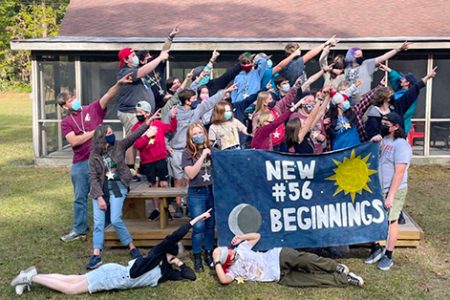

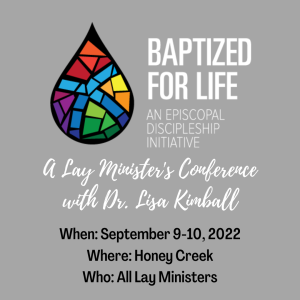 “Baptized for Life: A Lay Ministers’ Conference” will take place September 9-10 at Honey Creek! This conference is intended for any lay person in the Diocese who is in any active ministry in their congregation. Examples of such lay ministries include those who assist or lead worship, serve on the Vestry, serve on committees, teach Sunday School or lead youth activities, serve on the Altar Guild, care for the buildings and grounds, lead outreach activities, and more. This conference will be led by Dr. Lisa Kimball, the Vice President for Lifelong Learning and the James Maxwell Professor Chair of Lifelong Christian Formation at Virginia Theological Seminary. “Dr. Kimball has focused her teaching and research on lifelong, life-wide, and life-deep discipleship and Christian vocation…She is a passionate advocate for lay ministry, the full inclusion of all generations, digital literacy, and leaders who are confident teachers of the faith.” For more information about Dr. Kimball’s background and history,
 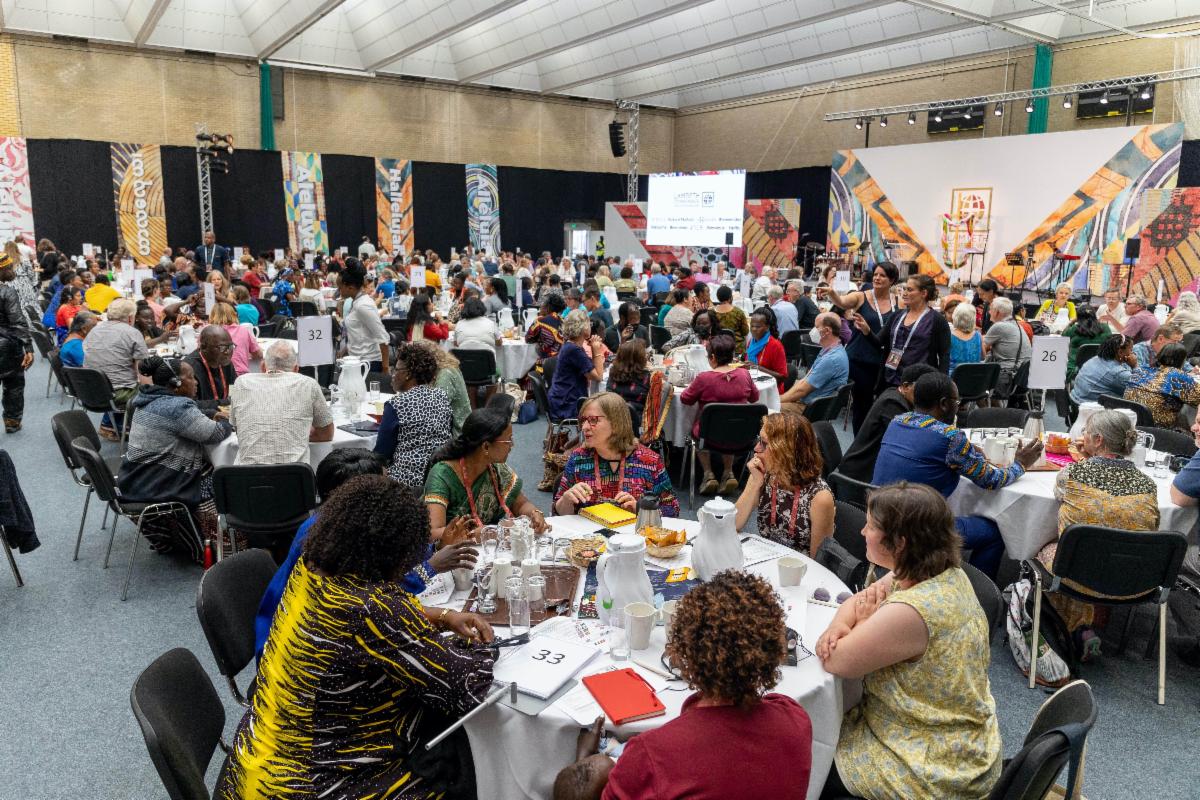 The Lambeth Conference—as an introvert, I both looked forward to and dreaded attending. From meeting with other spouses of Bishops (via Zoom instead of in-person because of Covid), I learned that we would be broken into small groups of 8-10 with other spouses from around the globe. Which meant, I was sure, that I would have to hear the simple phrase that accelerates the hearts of introverts: Let’s go around and introduce ourselves.
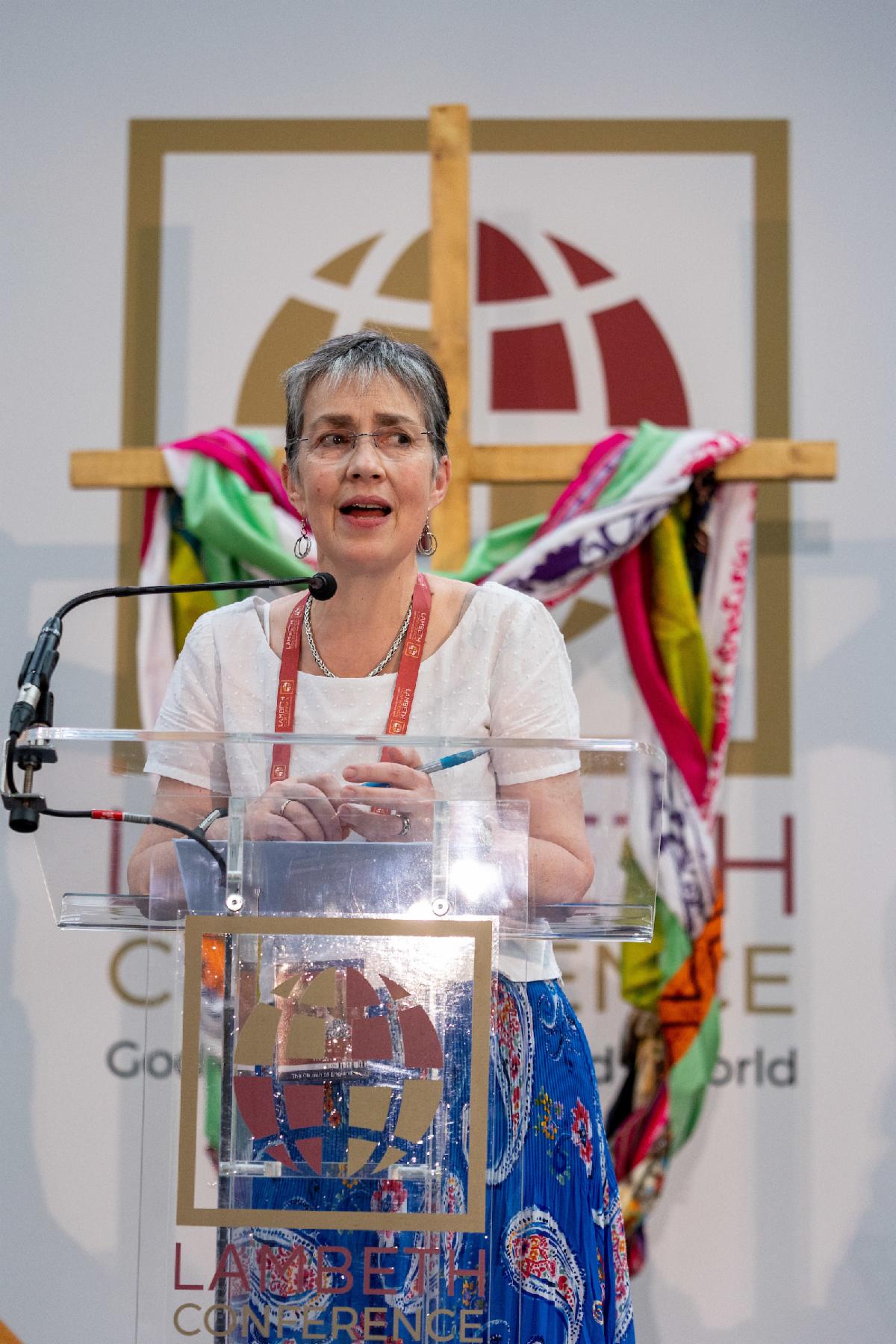 Working with the app also helped me to acquaint myself with some of the spouses attending Lambeth. So, the first time I was asked to introduce myself, I was already familiar with a number of spouses. (photo of Caroline Welby)
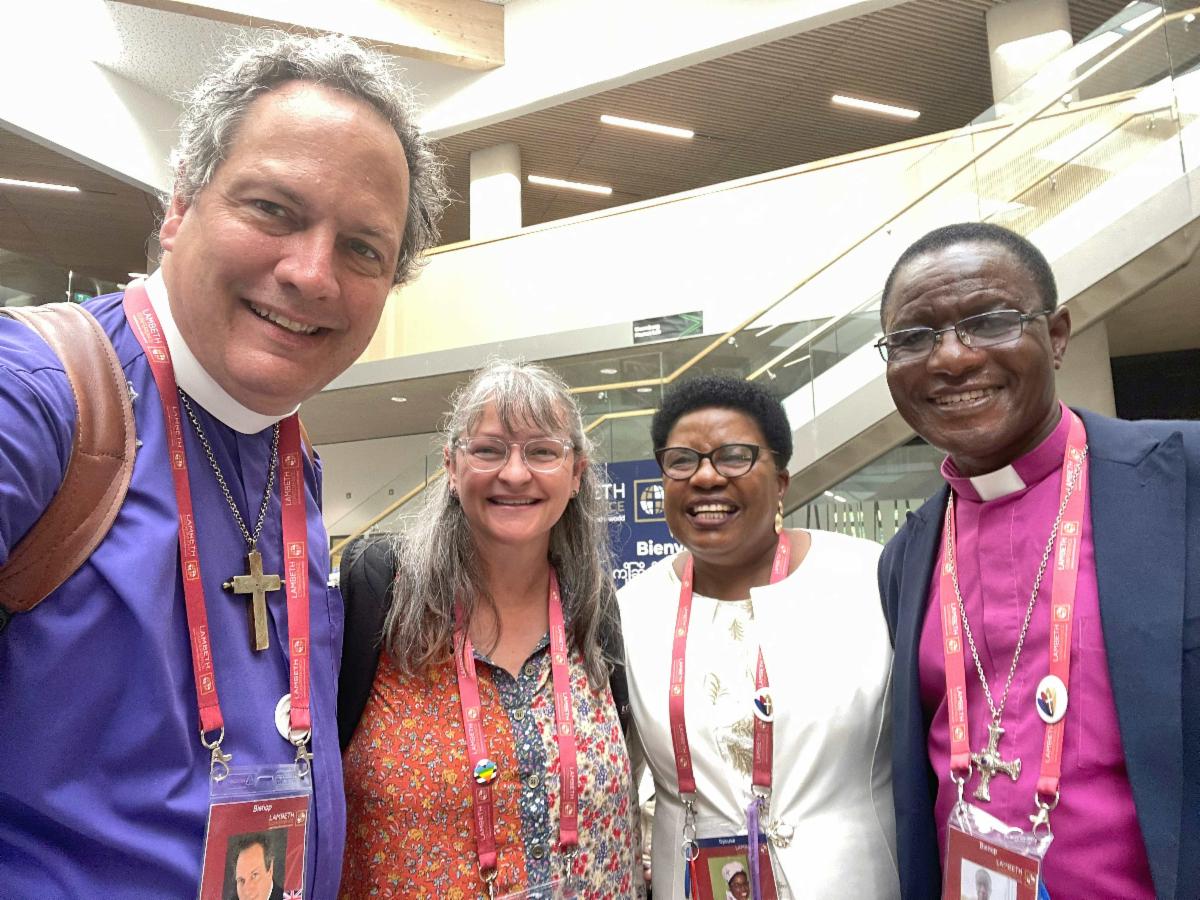 We would then break up into our small group Bible studies with the Bishops crossing the street to gather at the Parkwood Apartments in small groups and the spouses hurrying over to Venue 2 to gather at our round tables. Here we would look at the verses we had just heard about and speak to them in what became the favorite phrase at the Lambeth Conference: in my context. Because the gathered bishops and spouses were from more than 160 countries from around the world, the context for a spouse in South Sudan was different than the context for a spouse in Pakistan, which was different for a spouse in Malaysia, which was different from a spouse in America . . .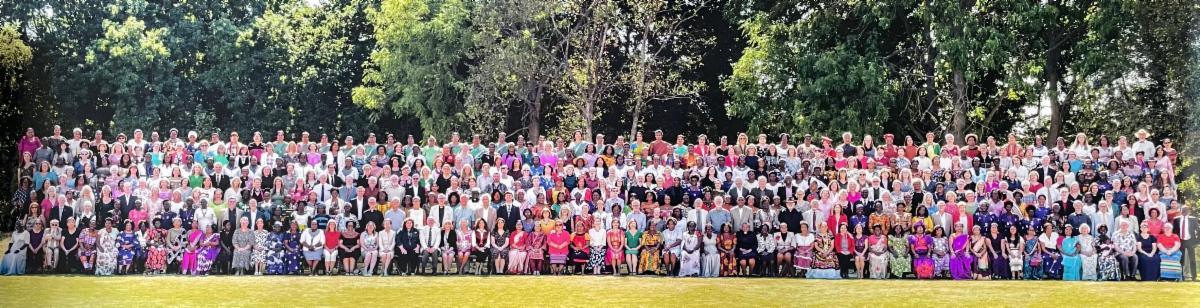
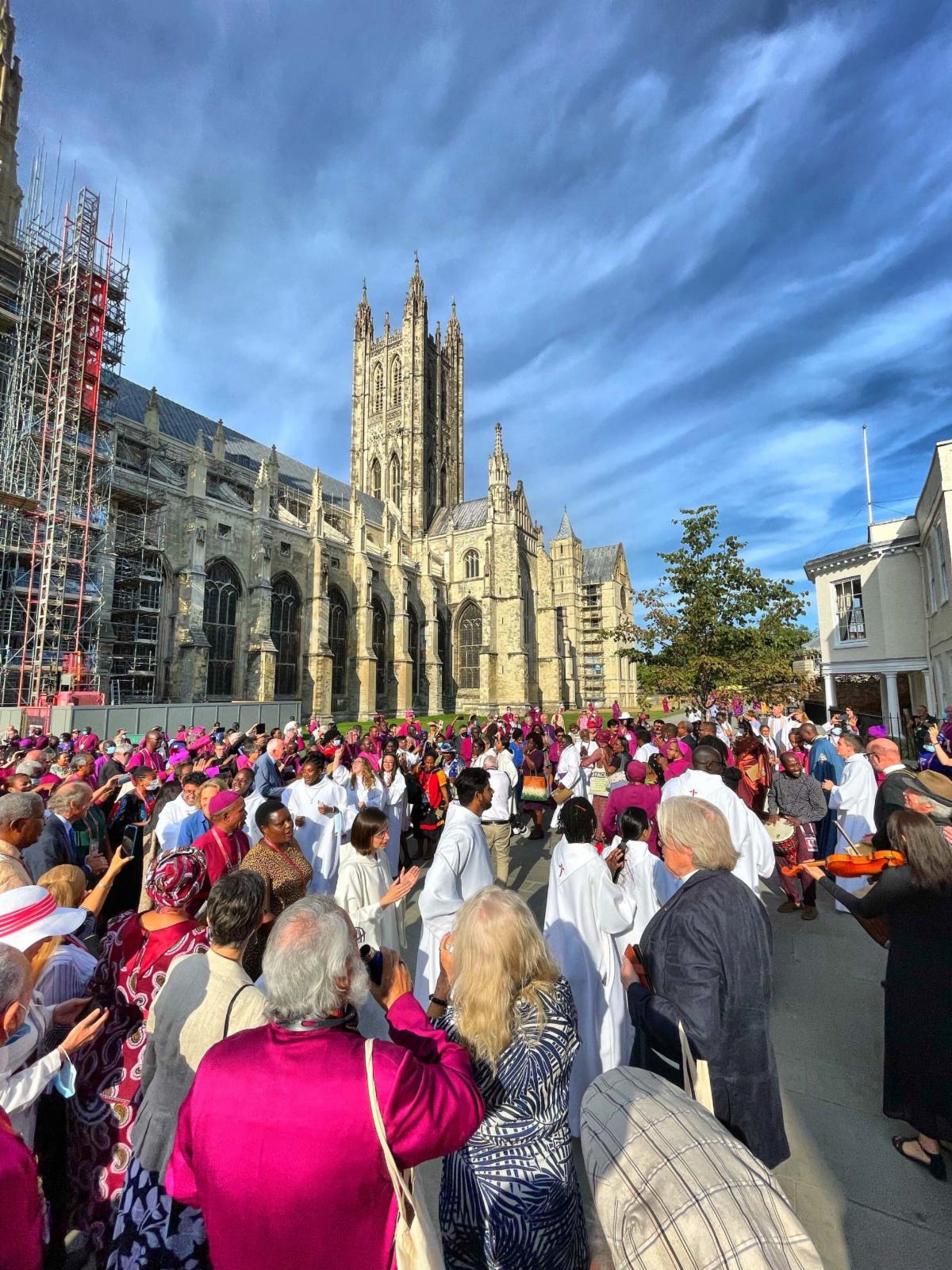 In every congregation of the Diocese of Georgia, I know people who disagree with each other profoundly on politics (and sports which is even more difficult) who are grateful to worship together and miss one another if someone is not in church. I value this so much. We differ in many ways, but we all know that we need Jesus and we need each other. I have seen this writ large in gathering with more than 650 bishops from 165 countries at the Lambeth Conference.
 When we gathered here, Archbishop Welby said, “You are the shepherds of your flock as I am the shepherd of the flock that I serve. Let us not act in a way that disgraces our witness. Speak frankly, but in love.”
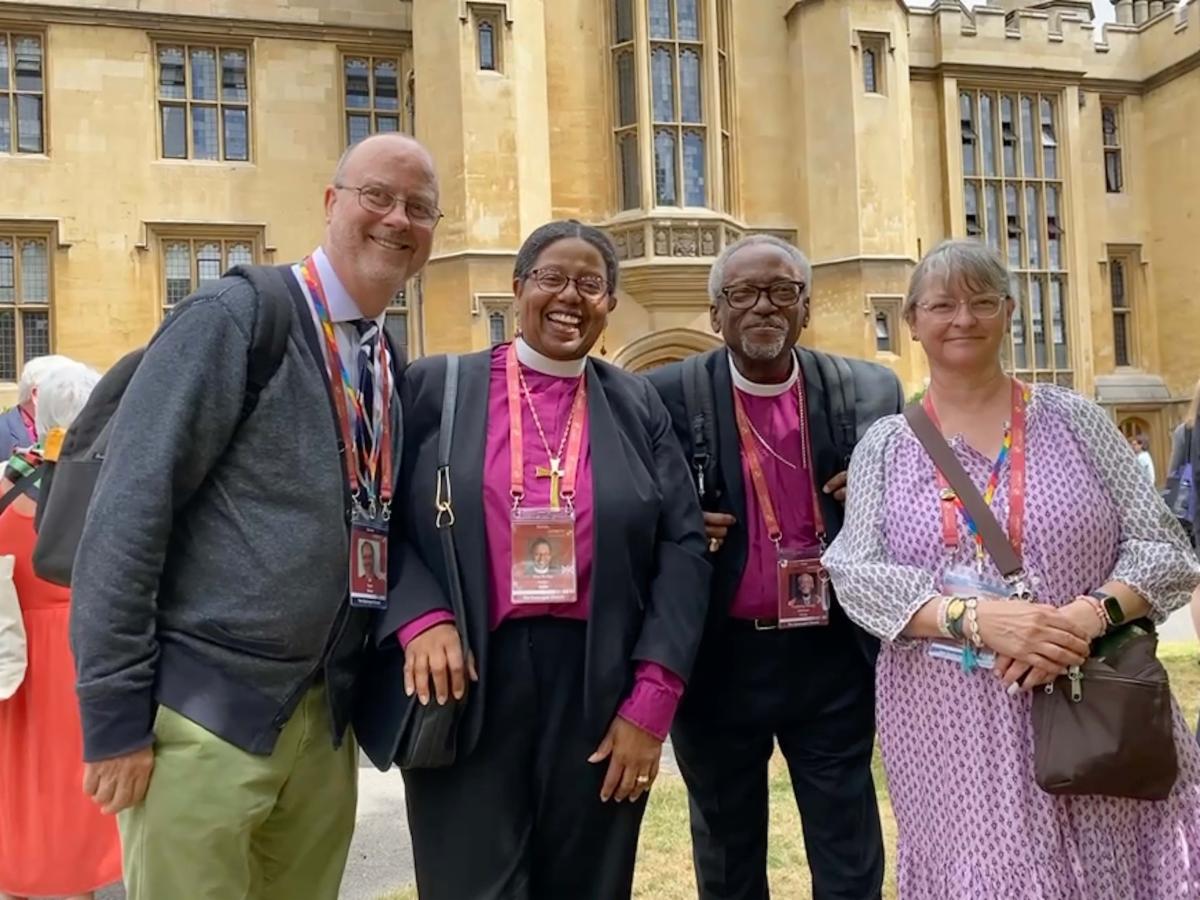 Last evening, in a bit of serendipity, I came back to the dorm from the Eucharist walking, holding hands, and talking with the Archbishop of South Sudan, on a lovely late evening in Kent with Canterbury Cathedral at our backs and a return home in front of us. Two bishops from very different contexts with different views of a Jesus shaped life, but with the most important thing in common: we are both beloved children of God, united by one Lord, one faith, one baptism.
 I am at the Lambeth Conference of Bishops of the Anglican Communion with more than 650 bishops and more than 460 spouses from 165 countries. Our time together includes a deep dive into the First Letter of Peter led by the Archbishop of Canterbury, Justin Welby. This week Bishop Hosam Rafa Naoum, the Bishop of Jerusalem and the Middle East, who I met at his church in 2018 before either of us were elected as bishops, told me then and repeated again to a gathering this week that people go to the Holy Land to see the stones, but need to meet the living stones, the Christians of the Holy Land. Now here at Canterbury Cathedral, an ancient site of pilgrimage, I have enjoyed this historic place, but am being transformed by the living stones, the bishops and spouses from around the world.
 I am finding this time so humbling. The problems we face in Central and South Georgia are put into perspective by dedicated followers of Jesus who love Word and Sacrament as we do and face daily challenges we can not imagine. This is the 15th Lambeth Conference since the first in 1867. While the provinces of the Anglican Communion, such as our Episcopal Church, are independent, we are also deeply interdependent and while this conference has no authority over us, the moral authority over time makes a difference.
 As the Bishops of the Anglican Communion meet together for the first time since 2008, Bishop Frank and Victoria Logue are representing the Diocese of Georgia at the historic meeting. First convened by the Archbishop of Canterbury in 1867, these conferences are an essential part of establishing and maintaining connections with Anglicans around the world. With the theme of ‘God’s Church for God’s World – walking, listening and witnessing together,’ the conference will explore what it means for the Anglican Communion to be responsive to the needs of a 21st Century world.
 Victoria is on the leadership team for the “House of Spouse” as the spouses of the House of Bishops are known. She will take part in a variety of events at Lambeth that will include any of the spouses of the Episcopal Church who will be present for the conference as well as spouses from around the Communion. The spouse gatherings are an important part of the meeting.
 The announced goal of the conference is to resource, inspire, and encourage Bishops in their local ministries; supporting their pastoral and leadership roles in church life and mission as we all follow Jesus. In an unexpected move, the Archbishop of Canterbury sent out a 58-page document to affirm as a body. The text is problematic as it asks for clear stands together where there are deeply held differences. Most notably, it initially asked those in attendance to reaffirm Lambeth resolution I.10, from 1998, which is against extending all of the sacraments to all baptized Christians. The concerns many bishops raised, including Bishop Logue, led to a revision, which itself may be the subject of further debate. This late change is shifting the character of the meeting even as bishops are checking in on site for the conference. Please hold the Logues in prayer as they worship and discern alongside their colleagues from around the world a faithful way to continue to walk together given these differences, while honoring the dignity of all God’s children.
 In the spring of 2020, Presiding Bishop Michael Curry saw how the pandemic led to history was repeating itself when planning was underway to consecrate a handful of bishops with only the minimal people present as required by canons. He was reminded of the Scottish Episcopal Church’s cathedral in Aberdeen where a small gathering consecrated Samuel Seabury as the first American Bishop in November 1784. Bishop Curry referred to the liturgies in pandemic as “Aberdeen Consecrations.” When Bishop Logue became the first person made a bishop with a congregation largely online, the image was even clearer as Communications Manager Liz Williams’ photo of the moment with just three bishops laying on hands looked more like a stained glass window in Aberdeen than any consecration in memory.
 To honor this history and further renew the connection, Bishop Logue, together with Bishop Deon Johnson of Missouri, Bishop Glenda Curry of Alabama, and Bishop Craig Loya of Minnesota will travel this week to Scotland for a series of visits in the Diocese of Aberdeen and Orkney. Bishop Logue will preach at St. Andrew’s in Alford this coming Sunday as a part of this visit.
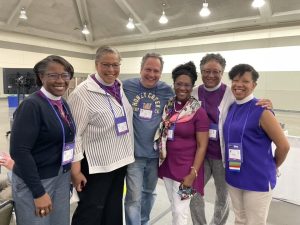 This General Convention was the seventh I have traveled to on behalf of the Diocese of Georgia, but my first in the House of Bishops. The General Convention is sometimes compared to the US legislature with a larger House of Representatives and small Senate. In the General Convention, the House of Deputies comprises four lay persons and four clergy persons from each diocese for more than 800 deputies in a typical convention. Every convention has a lot of first time deputies learning their way around. The House of Bishops, which is more analogous to the Senate, has less than 150 members and most have previously taken part in a convention.
 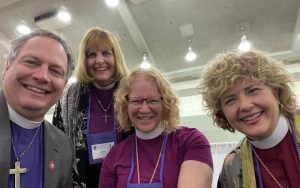 This familiarity changes the nature of debate on resolutions in the House of Bishops as you are speaking to a smaller group of people who you know well, creating a higher level of trust and allowing deeper conversations.
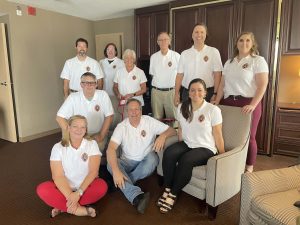 Having attended four prior General Conventions in the past (twice as an ECW Triennial Delegate and twice as a Deputy’s spouse), I felt somewhat prepared to serve as a first time Deputy for GC80. I was quite overwhelmed, however, with the rapid pace of voting on legislation on the house floor, with over 400 resolutions to be considered in only four days (and nights!). Just the time involved in searching the Virtual Binder to review the resolutions, the explanation of the resolutions, the floor amendments, the calendars, the agendas, the committee reports, and listening to the debates both for and against the resolutions, then being prepared to vote, was enough to make this first time Deputy’s head spin! Whew! It looked so much easier from the observer’s point of view! And then there were reports, memorials, elections, worship, and late evening deputation meetings, not to mention the daily Covid testing and wearing masks. But it was truly a privilege and a blessing to have the opportunity to do this work on behalf of our Diocese, and I am so very grateful for the support and assistance I received from my fellow deputies and from our Bishop, and for the opportunity to share this experience with them.
 It was the best of times. It was the worst of times. It was technology at General Convention. The 80th General Convention was the shortest in generations due pandemic concerns, only four days rather than the usual eight to ten days. How was this possible? The answer was technology. In particular, the committees of General Convention, which have previously only met in-person at convention, accomplished their tasks via zoom meetings in the three months leading up to the in-person meeting in Baltimore. Committee work is essential to the functioning of General Convention and thus the Church. Without technology, ie. the availability of zoom, it is possible that General Convention would have had to have been postponed another year. Technology, however, was not all good. General Convention has gone paperless with every deputy being assigned an iPad for access to the resolutions under consideration and for voting. Great idea, but an iPad is useless without reliable WIFI, and reliable WIFI was in short supply. A meaningful portion of those precious four days was squandered due to this problem. For all of its good and bad, technology is here to stay at General Convention. One of the resolutions passed was a change to the rules of the House of Deputies that will allow the use of zoom meetings in future conventions, not just in the extraordinary circumstances of this pandemic shortened meeting. This will allow more people to give input into the workings of the church—people can participate in committee without having to travel to convention for committee hearings—but we may lose the substantial benefit of people meeting face-to-face with all of the interactions that provides. Having been a deputy at four General Conventions. Technology, for good or for ill, will be playing an ever expanding role in the governance of the Episcopal Church.
 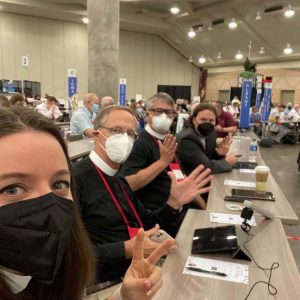 One of the recurring themes at this 80th General Convention has been racial justice and equity. The Episcopal Church has been on a journey in this regard for some time, having addressed matters of race consistently for decades. Much of this work has accelerated in recent years because of what has gone on in our nation, and the leadership of Presiding Bishop Michael Curry. While the General Convention has previously established educational offerings and encouraged the Beloved Community model as an aspiration for the Church, we have now committed to a time of study and introspection about our own specific history with race as a church. This includes evaluating the sources of Episcopal Church financial resources and beginning to allocate future funds to building up historically underrepresented peoples. We have also called for an honest evaluation of the Church’s role in facilitating indigenous boarding schools, where indigenous children were often abused. Understanding our history and the actions of previous generations is not about guilt, but about healing. If we do not know or admit the legacy of the Church’s historic actions we will continue to struggle to facilitate healing and reconciliation. Much of that history is recent enough that Deputies gave personal testimony on such matters. Before the 81st General Convention such investigations should give us a full sense of where we’ve been in the hopes that we can form a future that is defined by reconciling love.
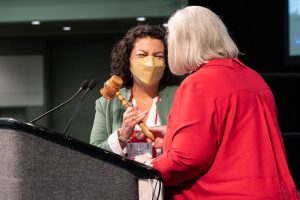 In Austin, at the 79th General Convention, Georgia’s Deputy the Rev. Cynthia Taylor was working with a group of lay and clergy women to bring forth reckoning and healing regarding gender-based abuse with the ultimately passed set of “#metoo” resolutions. Principle in the coordination of those successful efforts was Cynthia+ and others’ testimonies, which came forth through the collaborative organization of Executive Council member Julia Ayala Harris among a few others.
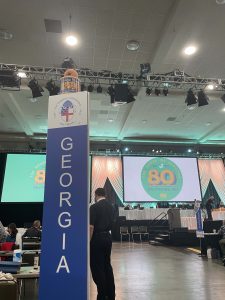 While the entire experience of my first General Convention was illuminating and inspiring, I was especially excited about legislation that advanced two of my own areas of ministry, immigration and Creation Care.
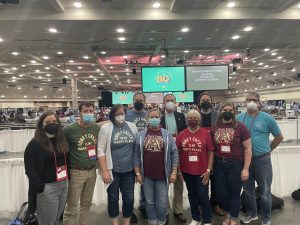 There were two particularly important pieces of legislation involving our Indigenous brothers and sisters that passed at the 80th General Convention. On the first legislative day, the House of Deputies heard testimony from some of our indigenous sisters who had been personally affected or whose family members were affected by their experiences in Episcopal boarding schools. The testimony was heartfelt and impassioned, and sometimes difficult to hear. To hear about incidents of abuse that happened to indigenous students “on our watch” was disturbing and eye opening. It was important for all of us for these testimonies to be given. It is a step toward much of the focus of this convention – Truth Telling and Reparation. We must know our entire past to be able to have a stronger future.
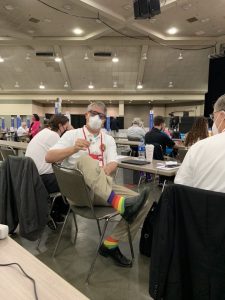 As a first-time deputy, it was a joy to attend and represent this diocese that has become home to my family and me. One of the truly refreshing aspects of General Convention was its inclusive nature. Inclusion wasn’t something simply given lip-service, but intentionally lived out in multiple aspects. From the ASL interpreter and captioning on every screen; worshiping in multiple languages; deputies who were in their teens to deputies who had been to 15 conventions; diversity among deputies including a high number of deputies of color, women, and deputies who are part of the LGBTQ+ community; one could not fail to notice the work that has been done to truly give voice to as broad a spectrum as possible.
 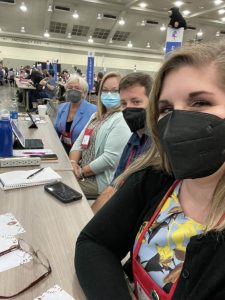 As the former Nominations Chair and Elections Czarina for the Diocese of Georgia, I’ve had the opportunity to facilitate the elections of our General Convention deputies the last few General Conventions. It was always an honor to send our deputation off to the infamous General Convention, and when I decided to run, it was with great respect and excitement. As a self proclaimed Church Nerd, arriving to the floor of convention was overwhelming. And getting to vote for the first time? Pure giddiness! Each session I grew more comfortable with the process and the flow of convention. We passed a lot of resolutions, had interesting conversations, and held elections. But more importantly, I came away with an even greater love for our church and the people in it. We continue to see where we have wronged others and how we can make amends, we continue to work towards proclaiming that the love of Christ is not exclusionary, and we look towards the future of the church. For all of this, and more, I am grateful to have been a member of our diocesan deputation.
 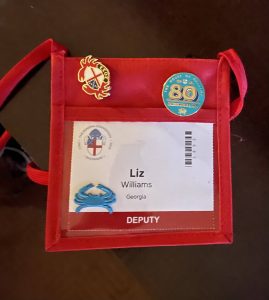 After a one year delay due to the pandemic, we returned to General Convention masked, vaccinated and ready to do the work of the Church. As Chair of Credentials, I had the unique opportunity to oversee the “checking in” of all deputies to ensure voice and vote of the dioceses. At last count, 802 deputies (clergy and lay) representing 107 dioceses were seated. My committee worked long hours on registration day, and then every day of sessions, as deputies checked in and alternates and deputies switched in and out. With shortened time frame and increased Covid restrictions, I knew this Convention would be different, and it was. Having been a deputy before, I missed the expanded worship services, the fellowship gatherings, the exhibit hall, and the in-person legislative hearings (and the snacks at the tables!). We still gathered together to accomplish the necessary tasks required by our constitution and canons. In spite of the differences between this Convention and others, great work, positive changes, and history-making elections were the result.
  After her husband died in 1746, Hastings increasingly connected with Methodism through the Rev. John Wesley, who she met after his return from Georgia. In published letters, Wesley credited the Countess with convincing him to preach to miners in the open air, telling him “They have churches, but they never go to them! And ministers, but they seldom or never hear them! Perhaps they might hear you.” He tried her plan and found his preaching transformed.
 Her views on slavery were inconsistent and her work in Savannah was part of that story. She promoted the freedom of formerly enslaved Africans and supported publication of two slave narratives, written by Ukawsaw Gronniosaw and Olaudah Equiano. Those 1700s memoirs published in England were the first time those in Britain heard of life directly from those who had been enslaved. On Whitefield’s death in 1770, she inherited his estates in Georgia and South Carolina, including the Bethesda Home for Boys and some enslaved persons who worked at the home. She then added to their number, approving the purchase of more enslaved persons to work at Bethesda. She continued to support and oversee the orphanage until the newly formed State of Georgia confiscated the property after the Revolution.
 James Edward Oglethorpe sent a party up the Savannah River in 1735 to build a fort as a refuge for settlers living near the first set of rapids. Oglethorpe named Fort Augusta for the princess who would become the mother of George III. In time, the trading post prospered. In April of 1750, the people who lived and traded in this area erected a church. Noting that their friendship with the indigenous population was “sometimes precarious,” they built the church under the shelter of the Fort.
 The first report from Mr. Copp came six months later when he asked for a transfer to a church in South Carolina. He did say that 80-100 people a week attend divine worship and he had baptized 30 from both Georgia and South Carolina. But he added, “Here we have been under continual fears and apprehensions of being murdered and destroyed by the [native inhabitants] there being no one within 140 miles capable of lending us any assistance in times of danger—so far are we situated in the wild, uncultivated wilderness.” He was not granted the transfer for three years.
 Zouberbuhler was appointed on All Saints’ Day, 1745, by the Society for the Propagation of the Gospel (SPG), to be pastor of Christ Church in Savannah. Bartholomew was the son of a native Swiss pastor who had originally served congregations of Swiss Protestants in the colony of South Carolina and then had become pastor of an Anglican parish there. Bartholomew, believing himself called to the ministry, made the long trip across the ocean to be ordained by the Bishop of London.
 Zouberbuhler’s concern was not only for Christians of other languages and church traditions who had settled in Georgia, but for all the inhabitants, including enslaved persons from Africa. At Christ Church in 1750, he baptized the first enslaved African to be baptized in the colony. When Zouberbuhler died, he left a sizable portion of his estate as a trust to be used to employ qualified teachers “to teach Anglican Christianity to Negroes.” He is buried in Savannah’s Bonaventure Cemetery.
 Though his legacy as the founder of the Methodist movement has born so much good fruit for almost three centuries, John Wesley’s ministry in Georgia went catastrophically wrong. Wesley arrived to a Savannah that was still a village of just two hundred houses. In less than two years, a 44-person grand jury, making up a significant percentage of the population, would approve a 10-count indictment against their idealistic minister.
 Wesley who had afflicted others with a rigid approach to religion was surprised by the grace of a God who knew John’s heart was altogether corrupt and abominable and yet loved the imperfect parson anyway. John would go on to travel a quarter of a million miles on horseback, delivering more than 40,000 sermons, and founding the Methodist Movement boasting 541 preachers and 135,000 members in his lifetime. There are 80 million Methodists around the world today who have found their hearts warmed by the grace John Wesley experienced.
 Coosaponakeesa of the Wind Clan was essential to the success of the Colony of Georgia. Born in 1700 in the Lower Creek Nation’s Capitol of Coweta, she was the daughter of Edward Griffin, an English trader, and a Creek woman usually referred to as Brim, which was also the name of her relative who ruled the Creek Nation. By the time of her death in 1765, she was the largest landowner and the wealthiest person in the colony.
 Jacob Matthews died in 1745. With her third marriage in 1747, Mary became the wife of the Rector of Christ Church in Savannah, the Rev. Thomas Bosomworth. The two became a power couple with strong connections in both Creek and British society. They pressed their land claim in a ten-year battle, traveling to England at one point to meet with the British Board of Trade. In 1759, a compromise resolved the issue. The Board of Trade auctioned off Sapelo and Ossabaw Islands, giving the proceeds to Mary. The land sold for £2,100, which would be worth more than half a million dollars today. She was also permitted to keep St. Catherine’s Island “in consideration of services rendered by her to the province of Georgia.” Mary moved to the island in 1760 and lived her remaining five years there.
 Growing up in the house next door to King George’s Whitehall Palace, James Edward Oglethorpe was the youngest of ten children born to a prominent English family. Inheriting a family estate at 26, the up-and-coming Oglethorpe ran for the House of Commons. Reports say soon after the election, Oglethorpe was already drunk when he wandered into a tavern at six o’clock in the morning. He got into a heated exchange over politics with a lamplighter and killed the man in the fight that followed. A powerful friend intervened to get Oglethorpe freed from jail.
 Living into the motto of Georgia’s Trustees—Non sibi sed aliis (Not for self, but for others)—Oglethorpe remained a tireless idealist. He wholly opposed slavery in Georgia and kept an enlightened approach in relations with the indigenous population. (The painting above shows Tomochichi and other Yamacraw visitors, being presented to the Georgia Trustees in London by James Edward Oglethorpe in 1734.)
 As we approach the bicentennial of our founding in 2023, we will share the story of the Diocese of Georgia. Looking back on our Centennial Celebration on April 22, 1923, the tone was laudatory. The fourth Bishop of Georgia, the Rt. Rev. Frederick Focke Reese (pictured here in the bishop’s chair that was in the sanctuary at Christ Church, Savannah) preached a sermon that praised his predecessors with words that made them seem so heroic as to not be real:
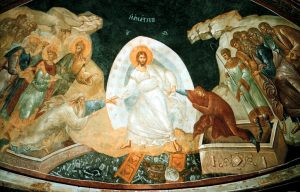 I am reminded of the Anastasis, that great icon of Holy Saturday where Jesus has descended to the dead and is bringing Adam and Eve up from the grave. In iconography, the first two humans are buried there just East of Eden, which is also the foot of the cross. Christ’s glory is bound with his degradation in this place where worlds collide, the fallen and the redeemed. Jesus’ tomb will not be empty until Jesus empties Hell.
  On February 24-28 in 1823, Saint Paul’s in Augusta hosted the First Convention of the Protestant Episcopal Church in the State of Georgia. Clergy and lay persons from Christ Church in Savannah and Christ Church Frederica on St. Simons Island joined the delegates from Augusta in forming this Diocese. We would not be able to call our first bishop until we had the six congregations required by the Canons of the Episcopal Church. That election happened in 1841, with the Bishop of South Carolina making visitations in the intervening years.
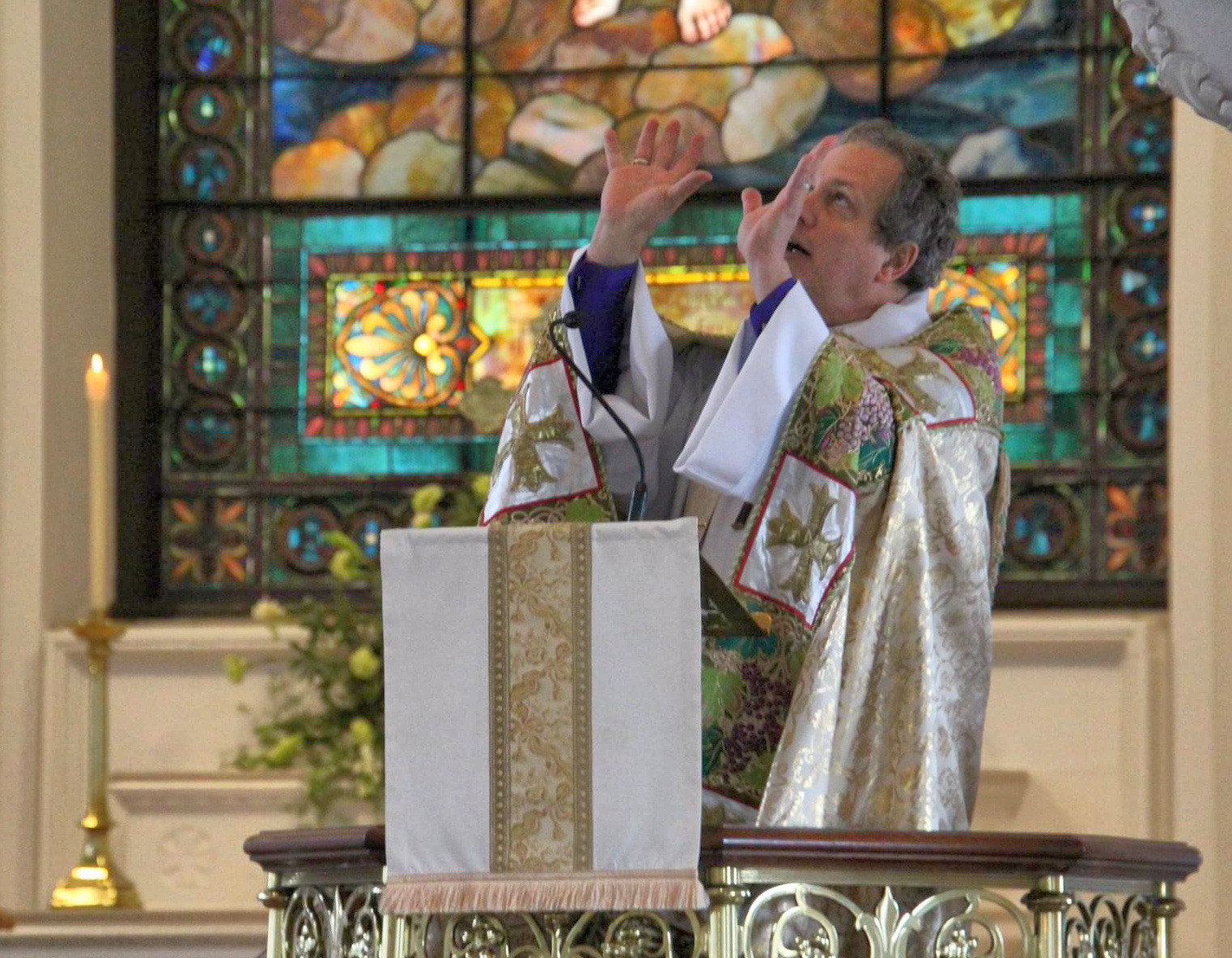 Nothing sounded like Good News to me until I looked at the Gospel passage from below, well below the waters of the Sea of Galilee, seeing a net descending. Okay, I know, a story of nets bursting with fish may not sound like Good News for the fish, but there is something deeper going on here. I stumbled into grace and love when I realized what Jesus did not say.
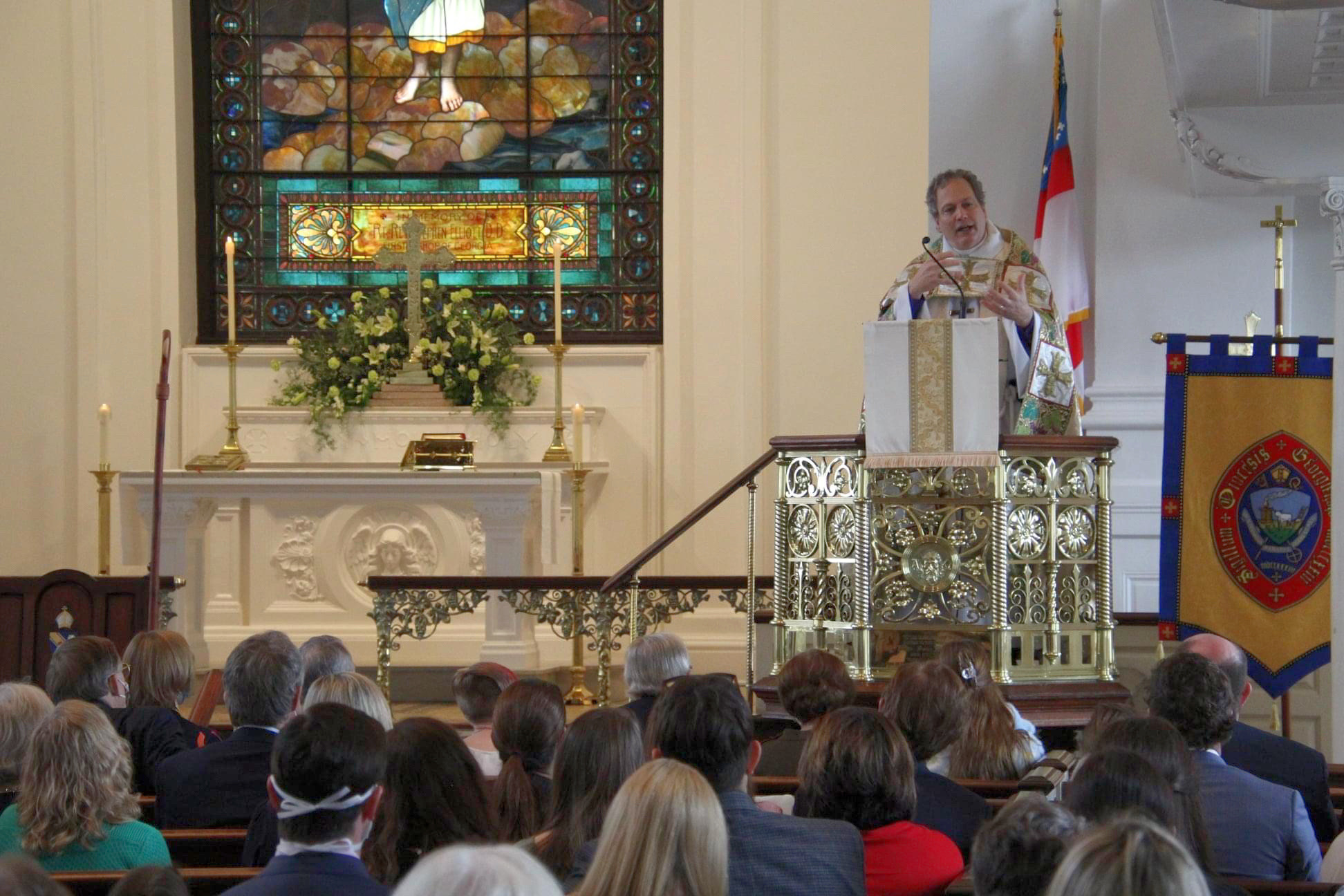 Yet, what we do have as followers of Jesus is a relationship with the God who is working to redeem our world one wild and precious life at a time. What we have is the knowledge that everything we now see and experience is not all there is. The creator of the cosmos knows you by name, has always loved you, will never give up on you, and wants better for you. We have the hope in the God who goes to the depths of human existence to love, truly love, those who see themselves as lost, unfit, and sinful. God is always offering a chance for a clean slate, a fresh start, and will never leave you to the chaos that threatens to consume you. God will send a net.